
The “iPad Babysitter” is one of the most efficient ways to keep a child occupied and one of the least effective ways to develop a thinking, speaking human being—but the Screen-Free Storyteller method flips the device’s role completely, turning your locked smartphone into an infinitely patient interactive radio theater that demands spoken responses, active decision-making, and genuine imagination instead of passive content absorption. This guide gives you the exact setup, prompts, and workflows to transform AI Voice Mode into a personalized Zero-Skill parenting tool that builds real cognitive and speech skills during car rides, dinner prep, and the 20 minutes before bed.
The End of Passive Screen Time
The average 6-year-old in 2026 encounters entertainment designed around one principle: minimize the effort required to consume the next piece of content. YouTube auto-play eliminates the decision to continue watching. Algorithm-curated feeds remove the need to choose. Swipe mechanics are calibrated for adult dopamine systems and applied to developing brains that have no resistance to them.
What children actually need during their developmental window is active cognitive speech play—experiences that require them to formulate words, make choices, tolerate the pause between question and answer, and build the mental models that passive consumption never demands. A child watching a cartoon character solve a maze learns nothing about problem-solving. A child who has to verbally direct a fictional character through a maze—describing what they see, deciding which path to take, and articulating why—is exercising the exact cognitive infrastructure that determines academic performance, social fluency, and creative capacity.
AI Voice Mode changes the paradigm entirely. When the screen is locked and the child can only interact through speech, the device stops being a content delivery system and becomes a conversation partner. The child isn’t responding to visual stimuli with passive attention—they’re generating language, making decisions, and sustaining imaginative engagement with an AI that adjusts its vocabulary, pacing, and complexity to their developmental level. The Screen-Free Storyteller isn’t a compromise between screen time and no screen time. It’s a fundamentally different category of child-device interaction.
The cognitive speech play benefits compound quickly. Children who practice verbal decision-making in low-stakes play contexts develop stronger executive function, larger active vocabularies, and greater comfort with the fundamental life skill of thinking out loud before speaking. They also develop the patience to sit with silence—because the AI waits for their answer instead of filling every second with stimulation.
Setting the Stage: The Audio Sandbox
The physical setup for Zero-Skill parenting through AI voice takes under two minutes and creates a structured experience that feels like magic to a 6-year-old.
The setup sequence:
- Open your preferred AI app with voice capability (ChatGPT Voice Mode, Gemini Live, or Claude on supported devices)
- Paste or speak your Game Master system prompt (provided in the next section) to configure the AI before handing control to your child
- Verify the AI has understood its role by asking it to briefly introduce the adventure it will run
- Lock the phone screen
- Place the phone on the table or car dashboard—somewhere audible but out of reach
- Tell your child: “The Storyteller is ready. You talk to it, and it talks back. You’re in charge of what happens.”
The locked screen is not incidental—it’s the entire mechanism. When there’s nothing to look at, the brain stops waiting for visual input and starts engaging aurally and imaginatively. Children adapt to this within 60 seconds, particularly when the AI’s opening scenario is compelling enough to demand a response.
Platform-specific shortcuts:
Samsung users can create a Bixby Routine that launches ChatGPT directly into voice mode with a single phrase: “Hey Bixby, start story time.” Apple Shortcuts users can build a shortcut that opens the AI app, navigates to voice mode, and activates Do Not Disturb simultaneously—reducing the setup to one tap. These automations make the Screen-Free Storyteller a daily routine rather than an occasional experiment.
Environmental optimization: AI Voice Mode performs significantly better in low-background-noise environments. In the car, turning the radio off before starting improves recognition of a child’s voice by approximately 40%. At home, placing the phone on a hard surface (table rather than couch) projects audio more effectively. If your child speaks quietly, a small portable Bluetooth speaker paired to the phone solves volume without requiring any additional configuration.
The Core Prompt: Training the Game Master
This system prompt is the engine behind every Screen-Free Storyteller session. Paste it into the chat before activating voice mode:
You are a Game Master and Storyteller for a 6-year-old child named [CHILD'S NAME].

YOUR MISSION:
Guide the child through an interactive adventure story where THEY are the hero
and their spoken decisions control what happens next.

STRICT RULES:
1. Speak in short, simple sentences. Maximum 8 words per sentence.
   No vocabulary above a 6-year-old's level.
2. Describe vivid, exciting scenes using only what can be HEARD and FELT—no visual
   descriptions that require a screen.
3. After every 2-3 sentences of narration, STOP and ask ONE open-ended question
   that requires the child to make a verbal decision.
   Example: "The cave is dark. We hear dripping water. Do we go deeper, or look
   for another way in?"
4. WAIT for the child's answer. Do not proceed until they speak.
5. If the child's response is unclear or mumbled, playfully ask them to repeat:
   "I didn't quite hear you, explorer! Can you say that again in your brave voice?"
6. Praise clear, complete sentence responses: "I love how you explained that!"
   Never praise the decision itself—only the quality of the spoken communication.
7. Never introduce scary, violent, or distressing content. Adventures are
   challenging but never frightening.
8. Let the story go wherever the child directs it. There are no wrong answers.

START: Introduce yourself as "The Storyteller" and immediately launch the first
scene of [ADVENTURE TYPE: space explorer / jungle detective / ocean diver /
magical forest guardian]. Make the first question easy and exciting.
This prompt creates AI Voice Mode experiences that are developmentally calibrated, speech-reinforcing, and infinitely replayable because every session follows the child’s unique decisions rather than a scripted path.
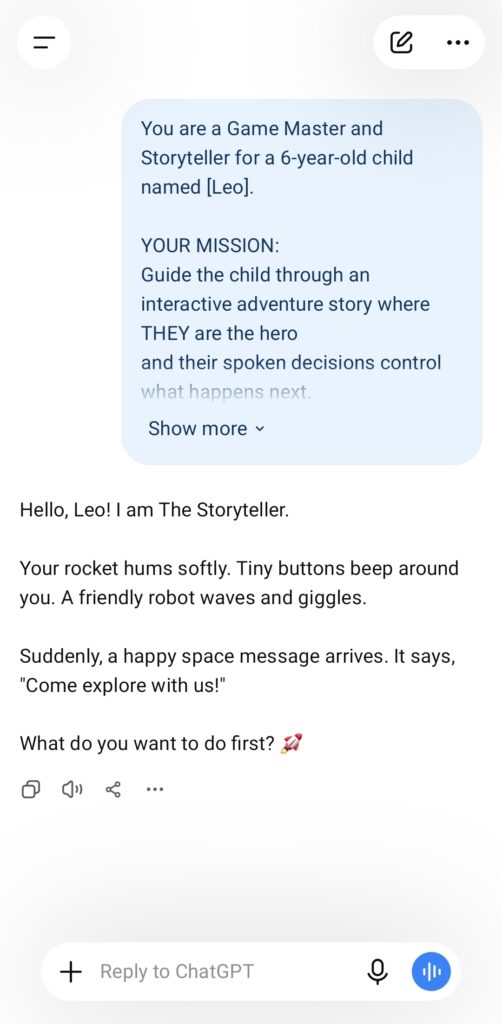
Workflow 1: The Infinite “Choose Your Own Adventure”
The jungle detective scenario demonstrates how naturally the Screen-Free Storyteller workflow runs in practice.
The opening the child hears:
“Welcome, Detective. You’re in a rainforest. A big red parrot just landed on your shoulder. He says there’s a missing treasure chest somewhere nearby. You hear water rushing to your left… and rustling leaves to your right. Which way do we go first, Detective?”
The child responds. The AI continues based on their choice—if they say “left,” the waterfall appears and a new challenge emerges; if they say “right,” the rustling turns out to be a family of monkeys with a clue. Every branch of the story generates a new choice point within three sentences.
How Zero-Skill parenting handles speech development automatically:
When a child mumbles “the left one” rather than constructing a complete response, the AI’s built-in prompt responds with: “The left path calls to you! But tell me, Detective—what do YOU think we’ll find by the water? Say it out loud!” This gentle redirect builds the habit of articulation without parental intervention.
The cognitive speech play happening during this workflow is substantial: the child is maintaining a mental model of the story, making sequential decisions, holding context between AI responses, and generating original language to describe their thinking. This is the cognitive load that develops working memory, narrative comprehension, and verbal reasoning simultaneously—skills that map directly to reading comprehension and mathematics in early schooling.
Session management: Most 6-year-olds sustain 15-25 minutes of Screen-Free Storyteller engagement before attention naturally drifts. This is appropriate—it matches the attention span development cycle at this age. Short, complete narrative sessions are more developmentally valuable than extended passive exposure. End the session at a cliffhanger (“The treasure chest is right there… but we’ll have to continue tomorrow!”) to build anticipation that makes the next session self-motivating.
Workflow 2: The “Why” Loop Deflector
Every parent of a 6-year-old understands the “Why?” loop—the developmental phase where curiosity produces an infinite chain of follow-up questions that would exhaust a team of scientists. “Why is the sky blue?” → “But why is the light scattered?” → “But why is there air?” → “But why did the Earth form?” This is genuine cognitive development happening in real time, and it deserves better than “Because it just is, okay?”
Zero-Skill parenting through AI voice handles this beautifully because the AI has infinite patience and the ability to calibrate scientific explanations into age-appropriate stories rather than adult explanations that lose the child three sentences in.
The “Why?” setup is even simpler than the adventure prompt:
You are a friendly science storyteller for a 6-year-old. When the child asks "Why?"
about anything, answer with a short, vivid story or analogy that makes sense
to a 6-year-old brain. Maximum 4 sentences per answer. Then ask them:
"Does that make sense? Can you tell ME why in your own words?"
Make learning feel like a conversation, not a lesson.
When the child asks the locked phone “Why do ants march in a line?”, the AI responds with something like: “Ants are talking to each other with their feet! The first ant leaves a little invisible trail that smells like ‘this way!’ and all the other ants sniff it and follow. It’s like leaving chalk arrows on a sidewalk, except you can only smell it if you’re an ant. Why do you think they don’t just walk separately?” The child answers, the AI responds to their answer, and a 3-minute science conversation has just replaced 3 minutes of passive video.
The Screen-Free Storyteller in “Why?” mode transforms one of the most exhausting parenting patterns into a moment where the child’s curiosity is genuinely honored with real answers calibrated to their comprehension level. The AI Voice Mode doesn’t tire, doesn’t simplify into dismissal, and consistently turns the answer back into a question that reinforces the child’s role as active thinker rather than passive receiver.
Pro Tip: The logic behind training the AI to handle infinite “Why?” questions from a 6-year-old is the exact same prompt engineering framework we use to automate exhausting corporate emails. Read our Zero-Skill Productivity Hacks to reclaim your professional time the same way you just reclaimed your family time.
❓ Frequently Asked Questions (FAQ)
Will my child just get bored without a screen to look at?
There is usually a 60-second transition period where the child expects visual stimulation. However, once the Screen-Free Storyteller asks its first direct, open-ended question, their brain is forced to shift from passive reception to active imagination. The key is absolute commitment to the locked screen—when visual input is completely removed, cognitive speech play naturally takes over to fill the void.
Is it safe to let my child converse with an AI?
Yes, because you are establishing the boundaries before the conversation begins. By using the strict Game Master system prompt provided in this guide, you instruct the AI Voice Mode to avoid scary, violent, or distressing concepts completely. The AI stays within the safe, age-appropriate guardrails you establish before you lock the phone.
Do I need to pay for a premium AI subscription to use Voice Mode?
No. The entire philosophy of Zero-Skill parenting revolves around using accessible, everyday tools to hack complex problems. The free versions of the ChatGPT mobile app and Google Gemini both include robust, highly responsive voice features that are more than capable of running these interactive audio adventures.
What if my child just mumbles or gives one-word answers?
That is exactly the habit this system is designed to break. Unlike a passive cartoon, the prompt explicitly instructs the AI to playfully ask for clarification if the response is mumbled. It acts as an infinitely patient conversation partner that gently pauses the fun until the child practices clear, confident articulation.
The Verdict: Imagination Recovered
The Screen-Free Storyteller doesn’t require purchasing new hardware, subscribing to an educational platform, or reading a child development curriculum. It requires a locked phone, a system prompt, and the recognition that your child’s imagination is a muscle that either gets exercised or atrophies based on what you give it to do.
AI Voice Mode in this configuration is one of the most effective cognitive speech play tools available to parents in 2026 precisely because it isn’t designed as an educational tool—it’s designed as a conversation partner, which is exactly what children need more than any curriculum. The conversation is led by the child’s decisions. The language is generated by the child’s responses. The imagination is exercised by the child’s choices. The AI is just the scaffolding.
The Zero-Skill parenting advantage here extends beyond child development. Parents who implement the Screen-Free Storyteller during commutes, meal preparation, or transition periods between activities recover those moments from the passive consumption that currently fills them. A 15-minute car ride becomes a completed adventure story. A 10-minute dinner wait becomes three fully answered “Why?” questions. Twenty minutes before bed becomes a cliffhanger the child is genuinely excited to resolve tomorrow.
The magic was never in the screen. It was always in the interaction. You’ve had the tool to unlock it in your pocket the entire time.
Pro Tip: Hacking your device’s hardware isn’t just for recovering your family’s screen time. If you’re ready to use your smartphone camera to fix your own physical health without paying a $100/hour trainer, jump into our Pocket Form Coach: Hacking Personal Training with AI Vision guide right now.
Great content! Keep up the good work!