
Asking one AI chatbot to research a topic, synthesize findings, and format a professional report in a single prompt is the productivity equivalent of hiring one employee to simultaneously answer phones, drive a forklift, and manage accounting—what emerges is mediocre at best and confidently hallucinated at worst. Modular AI is the architectural antidote: breaking complex tasks into discrete, specialized functions and connecting purpose-built AI tools that each perform exactly one job exceptionally well, passing clean outputs down an automated chain without human intervention between stages.
The Death of the “Do-It-All” Prompt
The “ChatGPT for everything” approach dominates how most people use AI in 2026, and it’s the primary reason AI-assisted work still feels manually intensive, unreliable, and time-consuming to review. Pasting a wall of raw context into a single chat window and expecting research, analysis, and formatted output to emerge simultaneously is asking one cognitive system to do what multiple specialized systems handle far more accurately when working in sequence.
The human brain doesn’t operate this way—different neural systems handle perception, analysis, language production, and executive function independently. Your AI stack shouldn’t work differently.
The Lego block method provides the architectural solution: every AI module in your system has one strictly defined input and one strictly defined output, established in advance by a constrained system prompt. One block transcribes audio. One block classifies content. One block extracts structured data. One block formats output for delivery. Stack them correctly and the combined system outperforms any single all-in-one prompt by a margin that compounds with every stage added.
When you ask a single AI to research and write and format simultaneously, each function dilutes the accuracy of the others. When you deploy Modular AI pipelines where each tool receives clean input and produces clean output before passing to the next stage, accuracy improves at every step because no single model is context-switching between fundamentally different cognitive tasks.
The Lego block method isn’t complicated—it’s a mindset shift from treating AI as an assistant to treating it as a factory floor. Your role changes from prompt engineer to systems manager.
Setting the Stage: The Digital Conveyor Belt
Zero-Skill automation doesn’t require Python expertise, API authentication knowledge, or a development budget. The no-code platforms available in 2026—Make.com, Zapier, and n8n—function as visual drag-and-drop conveyor belts that move data between AI tools, apps, and databases through a graphical node interface where you connect blocks rather than write code.
Here’s what the infrastructure looks like:
- Trigger: Something happens—a voice memo is saved, an RSS feed updates, a file lands in a folder
- Module 1: First AI tool receives raw input and performs one operation (transcription, scoring, or classification)
- Module 2: Second AI tool receives cleaned output from Module 1 and performs the next distinct operation
- Module 3: Third tool formats, stores, or delivers the final result to its destination (Notion, email, Slack, or Google Sheets)
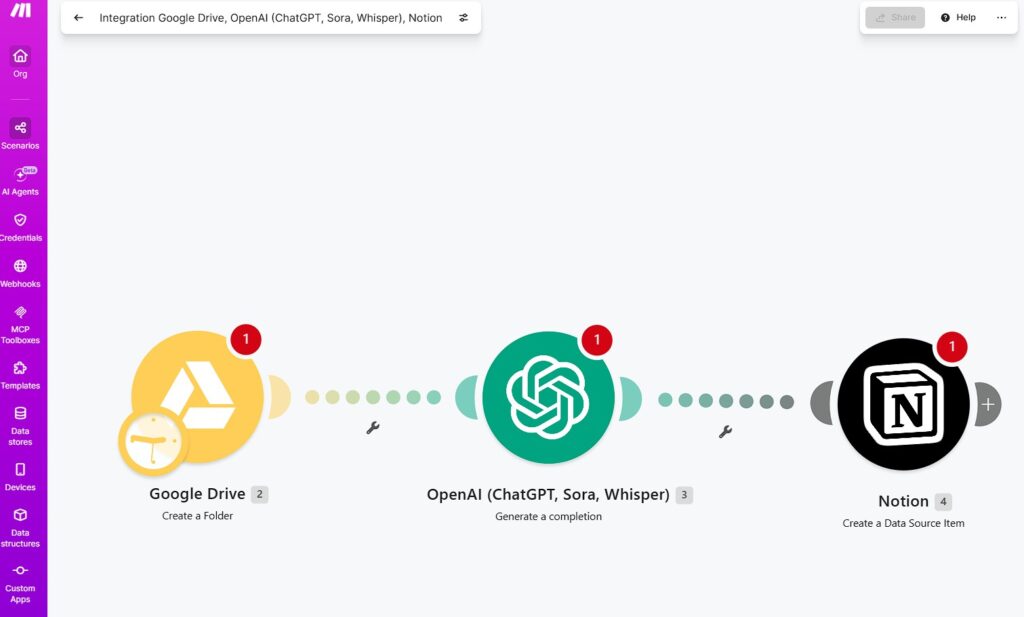
The conveyor belt runs without your involvement after setup. Zero-Skill automation advantage is that setup cost is fixed while operational leverage scales indefinitely—a pipeline processing one voice memo processes one thousand with identical effort from you: zero.
Make.com is the recommended starting platform because its visual interface most clearly represents the linear data flow of an AI Assembly Line. Each module appears as a connected node. Data flows left to right. You can see exactly where information enters each stage, what transformation occurs, and what exits to the next—making debugging straightforward even for users with no technical background whatsoever.
The Core Rule: One Prompt, One Job
The architectural philosophy of an AI Assembly Line requires one non-negotiable constraint: every AI node receives one type of input and produces one type of output, defined by a strict system prompt established before deployment.
Bad workflow (the standard approach):
- Human pastes raw, messy notes into a single ChatGPT session
- Prompt: “Research this, summarize the key points, identify action items, and format it as a professional report”
- Output: Partially hallucinated, inconsistently formatted, requires significant editing before use
Good modular workflow:
- Human saves a 5-minute voice memo
- Module 1 (Whisper): Transcribes audio to plain text. No analysis.
- Module 2 (Claude): Receives transcript. Extracts to-do items as a numbered list. Nothing else.
- Module 3 (Claude or GPT-4): Receives to-do list. Formats as structured JSON. No commentary.
- Automation: JSON data routes to the correct destination app automatically
The Lego block method works because each module’s system prompt is a constraint rather than a broad request. “Extract only the to-do items from this transcript. Output a numbered list. Include nothing else.” That module cannot wander into summarization because it has no instruction to do so.
Modular AI precision comes directly from limitation. Every system prompt in a well-designed AI Assembly Line should pass one practical test: given a sample input, can you predict the exact format of the output before running it? If the output format surprises you, the prompt needs narrowing before deployment.
Workflow 1: The “Second Brain” Voice Pipeline
This is the highest-value Zero-Skill automation use case for knowledge workers and entrepreneurs who generate ideas verbally but lose them to disorganization before they become actionable. The voice pipeline converts a chaotic 5-minute brain dump into organized, stored data without requiring you to look at a screen.
Step 1 — Transcription (Whisper AI): Save a voice memo to a designated cloud folder (Dropbox, Google Drive, or iCloud). Make.com detects the new file and routes it to OpenAI’s Whisper API. Whisper’s only job: produce a raw text transcript. No punctuation cleanup, no analysis—plain text output only. That text passes to Step 2.
Step 2 — Extraction (Claude via API): Claude receives the raw transcript with this strict system prompt:
You are a data extraction module. From the following transcript, extract exactly two lists:

1. TO-DO ITEMS: Concrete, actionable tasks mentioned
2. BUSINESS IDEAS: Concepts, project ideas, or opportunities mentioned

Output ONLY these two labeled lists. No summaries. No context. No preamble.
If nothing qualifies for a category, write the heading followed by "(none)".
Output: Two clean lists. Nothing else passes forward.
Step 3 — Routing (Make.com): Make.com parses Claude’s output. To-do items route to your task manager via API. Business ideas route to a dedicated Notion page via API. Both operations run simultaneously within 90 seconds of the voice memo being saved.
Result: A voice memo recorded during your morning walk produces organized task entries and saved business concepts before you return home—with zero additional effort from you. This Modular AI pipeline permanently replaces 20-30 minutes of daily manual note organization.
Workflow 2: The Automated Deep Research Machine
Staying current in any industry requires consuming significant information volume daily—a task that either takes 2 hours of active reading or simply doesn’t happen. The research pipeline compresses this into an 8am email containing only the day’s most relevant developments, curated automatically overnight while you sleep.
Step 1 — Content Sourcing (RSS + Make.com): Configure RSS feeds from 10-15 industry publications, news sources, and competitor blogs. Make.com monitors these feeds and collects every new article published in the previous 24 hours—typically 30-50 articles across an active niche. Article titles, URLs, and available body text are gathered as a complete batch.
Step 2 — Relevance Scoring (GPT-4 via API): Each article is sent individually to a GPT-4 module with this system prompt:
You are a relevance scoring module. Score the following article 1-10 based on
relevance to [YOUR SPECIFIC NICHE AND INTERESTS].

Output only:
SCORE: [number]
REASON: [one sentence maximum]
This Zero-Skill automation step filters 50 articles down to the 5-8 scoring 8 or above. Every article below 8 is discarded automatically. No human reads them.
Step 3 — Summarization (Claude via API): High-scoring articles route individually to Claude with this strict prompt:
You are a summarization module. Write one paragraph (4-6 sentences maximum)
summarizing the key insight of this article for a senior professional in [NICHE].
Focus on: what happened, why it matters, what to watch next.
No filler sentences. No opinion. Pure signal only.
Step 4 — Delivery (Make.com + Email): Make.com assembles the summaries with article titles and source links, formats them into a clean email template, and sends at 8:00 AM. The Lego block method is absolute here—the delivery module has one job: format and send. It does not analyze, score, or rewrite. Format and send.
The AI Assembly Line here processes 50 articles overnight, scores for relevance, summarizes the valuable ones, and delivers a curated intelligence briefing before you open your laptop. Your involvement: reading a 4-minute email.
Daily API cost: approximately $0.30-0.80. Daily time requirement: 4 minutes of reading. Work replaced: 90-120 minutes of manual research that most busy professionals simply never complete.
Pro Tip: Looking for a specific modular AI use case? You can use this exact assembly line logic to evaluate physical biomechanics. Read our guide on Pocket Form Coach: Hacking Personal Training with AI Vision to see how we route image data into AI for rapid analysis.
Frequently Asked Questions (FAQ)
Do I need to know how to code to build a Modular AI pipeline?
Absolutely not. Zero-Skill automation platforms like Make.com or Zapier use a visual, drag-and-drop interface. You are simply connecting functional blocks (like a Lego set) and filling in plain-English prompts. If you can draw a flowchart on a napkin, you can build an AI pipeline.
Are these automation tools and API connections expensive?
No. Most automation platforms offer generous free tiers that easily cover personal productivity workflows like the voice memo pipeline. Furthermore, API calls to AI models like OpenAI’s Whisper or GPT-4 are charged fractions of a cent per use. A daily research automation that saves you two hours of reading typically costs less than $1 per month to run.
What happens if the AI hallucinates in the middle of the assembly line?
This is exactly the problem the Lego block method solves. Because each AI module uses a highly restricted, single-purpose system prompt (e.g., “Extract ONLY a numbered to-do list”), the AI is constrained. It doesn’t have the freedom to hallucinate or generate creative filler because it is strictly fenced in by its specific module rules.
Can I connect my company’s specific software to these AI workflows?
Yes. Modern platforms feature thousands of pre-built integrations. Whether you use Notion for project management, Slack for communication, or a CRM like Salesforce, you can set these apps as the final destination module in your AI Assembly Line to receive the perfectly formatted data automatically.
The Verdict: Become the Manager, Not the Worker
The shift from ad-hoc AI user to Modular AI architect is the most significant productivity evolution available in 2026—requiring no coding skills, no technical background, and no significant investment beyond setup time.
When you stop treating AI as a do-everything chat window and start building a factory where each station performs a precise function, outputs improve dramatically while your active involvement approaches zero. The Lego block method philosophy isn’t about working less for its own sake—it’s about redirecting cognitive energy from mechanical processing toward the judgment calls, creative decisions, and strategic thinking that genuinely require human intelligence.
Every hour spent manually organizing information a pipeline could handle is an hour not spent deciding what to do with it. Modular AI handles the former automatically, freeing undivided mental bandwidth for the latter.
Zero-Skill automation pipelines built today run while you sleep, travel, and build other systems. They don’t fatigue, lose context, or forget follow-ups. The fiftieth article receives identical processing precision to the first.
Design your first AI Assembly Line this week. Start with Workflow 1—a voice memo pipeline that costs 2 hours to build and returns 20+ minutes daily indefinitely. Add Workflow 2 the following week. By month’s end, the Zero-Skill automation systems you’ve built will have recovered more hours than you spent constructing them.
Modular AI systems you deploy this week generate compounding leverage indefinitely. The Lego blocks are in front of you. Assemble your first stack. Zero-Skill automation starts returning value the moment the pipeline runs.
You don’t need to become a developer. You need to become a systems manager who thinks in inputs, outputs, and clean connections. The factory floor is assembled. Modular AI is running. Step back and manage it.