
The default AI output problem isn’t a model problem — it’s a vocabulary problem. Without specific art direction, every generator defaults to the same sterile look: plastic-smooth surfaces, synthetic lighting, and a texture-less “CGI render” quality that screams artificial. The solution isn’t adjectives like “hyperrealistic” or “stunning.” The solution is using specific art movements sourced from real art history, physical mediums, and specific ai art aesthetics that give the model a precise artistic language to work from.
This cheat sheet gives you every prompt term organized for instant copy-paste use to help you master the most effective midjourney art styles.
Mastering Midjourney Art Styles Across History
Historical art movements are among the most powerful prompt triggers available. Each one carries centuries of visual convention — specific color relationships, compositional rules, and surface treatments that the model has absorbed from thousands of real artworks.
| Prompt Keyword | Visual Characteristics | Best Used For |
|---|---|---|
| Art Nouveau | Organic flowing lines, botanical motifs, decorative borders, muted jewel tones | Portraits, posters, fashion illustration, fantasy |
| Bauhaus | Geometric simplicity, primary colors, functional form, no ornamentation | Typography art, product design, minimalist architecture |
| Surrealism | Dreamlike juxtapositions, photorealistic impossible scenes, melting or floating objects | Conceptual art, psychological portraits, editorial |
| Baroque | Deep chiaroscuro, rich jewel tones, dramatic diagonal compositions, theatrical staging | Historical portraiture, dramatic scenes, fine art |
| Impressionism | Visible brushstrokes, broken color, light captured in motion, soft edges | Landscapes, outdoor scenes, nostalgic portraits |
| Syd Mead inspired aesthetic | Retro-futurist transportation, chrome surfaces, optimistic sci-fi industrial design | Vehicles, spacecraft, utopian city concepts |
| Ukiyo-e woodblock print | Flat color planes, bold outlines, stylized waves, minimal shadow, Japanese compositional space | Landscapes, character portraits, nature scenes |
| De Stijl / Mondrian | Pure primary colors in rectangular grids, absolute flatness, no curves | Abstract composition, graphic design concepts |
| Art Deco | Geometric glamour, gold and black palette, symmetry, luxury industrial materials | Architecture, fashion, poster design |
| Gothic medieval manuscript | Gold leaf illumination, flat figures with halos, decorative borders, tempera paint quality | Fantasy, religious iconography, historical fiction |
Stacking tip: Combine movement with medium for layered specificity. This is the secret to developing unique midjourney art styles. For example, ‘Ukiyo-e woodblock print aesthetic…’ produces a far more controlled output than ‘Ukiyo-e‘ alone.
Physical Textures with Midjourney Mediums
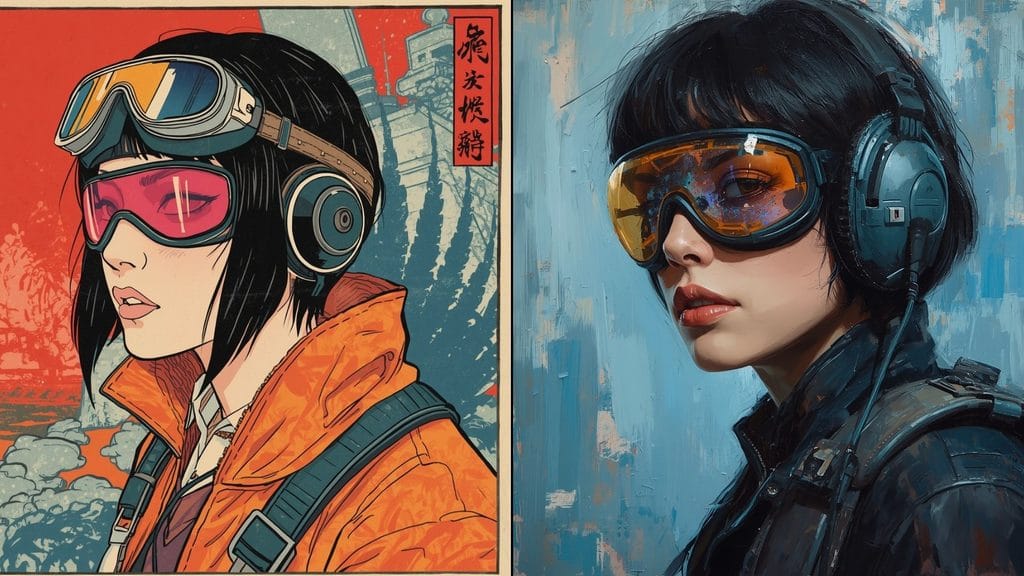
The most overlooked midjourney mediums in most prompt guides are physical ones. Naming a real artistic tool or process forces the model to render the organic imperfections, surface texture, and material behavior that breaks the default synthetic look immediately.
Paint & Wet Media:
- Impasto oil painting — Thick visible paint application, palette knife texture, raised brushwork catching light. Adds physicality and old-master richness to any subject.
- Watercolor wash — Soft wet-into-wet blooms, visible paper grain, translucent color layers, natural bleeding at edges. Essential for delicate, luminous outputs.
- Gouache on cold-press paper — Opaque matte colors, visible paper texture beneath, flat graphic quality. Sits between watercolor and illustration.
- Encaustic wax — Layered translucent wax with embedded texture, hot-tool marks, ancient aged quality. Exceptional for fine art and abstract work.
- Fresco painting — Plaster texture beneath pigment, aged cracks, wall-bound permanence. Historical and architectural subjects.
Dry Media & Printmaking:
- Charcoal sketch — Soft powdery marks, rich blacks, subtle mid-tones, visible smudging. Immediate emotion, high contrast without harshness.
- Linocut print — Bold carved lines, flat ink areas, deliberate graphic simplification. Powerful for portraits and poster aesthetics.
- Risograph print — Limited spot-color ink layers, visible halftone dots, slight ink misregistration. The defining indie/zine aesthetic of the 2020s.
- Cross-hatch ink illustration — Dense parallel lines creating tone, pen nib texture, editorial illustration character. Used heavily in editorial and scientific illustration.
- Etching / dry point — Fine needle-scratched lines on metal plate, rich velvety blacks, old-world technical precision.
Mixed & Sculptural:
- Claymation / Plasticine — 3D modeled feel with visible fingerprints and texture marks, warm matte surfaces, stop-motion character. Immediately charming.
- Stained glass — Leaded outline dividing colored glass panels, transmitted light, jewel-tone saturation, flat design.
- Paper cutout / Kirigami — Layered paper planes, hard cast shadows, handcrafted depth, visible cut edges.
- Felt and textile — Fabric texture, stitched edges, soft material boundaries. Cozy, handmade, Scandinavian craft aesthetic.
Digital Engines & Cinematic Art Prompts
For sci-fi, gaming concept art, and architectural visualization, cinematic art prompts drawn from real rendering technology tell the model which lighting behavior and surface treatment to apply. These aren’t stylistic — they’re technical instructions the model has learned from thousands of renders produced in these actual engines.
Rendering Engines:
- Octane Render — The gold standard for photorealistic volumetric lighting, subsurface scattering on skin, and physically accurate glass/water behavior. Adds cinematic realism to any scene.
- Unreal Engine 5 render — Real-time global illumination, Nanite-quality geometric detail, next-generation game environment visual fidelity. Film-quality without being photographic.
- Ray tracing — Physically accurate light reflection, refraction, and shadow generation. Use when you need perfect mirror surfaces and realistic caustic light patterns.
- Arnold Renderer — Studio-quality soft shadows, natural subsurface skin, industry-standard film VFX aesthetic. Character-focused.
- V-Ray architectural render — Clean professional building visualization, perfect white light balance, photorealistic interior surfaces.
Compositional & Painterly Digital:
- Matte painting — The classic film VFX background technique. Epic landscapes, impossible locations, seamless sky replacements. Cinematic scale at maximum.
- Isometric 3D voxel art — Pixel-art blocks arranged in isometric perspective, game-map aesthetic, clean and systematic. Exceptional for urban planning visualization and retro gaming style.
- Cel-shaded animation — Hard-edged color fills with bold outlines, anime or cartoon color logic, no photorealistic lighting. Pure graphic character.
- ZBrush sculpt render — Visible digital sculpting tool marks, high-polygon surface detail, grey clay render. Concept art and character design standard.
Trend-Driven AI Art Aesthetics for 2026
These are the contemporary internet-native ai art aesthetics that dominate social media platforms and commercial design briefs in 2026. Each one has a precise visual vocabulary the model responds to consistently.
- Dark Academia — Warm candlelight, aged wood and leather, ivy-covered stone buildings, sepia tones, antiquarian book stacks, melancholy intellectual atmosphere. Trigger: “Dark Academia aesthetic, warm candlelit library, aged paper tones”
- Solar Punk — Lush botanical integration with architecture, soft warm sunlight, diverse community, sustainable handmade technology, Mediterranean-influenced palette. Trigger: “Solarpunk aesthetic, living architecture, overgrown greenhouse, warm solar palette”
- Vaporwave / Synthwave — Magenta/cyan/purple neon gradient, retrocomputing hardware, Roman bust sculptures, 80s grid geometry, digital sunset. Trigger: “Vaporwave aesthetic, neon pink and blue gradient, retro CRT monitor, grid sunset”
- Brutalist minimalism — Exposed raw concrete, geometric mass, deliberate absence of decoration, monochrome or limited palette, architectural dominance. Trigger: “Brutalist minimalism, exposed concrete, stark geometry, monochrome”
- Y2K aesthetic — Translucent plastic, chrome bubble letters, holographic surfaces, early 2000s optimism, iridescent gradients. Trigger: “Y2K aesthetic, transparent plastic, holographic iridescent, chrome bubble typography”
- Neo-noir — Rain-slicked city streets, harsh neon in darkness, moral ambiguity, extreme chiaroscuro, trench coats and shadow. Trigger: “Neo-noir aesthetic, rain-soaked alley, neon reflections, deep shadow, cinematic”
- Cottagecore — Handwoven textures, wildflower meadows, linen and ceramics, soft natural light, pastoral pre-industrial domestic life. Trigger: “Cottagecore aesthetic, wildflower field, linen textures, warm soft natural light”
- Quiet Luxury — Understated neutral palette, fine material texture (cashmere, marble, brushed metal), negative space, zero logos, old-money restraint. Trigger: “Quiet luxury aesthetic, neutral tones, cashmere texture, architectural negative space”
The Universal Stacking Formula for Midjourney Visual Styles
This is the master architecture for any professional prompt. By blending physical midjourney mediums with precise lighting, all midjourney visual styles reach their maximum potential when every layer of visual instruction is present simultaneously.
[Medium] + [Subject + Action] + [Art Style / Movement] + [Shot Type + Camera Angle] + [Lighting & Atmosphere] + [Engine / Film Tag]
Example Prompt 1 — Fine Art Character Portrait:
Impasto oil painting, a weathered 19th century lighthouse keeper standing at the cliff edge in a storm, Baroque art style, dramatic chiaroscuro, full body shot, low angle, single lantern key light from the left, volumetric fog and rain, deep shadow on right side of face, Rembrandt lighting, photorealistic oil on canvas texture, museum-quality –ar 2:3 –s 750
Analysis: Impasto forces visible oil paint texture. Baroque provides the compositional and color convention. Low angle creates heroism. Single named lantern key light gives the model a specific source to obey. Volumetric fog layers atmosphere. Rembrandt instruction places the signature shadow triangle. Every term contributes a distinct layer — none repeat the same instruction.
Example Prompt 2 — Sci-Fi Environment Concept:
Matte painting, a Solarpunk city district where ancient Roman architecture is overtaken by vertical gardens and solar panels at sunrise, Ukiyo-e woodblock print color palette, wide establishing shot, bird’s eye view drone angle, golden hour rim lighting, volumetric god rays through the canopy, Octane Render, cinematic art prompt, photorealistic –ar 16:9 –s 500
Analysis: Matte painting establishes the epic scale and film VFX quality. Solarpunk defines the ideological aesthetic. Ukiyo-e palette instruction applies flat color logic without overriding the environmental realism. Bird’s eye drone angle gives the scale that the Solarpunk concept requires. God rays through canopy combine botanical density with cinematic atmosphere. Octane Render brings photorealistic surface physics. By utilizing these cinematic art prompts, the result is a fully art-directed scene, not an AI hallucination.
Frequently Asked Questions About AI Styles
Why does my prompt still look like generic 3D CGI despite using art style keywords?
Generic CGI look persists when style keywords are too vague or placed at the end of the prompt where they carry less weight. Three fixes: (1) Move your medium term to the very first position in the prompt — “Impasto oil painting, …” front-loads the material instruction before the model processes anything else. (2) Add explicit anti-CGI language in your negative prompt: “no CGI render, no plastic surface, no synthetic lighting, no 3D model”. (3) Add film grain or physical medium tags: “visible brushwork, hand-painted texture, canvas grain” are affirmative statements that push the model away from default render behavior.
Can I combine two conflicting art styles like Cyberpunk and Ukiyo-e?
Yes — and hybrid style prompts often produce the most distinctive and commercially valuable midjourney art styles outputs.. The key is weighting clearly. “Ukiyo-e woodblock print, cyberpunk aesthetic” gives Ukiyo-e priority. “Cyberpunk cityscape rendered in the style of Ukiyo-e woodblock prints, flat color planes, bold outlines, neon ink” makes the cyberpunk the subject and Ukiyo-e the rendering method. The model handles cross-style prompts well when you specify which element is the subject and which is the visual treatment — confusion happens when both are competing for the same role.
Do these midjourney art styles work the same way in DALL-E 3 and Stable Diffusion?
Yes — all terms in this guide are drawn from universal art history and photography vocabulary that all major models have absorbed from the same training data. DALL-E 3 responds better to descriptive compound phrases than single keywords: “rendered in the style of a Bauhaus design poster with primary color geometric shapes” outperforms just “Bauhaus.” Stable Diffusion benefits from placing style terms in both the positive prompt and their opposites in the negative: adding “no photograph, no realistic render” to the negative prompt pushes the model more aggressively toward the named art style. The core vocabulary is universal; the syntax optimization differs slightly per model.
How do I tone down an overly aggressive art style in Midjourney?
Use the --stylize (or --s) parameter to control how literally Midjourney interprets your style instruction. The default is --s 100. Lowering to --s 25–50 pulls the output toward your subject description and reduces style intensity — useful when Baroque chiaroscuro is overwhelming the subject. Raising to --s 750–1000 lets Midjourney apply its own stylistic interpretation more freely, often producing more distinctly artistic results at the cost of literal prompt accuracy. For blended styles where you want both to read clearly, --s 250–400 is the working range where the model balances instruction and artistic expression without either dominating completely.
Final Thoughts: Building Your Visual Signature
A consistent visual identity is the difference between a creator whose work is immediately recognizable and one producing generic content that blends into the feed. The midjourney art styles, ai art aesthetics, and physical midjourney mediums in this guide are the raw vocabulary — but fluency comes from combining them deliberately with the same principles every time.
For maximum creative control, use this cheat sheet in tandem with the ZeroSkillAI Camera Angles & Shot Types guide and the Lighting Prompts guide. When your medium, camera position, and lighting language are all working together from the same visual intention, the output shifts from “an AI image” to a cohesive piece of art with a defensible point of view.
Bookmark this page. The formula is simple: pick your medium, name your movement, specify your light. Do it consistently and the model learns your language.