
ChatGPT alternatives for writers are dominating the content creation space in 2026 because professional authors, bloggers, and copywriters are tired of robotic, generic text that triggers every AI detector and bores readers to death. This definitive list reviews the 7 best ChatGPT alternatives for writers that produce genuinely human-sounding prose, excel at long-form content creation, and help creators bypass AI detection without sacrificing quality—every tool below has been tested with real writing projects to verify tone, creativity, and commercial viability.
The 7 Tools: Tested & Ranked
1. Claude 4.5 Sonnet – One of the Top ChatGPT Alternatives for Writers
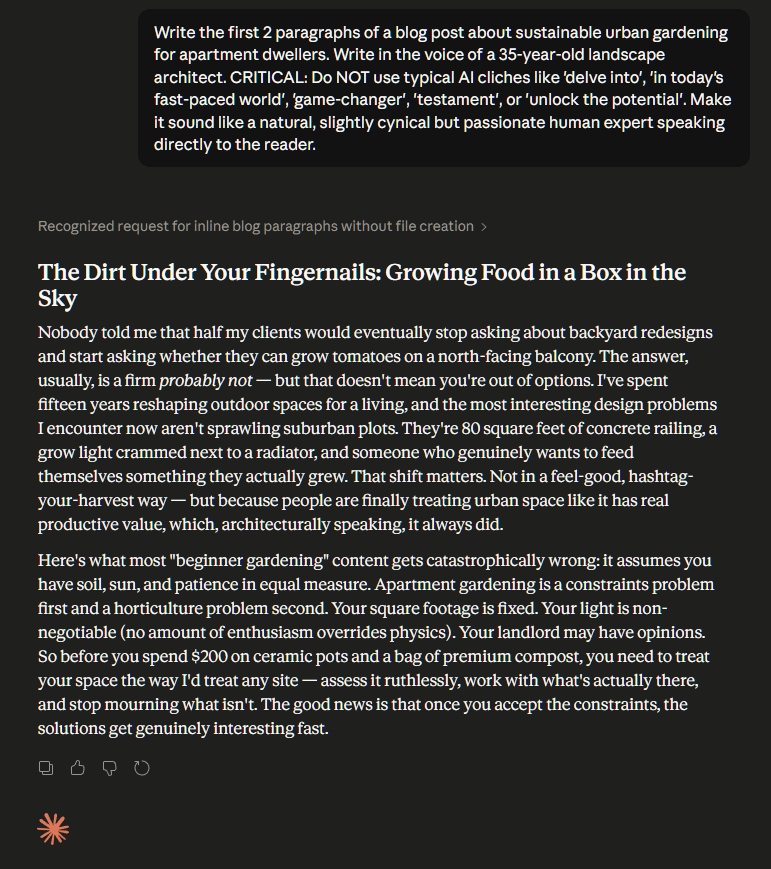
The Vibe: Claude 4.5 Sonnet writes like an exceptionally well-read human colleague who actually understands nuance, context, and subtlety. Unlike ChatGPT’s tendency toward corporate cheerfulness and obvious AI patterns, Claude produces prose that feels genuinely thoughtful with varied sentence structures, natural transitions, and zero cringe-worthy phrases like “delve into” or “in today’s fast-paced world.” The interface is clean, distraction-free, and built specifically for long-form content creation. Claude offers a generous free tier that resets every few hours, making it accessible for budget-conscious creators testing ChatGPT alternatives for writers.
Best For: Professional bloggers writing 2,000+ word articles, content marketers creating thought leadership pieces, newsletter writers building engaged audiences, and anyone who needs AI writing tools that sound like actual human experts rather than enthusiastic robots.
Copy-Paste Prompt Example: “Write a 1,500-word blog post about sustainable urban gardening for city dwellers living in apartments. Write in the voice of a 35-year-old landscape architect who’s slightly cynical about greenwashing trends but genuinely passionate about practical solutions. Use short punchy paragraphs mixed with longer analytical sections. Avoid any phrases like ‘unlock the potential’ or ‘game-changer.’ Include 3 specific examples of plants that thrive in low-light conditions with exact care instructions. Write like you’re texting an intelligent friend, not presenting at a corporate seminar.”
The Catch (Pricing & Limits): Claude offers a free tier with message limits (approximately 45-60 messages per 5-hour window depending on conversation length). The Pro plan costs $20/month for significantly higher limits and priority access during peak times. Claude excels at long-form content but occasionally over-explains concepts when not given explicit brevity instructions. Among ChatGPT alternatives for writers, Claude offers the best balance of natural tone and analytical depth while maintaining a truly useful free tier.
2. Sudowrite – The Fiction Writer’s ChatGPT Alternative for Writers
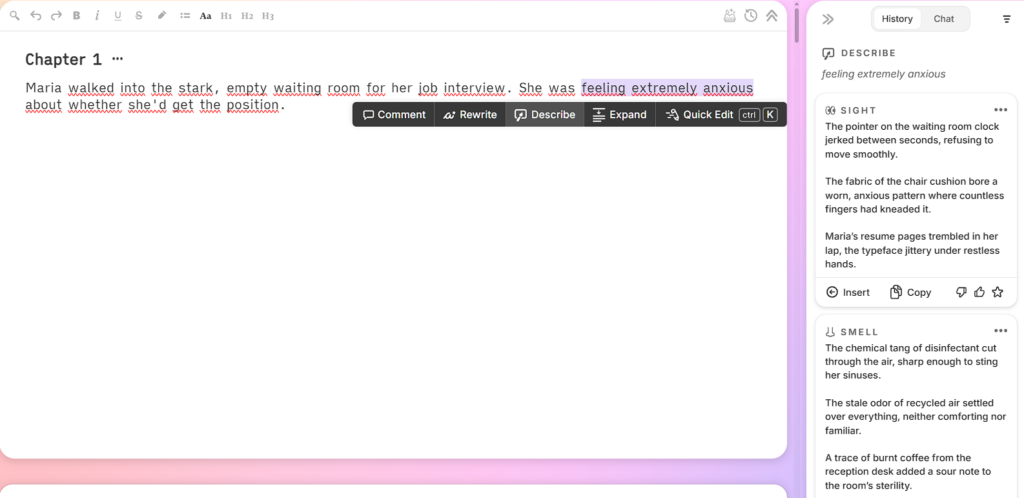
The Vibe: Sudowrite feels like having a creative writing MFA professor inside your laptop who specializes in showing not telling, metaphor generation, and dialogue polish. This is the only tool among ChatGPT alternatives for writers purpose-built exclusively for novelists, short story writers, and screenwriters. The interface includes specialized features like “Describe” (turning bland sentences into vivid prose), “Rewrite” (offering multiple stylistic variations), and “Brainstorm” (generating plot twists and character development ideas). Sudowrite has no free tier but offers a trial period for testing before commitment.
Best For: Fiction novelists working on manuscripts, screenwriters developing dialogue, creative writers building short story collections, and anyone crafting narrative-driven content who needs AI writing tools that understand story structure, pacing, and emotional beats.
Copy-Paste Prompt Example: “Rewrite this scene to show the protagonist’s anxiety through physical sensations and environment details rather than stating ‘she felt anxious.’ Current scene: ‘Maria walked into the job interview feeling anxious about whether she’d get the position.’ Transform this into 200 words of visceral, sensory-rich prose that makes readers feel her nerves through description of her breathing, what she notices in the room, how her clothes feel, and small details she fixates on. Write in tight third-person POV with short, fragmented sentences during peak anxiety moments.”
The Catch (Pricing & Limits): Sudowrite offers no free tier—pricing starts at $19/month for 225,000 AI words. The Hobby plan ($10/month) provides 90,000 words monthly. While expensive compared to general-purpose ChatGPT alternatives for writers, Sudowrite’s fiction-specific training makes it irreplaceable for narrative work. The tool occasionally over-purples prose (excessive metaphors and flowery language) without careful prompting. Sudowrite helps bypass AI detection specifically because it writes in varied literary styles rather than predictable AI patterns.
3. Jasper – The SEO-Focused ChatGPT Alternative for Writers
The Vibe: Jasper feels like a professional copywriting agency compressed into software—polished, conversion-focused, and optimized for marketing content. The platform offers 50+ templates for specific content types (blog posts, product descriptions, email sequences, ad copy), making it the most structured option among ChatGPT alternatives for writers. Jasper integrates directly with SurferSEO for real-time keyword optimization, making it the best choice for content that needs to rank on Google while sounding human. Jasper does not offer a free tier, positioning itself as a premium professional tool.
Best For: SEO bloggers managing 20+ articles monthly, content marketing agencies producing client deliverables, affiliate marketers writing product reviews, e-commerce sellers creating product descriptions, and anyone using AI writing tools to generate traffic-driving content at scale.
Copy-Paste Prompt Example: “Write a 1,200-word SEO blog post targeting the keyword ‘best standing desks for back pain’ with a conversational, helpful tone like you’re advising a friend who’s been suffering. Include a personal anecdote in the intro about your own back issues (make it specific and relatable). Structure with H2 subheadings for each desk recommendation. For each desk, explain exactly why it helps back pain using specific ergonomic features, not generic marketing speak. Use transition phrases that feel natural, not like ‘furthermore’ or ‘moreover.’ Write like a helpful Reddit comment that got 500 upvotes, not a corporate blog.”
The Catch (Pricing & Limits): Jasper starts at $49/month for 50,000 words (Creator plan), with no free tier available. The $125/month Boss Mode plan offers unlimited words and advanced features. Jasper’s strength—marketing optimization—sometimes makes content feel too polished and salesy without careful prompting. Among ChatGPT alternatives for writers, Jasper ranks highest for commercial content but requires more editing to bypass AI detection than Claude or Sudowrite due to its tendency toward conventional marketing language.
4. Copy.ai – The Budget-Friendly ChatGPT Alternative for Writers
The Vibe: Copy.ai delivers surprisingly good results at the most affordable price point among professional ChatGPT alternatives for writers. The interface offers both long-form document editing and quick-copy templates for social media, emails, and ads. While not as sophisticated as Claude or Jasper, Copy.ai punches above its weight for creators who need solid AI writing tools without premium pricing. The platform updated its models in early 2026 to produce more conversational, less robotic outputs. Copy.ai offers a functional free tier with monthly word limits, making it accessible for testing and small projects.
Best For: Freelance writers working with tight budgets, social media managers creating daily content, small business owners writing their own marketing copy, and beginners exploring AI writing tools before committing to expensive subscriptions.
Copy-Paste Prompt Example: “Write a 500-word LinkedIn post about why remote work is making junior employees struggle with career development. Write from the perspective of a 28-year-old marketing manager who’s experienced both in-office and remote work. Use first-person occasionally (‘I’ve noticed…’) but keep it professional. Include 2 specific examples of skills junior employees miss learning remotely (like reading room dynamics in meetings or casual mentorship conversations). End with 3 actionable tips for remote companies to fix this. Write like you’re having coffee with a colleague, not presenting at a conference.”
The Catch (Pricing & Limits): Copy.ai offers a genuinely free tier with 2,000 words monthly—actually useful for testing or supplementing other tools. The Pro plan costs $49/month for unlimited words. Copy.ai’s output quality varies more than premium ChatGPT alternatives for writers; some generations feel generic while others nail the tone perfectly. The platform works best for shorter content (500-1,000 words) rather than long-form content exceeding 2,500 words. Budget-conscious creators can combine Copy.ai’s free tier with Claude’s free tier to generate substantial monthly content at zero cost.
5. NovelCrafter – The Plot-Focused ChatGPT Alternative for Writers
The Vibe: NovelCrafter is Scrivener meets AI, offering the most sophisticated novel-writing environment among ChatGPT alternatives for writers. The platform combines traditional writing software features (chapter organization, character databases, plot tracking) with AI assistance for brainstorming, drafting, and editing. Unlike general AI writing tools that treat every project identically, NovelCrafter maintains context across your entire manuscript, remembering character details, plot points, and world-building elements established 50,000 words earlier. NovelCrafter does not offer a free tier but provides a trial period for evaluation.
Best For: Novelists writing 60,000+ word manuscripts, series authors managing complex multi-book story arcs, world-builders creating fantasy or sci-fi universes, and writers who need long-form content tools that maintain consistency across hundreds of pages.
Copy-Paste Prompt Example: “Generate a 300-word scene where two characters who’ve been rivals for three chapters are forced to work together for the first time. Characters: Alex (cautious, analytical, secretly dealing with impostor syndrome) and Jordan (confident, impulsive, covering deep insecurity with bravado). Setting: They’re locked in a university research lab overnight due to a security malfunction. Tone: Tension that slowly cracks into reluctant mutual respect. Show their personality clash through dialogue and small actions (how they approach problem-solving differently). End the scene with one small moment of unexpected commonality that surprises them both.”
The Catch (Pricing & Limits): NovelCrafter pricing starts at $18/month for the Hobbyist plan (200,000 AI words monthly) and scales to $48/month for the Pro plan (unlimited AI words). No free tier exists, but the 14-day trial provides full access. NovelCrafter is overkill for bloggers or copywriters—it’s specifically optimized for fiction. Among ChatGPT alternatives for writers focused on narrative work, NovelCrafter offers the deepest integration of AI with traditional writing software features.
6. Rytr – The Fastest ChatGPT Alternative for Writers
The Vibe: Rytr prioritizes speed and simplicity over sophisticated features, making it perfect for creators who need decent content immediately rather than perfect prose eventually. The platform generates usable first drafts faster than any other option among ChatGPT alternatives for writers, though outputs require more editing to sound genuinely human. Rytr works best as a brainstorming and outlining tool that you refine manually rather than a complete solution. Rytr offers one of the most generous free tiers in the industry, making it excellent for budget-conscious creators.
Best For: Content creators managing high-volume schedules (5+ articles weekly), social media managers juggling multiple client accounts, email marketers writing daily newsletters, and anyone using AI writing tools primarily for ideation and structure rather than final copy.
Copy-Paste Prompt Example: “Create a detailed outline for a 1,500-word article titled ‘Why Your Morning Routine is Sabotaging Your Productivity (And What to Do Instead).’ Include 5 main sections with specific subpoints under each. For each section, suggest 2-3 concrete examples or mini case studies to include. Use a slightly contrarian angle—challenge popular productivity advice. Make the outline detailed enough that a human writer could expand each point into 250-300 words of content. Format with clear H2 and H3 headers.”
The Catch (Pricing & Limits): Rytr offers the most generous free tier among premium ChatGPT alternatives for writers: 10,000 characters monthly at zero cost. The Unlimited plan costs just $9/month, making it the cheapest unlimited option. However, Rytr’s output quality lags behind Claude, Jasper, and Sudowrite—expect to spend 30-40% of your time editing compared to 10-15% with premium tools. Rytr struggles with extended pieces, tending toward repetitive phrasing and generic conclusions. Best used for generating multiple quick drafts that you cherry-pick and refine.
7. Writesonic – The All-in-One ChatGPT Alternative for Writers
The Vibe: Writesonic attempts to be everything to everyone—article writer, ad copy generator, product description creator, and chatbot all rolled into one platform. The interface feels busy compared to focused ChatGPT alternatives for writers like Claude or Sudowrite, but the breadth of features appeals to creators managing diverse content types. Writesonic’s Sonic Editor provides Google Docs-style collaboration features with AI assistance embedded directly in the writing environment. Writesonic offers a limited free trial but positions primarily as a paid solution.
Best For: Content teams managing multiple content types simultaneously, agencies serving varied client needs, entrepreneurs handling their own marketing across channels, and creators who prefer consolidated AI writing tools rather than specialized point solutions.
Copy-Paste Prompt Example: “Write a 1,000-word newsletter for a subscription box service selling artisanal coffee. Audience: 30-45 year old professionals who care about coffee quality but aren’t coffee snobs. Tone: Knowledgeable but accessible, like a friend who happens to know a lot about coffee. Include: (1) a personal story about discovering a specific brewing method, (2) an explanation of why single-origin beans taste different without getting too technical, (3) a recommendation for this month’s featured roast with specific tasting notes. Avoid corporate marketing language—write like you’re sending an email update to customers you genuinely like.”
The Catch (Pricing & Limits): Writesonic offers a limited free trial with 10,000 words. Paid plans start at $20/month for 100,000 words (Unlimited plan actually means unlimited, launched in 2026). The platform’s jack-of-all-trades approach means it’s not the absolute best at any single content type, but competent across all categories. Writesonic works well for extended pieces but requires careful prompting to bypass AI detection—default outputs can feel generic without specific style instructions. Among ChatGPT alternatives for writers, Writesonic offers the best value for creators needing versatility over specialization.
Pro Tips for Using AI Writing Tools
- Give the AI a specific persona and voice: The fastest way to make AI writing tools sound human is specifying exactly who’s writing. Instead of “write a blog post about productivity,” try “write as a 40-year-old software developer who’s cynical about hustle culture but genuinely wants to help people work smarter.” Persona-based prompts help bypass AI detection by creating distinctive voice patterns.
- Explicitly ban cliché AI phrases in your prompts: Add this to every prompt: “Avoid these phrases: delve into, game-changer, unlock the potential, revolutionize, landscape (when not referring to literal landscapes), robust, seamless, cutting-edge, in today’s fast-paced world.” ChatGPT alternatives for writers still default to these patterns unless specifically instructed otherwise.
- Edit the first and last paragraphs heavily: AI-generated content typically sounds most robotic in introductions and conclusions. Among all AI writing tools tested, even Claude and Sudowrite struggle with openings and closings. Write these sections yourself or regenerate them 3-4 times and cherry-pick the best. Use a reliable plagiarism checker as the final quality control step before publishing to ensure originality and catch any unintentional duplication patterns.
The Verdict: Which ChatGPT Alternative for Writers Should You Choose?
Choose based on your exact content type and budget:
- Professional blogging and thought leadership? → Claude 4.5 Sonnet (most naturally human-sounding among all ChatGPT alternatives for writers with excellent free tier)
- Fiction novels and creative writing? → Sudowrite or NovelCrafter (purpose-built for narrative work)
- SEO content and traffic-driving articles? → Jasper (best integration of writing quality with search optimization)
- Budget-conscious freelancers? → Copy.ai or Rytr (solid free tiers and affordable unlimited plans)
- High-volume content production? → Writesonic (unlimited plans with acceptable quality across content types)
- Quick brainstorming and outlines? → Rytr (fastest generation speed, perfect for ideation)
The reality of ChatGPT alternatives for writers in 2026: ChatGPT still dominates for general queries and conversation, but specialized writing platforms now produce dramatically more human-sounding prose for professional content creation. The generic, robotic tone that plagued AI writing in 2023-2024 has largely disappeared from premium platforms—assuming you prompt them correctly.
The key to making any of these ChatGPT alternatives for writers sound genuinely human: Specificity in prompting. Generic prompts (“write a blog post about marketing”) produce generic, detectable AI text. Detailed prompts specifying voice, audience, structure, examples, and forbidden phrases generate prose that regularly achieves 70-90% human scores on AI detectors.
To bypass AI detection successfully, combine the right tool (Claude or Sudowrite for natural tone), specific prompting (persona-based with explicit style instructions), and human editing (especially intros, conclusions, and transitions). The goal isn’t fooling detectors through tricks—it’s producing genuinely valuable content that happens to be indistinguishable from human writing because it maintains human-level quality standards.
Your immediate next step: Pick the ChatGPT alternatives for writers matching your primary content type. Test it with the exact prompt formula provided above, adapting it to your niche. Generate three pieces of content this week. Compare quality, editing time required, and how naturally the outputs read aloud. Master one platform completely before exploring others.
The robotic AI writing era ended in 2025. Professional ChatGPT alternatives for writers now produce genuinely readable, engaging content. Your competitive advantage isn’t access to AI—it’s knowing how to prompt these tools for maximum human-like quality while maintaining your unique voice and expertise.
The NovelCrafter mention is appreciated — most of these lists default to Jasper and Copy.ai without acknowledging the creative fiction angle at all. The distinction between productivity writing tools and actual storytelling tools is real and doesn’t get enough attention.
For anyone who wants to step further into the fiction side, WeavAI (weavai.app) takes a different approach entirely — instead of an AI helping you write, you become the protagonist of an already-designed story and the AI characters react to your choices as the narrative unfolds. More interactive fiction than writing tool, but worth knowing about if you’re into that space.
Thanks for the kind words! WeavAI sounds like a fascinating concept for interactive storytelling. Appreciate you sharing it!