
Amateur prompters describe what they want to see. Professionals describe how it’s lit. Midjourney lighting prompts are the fastest single upgrade available to any AI art workflow — the same subject in flat lighting versus golden hour lighting produces images that look like they were created by completely different artists. This cheat sheet gives you every lighting term, atmospheric modifier, and studio technique you need to copy-paste into Midjourney, DALL-E 3, or Stable Diffusion immediately.
No theory. Just the exact keywords and what they do.
The Ultimate Midjourney Lighting Prompts Cheat Sheet (Natural Light)
These natural midjourney lighting prompts control the character of light hitting your subject. Mastering these terms is the foundation of every professional-looking outdoor generation.
| Prompt Keyword | Visual Effect | Best Used For |
|---|---|---|
| Golden hour lighting | Warm amber/orange tones, long shadows, low sun angle | Portraits, landscapes, romantic scenes |
| Blue hour lighting | Cool deep blue tones, twilight transition, artificial lights begin to glow | Urban scenes, moody portraits, architecture |
| Overcast flat lighting | Diffused, shadowless, even illumination across the entire frame | Product shots, documentary, natural skin tones |
| Dappled sunlight | Broken light patterns through foliage, organic shadow play on skin | Forest scenes, outdoor portraits, summer aesthetic |
| Harsh midday sun | High contrast, deep shadows directly below features, bleached highlights | Desert scenes, street photography, brutal/gritty mood |
| Magic hour | The 10-minute window before sunset — extremely saturated, cinematic warmth | Epic landscapes, cinematic scenes, emotional portraits |
| Moonlight | Cool blue-silver illumination, deep shadows, quiet atmosphere | Night portraits, fantasy, horror, mystery |
| Sunrise backlight | Subject silhouetted against bright warm horizon, rim of light | Silhouette art, spiritual tone, cinematic openers |
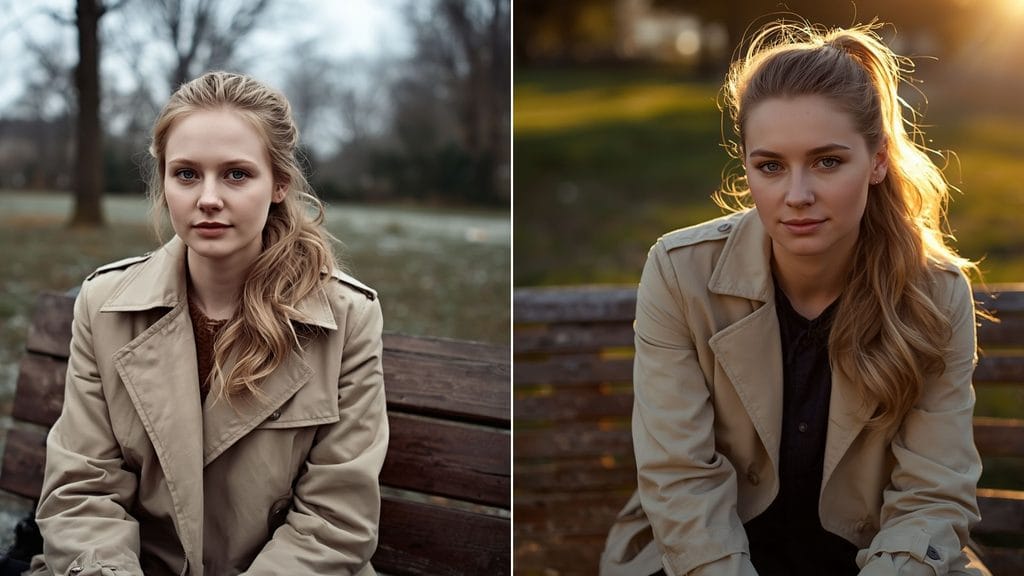
Pro tip: Stack multiple midjourney lighting prompts with specific times of day for precision. “Golden hour lighting, low sun through trees, warm dappled shadows” is far more controlled than “golden hour” alone.
Studio Techniques for AI Portrait Lighting
These are the midjourney lighting prompts drawn from classical portrait photography and film. Each one reshapes facial structure and emotional tone.
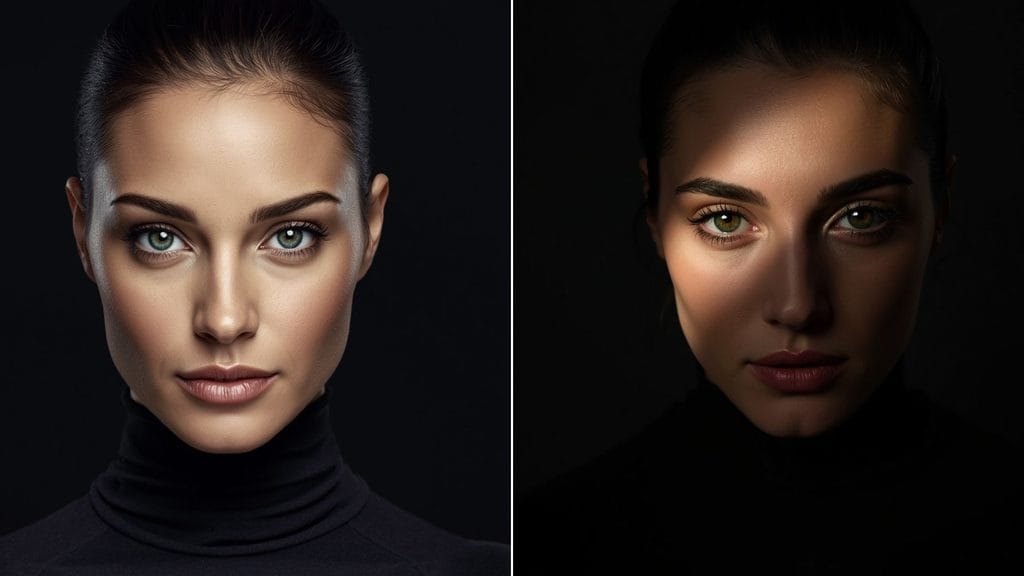
- Rembrandt lighting — Places a small triangle of light on the shadowed cheek. Creates depth, drama, and painterly character. Adds age, gravitas, and old-master aesthetic to any face. Best for: character portraits, historical figures, serious tones.
- Butterfly lighting — Light placed directly above and in front of the subject, creating a small butterfly-shaped shadow under the nose. Glamorous, symmetrical, flattering. Classic Hollywood beauty lighting. Best for: ai portrait lighting, beauty shots, editorial fashion.
- Split lighting — Exactly half the face lit, half in deep shadow. Divided down the center. Extreme drama, duality, mystery. Best for: villains, psychological tension, conceptual portraits.
- Rim lighting / backlighting — Light source placed behind the subject, creating a glowing outline separating them from the background. Ethereal, cinematic, otherworldly. Best for: sci-fi, fantasy, product isolation.
- Softbox lighting — Diffused, even studio light from a large light source at 45 degrees. Clean, professional, commercial. Eliminates harsh shadows. Best for: headshots, product photography, clean editorial.
- Chiaroscuro lighting — Extreme contrast between bright light and deep shadow, drawn directly from Baroque painting. Dramatic, theatrical, museum-quality. Best for: fine art portraits, dark fantasy, dramatic scenes.
- Three-point lighting — Key light, fill light, and rim light working together. The industry-standard setup for balanced, professional subject illumination. Best for: neutral-professional portraits, realistic character renders.
Creating Midjourney Atmosphere & Weather Effects
Pairing atmosphere modifiers with targeted midjourney lighting prompts adds the environmental depth that makes images feel physically real. These terms move outputs from “illustration” to “photograph.”
Light & Volume:
- Volumetric lighting — Light becomes visible as it passes through particles in the air. The classic “God rays” through dust or fog. Adds enormous cinematic depth.
- God rays / crepuscular rays — Specific directional shafts of light breaking through clouds or windows. Spiritual, epic, dramatic.
- Dust motes in the air — Tiny floating particles illuminated by a light beam. Signals old rooms, abandoned spaces, analog warmth.
- Lens flare — Optical artifact from bright light hitting the lens directly. Adds photographic authenticity and a sense of real capture.
Weather & Environmental:
- Cinematic fog / morning mist — Low-lying atmospheric diffusion that softens backgrounds and creates depth layers. Quiet, contemplative, ethereal.
- Heavy rain, rain-slicked streets — Wet surfaces reflect neon and artificial light. Multiplies light sources and color in the frame. Urban, noir, melancholic.
- Snowstorm / blizzard — White atmospheric noise that isolates subjects and flattens background detail. Cold, isolating, survival tone.
- Heat haze / desert mirage — Distortion in the lower portion of the frame. Extreme heat, arid landscape, unsettling surrealism.
Specialized & Stylized:
- Bioluminescence — Organic blue-green glow emanating from living things. Fantasy, deep ocean, alien environments, wonder.
- Neon cyberpunk glow — Saturated magenta, cyan, and purple light reflecting off wet surfaces. Urban decay, future-noir, sci-fi streets.
- Fire light / flickering candlelight — Warm, unstable, low-light illumination with dancing orange shadows. Medieval, horror, intimate.
- Aurora borealis / northern lights — Green and violet atmospheric light across the sky. Remote, otherworldly, peaceful spectacle.
The Best Lighting for AI Art (Master Combinations)
This is where your midjourney lighting prompts reach full power. By chaining these specific midjourney lighting prompts with camera angles, you unlock true cinematic realism.
Example Prompt 1 — Cinematic Character Portrait:
A veteran samurai warrior sitting in quiet meditation, close-up shot, low angle, 85mm lens, f/2.0 aperture, Rembrandt lighting, single candle as key light, deep shadow on half the face, dust motes floating in the candlelight, volumetric light beam from a paper screen window, Cinestill 800T film grain, photorealistic, ultra-detailed –ar 2:3
What this does: Rembrandt lighting creates facial depth and age. The single candle as a named light source locks the AI onto a specific, controlled light direction. Dust motes confirm the volumetric atmosphere. Cinestill 800T adds warm orange grain that makes digital renders look analog. The result reads like a high-end editorial photograph, not AI-generated art.
Example Prompt 2 — Atmospheric Urban Night:
A lone detective standing at the entrance of a rain-soaked New York alley, full body shot, eye level, 35mm lens, blue hour lighting, neon cyberpunk glow reflecting off rain-slicked streets, volumetric fog, rim lighting from a streetlight behind the subject, split lighting on the face, Kodak Portra 800 film stock, cinematic, photorealistic –ar 16:9
What this does: Blue hour establishes the late-twilight time. Rain-slicked streets multiply the neon color reflections across the ground plane. Rim lighting separates the subject from the dark background. Split lighting adds moral ambiguity to the face. The 35mm keeps the alley environment present without fisheye distortion. Every term is working simultaneously toward a single atmospheric goal.
Quick-Reference Lighting Stack Formula:
| Layer | Choose One or Two |
|---|---|
| Natural Base Light | Golden hour, Blue hour, Overcast, Moonlight |
| Studio Technique | Rembrandt, Butterfly, Split, Rim, Chiaroscuro |
| Atmosphere | Volumetric, Fog, Rain-slicked, Dust motes, Bioluminescence |
| Color Character | Neon glow, Candlelight, God rays, Aurora |
| Film/Realism Tag | Cinestill 800T, Kodak Portra 400, Film grain, Lens flare |
Save these midjourney lighting prompts into your daily workflow. Swap the variables, test one change at a time, and build your own custom visual aesthetic.
Frequently Asked Questions About Cinematic Lighting AI
How do I stop the AI from overexposing my images?
Overexposure in AI generations is usually caused by vague light descriptions without shadow instruction. To force contrast, add explicit shadow language alongside your light source: “dramatic chiaroscuro lighting, deep shadow on left side of the face, single key light from the right, high contrast, not overexposed.” Cinematic lighting ai outputs respond strongly to named shadow areas because the model understands light-shadow relationships as paired concepts — describe both sides of the lighting equation, not just the bright one.
Do these lighting terms work in DALL-E 3 and Stable Diffusion?
Yes — all of these midjourney lighting prompts are drawn from universal photography and film terminology that all major text-to-image models understand. DALL-E 3 responds particularly well to descriptive compound terms like “golden hour backlight with rim of warm light” over single keywords. Stable Diffusion benefits from adding lighting terms into the negative prompt as well — add “flat lighting, even lighting, no shadows” to your negative prompt to push the model away from the default toward more dramatic output.
How do I force the light source to come from a specific direction?
Name the direction explicitly and pair it with a physical source. “Light from the left” is weak. “Single soft key light from the upper left at 45 degrees, casting shadow toward the lower right, rim light from behind on the right shoulder” is precise. For the best lighting for ai art that obeys directional control, always specify: the position (upper left, directly above, behind), the quality (soft/harsh), and what it’s creating (shadow direction, highlight placement). Combining this with a named light source — “afternoon sun through a west-facing window” — gives the model two layers of directional instruction, dramatically improving compliance.
Final Thoughts: Lighting is Your Ultimate Control Variable
Stop rolling the dice with your AI generations. The difference between a casual user and a professional AI artist always comes down to one thing: how they control the light. By intentionally applying these midjourney lighting prompts, you are no longer just describing a subject—you are stepping into the role of a digital cinematographer.
The best way to master this cheat sheet is through isolation. Do not overwhelm your first prompt with five different weather effects. Start simple. Take a basic character description, apply a single studio technique like “Butterfly lighting,” and observe how the model handles the shadows. Then, try adding a single atmospheric modifier like “cinematic fog.” Once you understand how each term behaves on its own, you can start stacking them to produce breathtaking, photorealistic cinematic ai art.
Bookmark this page, keep it open during your next Midjourney or DALL-E 3 session, and remember to pair these lighting setups with the exact framing techniques from our Midjourney Camera Angles guide. Stop guessing, start prompting with purpose, and watch your digital canvas come alive.