
The most effective chatgpt prompts for youtube shorts aren’t one-sentence requests—they’re structured frameworks that give the model a psychological trigger, a defined audience, a specific hook mechanism, and word-count constraints that match how short-form attention actually works. Most creators type “write a Short about fitness” and get forgettable filler. Then they blame AI instead of the prompt.
If the script is boring, the editing doesn’t matter. No transition effect, caption style, or audio track rescues dead copy. The words are the product. A skilled short-form content writer understands that the script determines the ceiling—everything else just executes it.
This article gives you 7 copy-paste prompt frameworks engineered specifically for viral YouTube Shorts performance. Each one is built on a proven psychological mechanism, structured to produce human-sounding output, and formatted for immediate use.
The Anatomy of Viral YouTube Shorts Scripts
Before the prompts, understand the structure they’re designed to produce. Every Short that consistently outperforms follows the same three-part architecture.
Part 1: The Hook (Seconds 0-3)
This is the only part of your script that determines reach. YouTube measures retention from the first frame. If the majority of viewers swipe away in the first 3 seconds, the algorithm suppresses the video regardless of what follows.
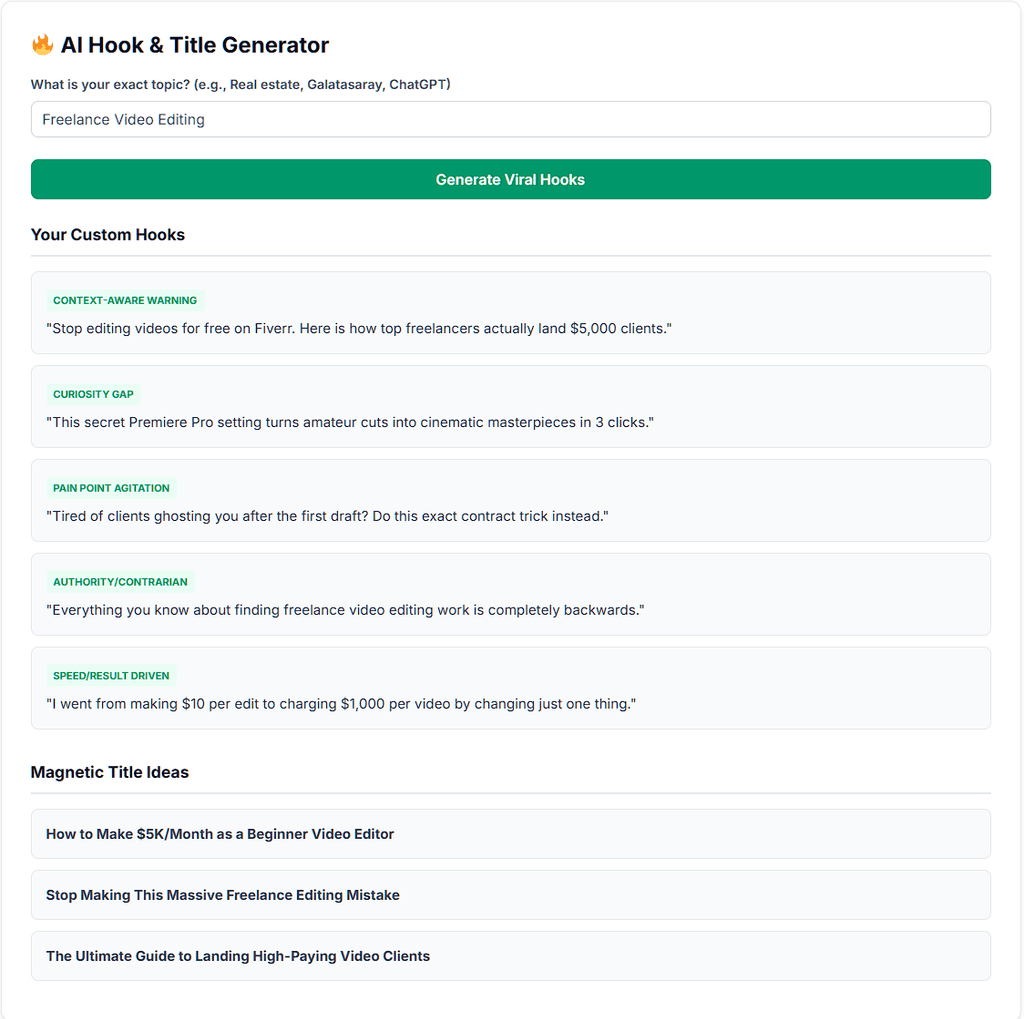
Creating viral hook variations that land across different niches and audiences is the hardest part of the scriptwriting process—and where most creators waste the most time through trial and error. Generate 5 viral hook variations instantly using the ZeroSkillAI Free Hook Generator by inputting your topic, target audience, and content format. It outputs multiple options across different psychological frameworks so you test with intent rather than hope.
Strong hooks do one of three things: make a provocative claim that demands verification, promise a specific and immediate payoff, or create a pattern interrupt that generates cognitive dissonance. Weak hooks explain context, introduce the creator, or describe what the video contains. The viewer didn’t ask for a summary. They need a reason to stay.
Part 2: The Value or Story (Seconds 4-50)
Deliver exactly what the hook promised—immediately. No preamble, no context-setting, no “before we jump in.” Pacing rule: one new idea every 4-6 seconds. If a single point requires 15 seconds to explain, it’s either too complex for short-form or needs compression.
Use numbered progression (Step 1, Step 2, Step 3) for instructional content or narrative arc (problem, tension, resolution) for story-driven formats. What never works is meandering—building context nobody asked for or explaining reasoning before making the point.
Part 3: The Loop or CTA (Last 5 Seconds)
The final 5 seconds determine rewatch rate and watch-time percentage—two heavily weighted algorithm signals. End with a loop (a callback to the opening that rewards rewatching) or a pattern interrupt CTA that earns the follow. Never end with “like and subscribe.” It signals content completion and actively encourages the viewer to close the app.
The 7 Proven ChatGPT Prompts for YouTube Shorts
These are the same frameworks that professional short-form content writers use when producing scripts for multiple clients at scale. Copy the prompt, fill the placeholders, and use the output as a first draft requiring light editing rather than a finished script requiring nothing.
Prompt 1: The “Controversial Truth” Framework
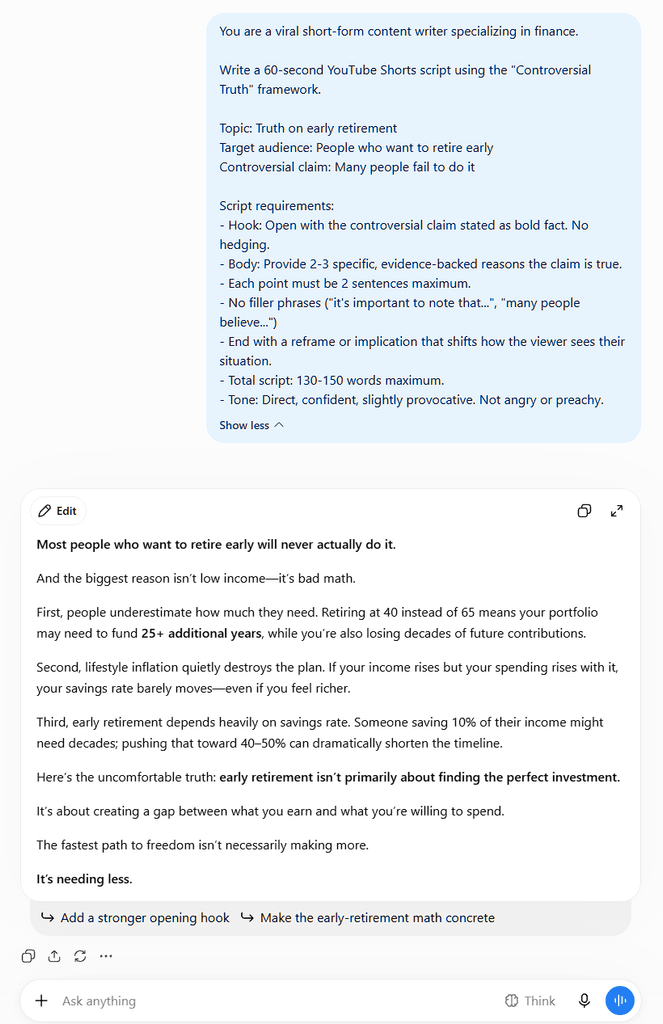
Best for: Opinion content, industry commentary, niche expertise positioning.
The psychology: Disagreement is inherently engaging. Challenge something your audience believes and they stay to hear your justification—even when they initially reject the premise.
You are a viral short-form content writer specializing in [NICHE/INDUSTRY].

Write a 60-second YouTube Shorts script using the "Controversial Truth" framework.

Topic: [YOUR TOPIC]
Target audience: [SPECIFIC AUDIENCE - e.g., "beginner freelancers who undercharge"]
Controversial claim: [THE BELIEF YOU ARE CHALLENGING]

Script requirements:
- Hook: Open with the controversial claim stated as bold fact. No hedging.
- Body: Provide 2-3 specific, evidence-backed reasons the claim is true.
- Each point must be 2 sentences maximum.
- No filler phrases ("it's important to note that...", "many people believe...")
- End with a reframe or implication that shifts how the viewer sees their situation.
- Total script: 130-150 words maximum.
- Tone: Direct, confident, slightly provocative. Not angry or preachy.
Example output opening: “Charging hourly is the fastest way to punish yourself for getting better at your job. The moment AI cuts your editing time in half, your income drops 50%—even though your output quality went up. Here’s why every editor making $10K/month switched to retainers…”
Prompt 2: The “Step-by-Step Tutorial” Framework
Best for: How-to content, skill-based niches, tool demonstrations.
The psychology: Numbered progression gives viewers a mental map, making them more likely to stay for the final step rather than exit mid-video.
You are a viral short-form content writer specializing in [NICHE/INDUSTRY].

Write a 60-second YouTube Shorts script using the "Numbered Tutorial" framework.

Topic: [SPECIFIC SKILL OR PROCESS]
Target audience: [AUDIENCE EXPERIENCE LEVEL]
Number of steps: 3 (maximum for 60 seconds)

Script requirements:
- Hook: Open with the end result the viewer will achieve, stated specifically.
  Not "I'll show you how to edit"—instead: "In 60 seconds you can turn a
  1-hour podcast into 12 Shorts without touching a timeline."
- Number each step visibly: "Step 1:", "Step 2:", "Step 3:"
- Each step = one sentence of action + one sentence of outcome.
- Final line: Tease what mastering this process enables. Not a generic CTA.
- Total script: 130-150 words maximum.
- Tone: Fast-paced, encouraging, no jargon without immediate definition.
Example output opening: “Three steps to turn any 60-minute podcast into 15 Shorts before lunch. Step 1: Upload the full recording to Opus Clip—it automatically identifies your highest-engagement moments and generates the cuts. Step 2: Pull those clips into CapCut and apply your branded caption template in 3 clicks…”
Prompt 3: The “Myth Buster” Framework
Best for: Correcting common misconceptions, authority positioning, countering bad advice circulating in your niche.
The psychology: Humans are wired to seek accuracy. Content that promises to correct a belief they might hold keeps them watching to protect themselves from being wrong.
You are a viral short-form content writer specializing in [NICHE/INDUSTRY].

Write a 60-second YouTube Shorts script using the "Myth Buster" framework.

Myth to bust: [COMMON BELIEF YOUR AUDIENCE HOLDS THAT IS WRONG OR MISLEADING]
Target audience: [WHO HOLDS THIS MYTH]
The truth: [WHAT IS ACTUALLY TRUE]

Script requirements:
- Hook: State the myth directly as something the viewer probably believes.
  ("You've probably been told that [MYTH]...")
- Body: Explain exactly why the myth is wrong using one specific data point,
  personal experience, or clear logical argument. Not a vague counterpoint.
- The correction must be actionable: what should they do instead?
- Final line: A consequence statement that makes the truth feel urgent.
- Total script: 130-150 words maximum.
- Tone: Authoritative but not condescending. The viewer was given
  bad information—they aren't stupid for believing it.
Example output opening: “You’ve probably been told you need 10,000 subscribers before monetizing YouTube. That’s not just wrong—it’s actively keeping you broke. YouTube’s Shopping affiliate program opens at 500 subscribers. Brand deals start at 1,000 with strong engagement metrics…”
Prompt 4: The “Story/Case Study” Framework
Best for: Results-driven content, social proof, transformation narratives.
The psychology: Stories trigger neural coupling—the listener’s brain activity mirrors the storyteller’s. Narrative engagement produces significantly higher retention than informational delivery.
You are a viral short-form content writer specializing in [NICHE/INDUSTRY].

Write a 60-second YouTube Shorts script using the "Mini Case Study" framework.

Subject: [REAL OR COMPOSITE EXAMPLE - you, a client, or a public figure]
Starting situation: [SPECIFIC PROBLEM OR CIRCUMSTANCE]
The turning point: [WHAT CHANGED - one action, tool, or decision]
The result: [SPECIFIC, QUANTIFIED OUTCOME]
Target audience: [WHO THIS RESULT IS RELEVANT TO]

Script requirements:
- Hook: Open at the result or the turning point—not the beginning of the story.
  Start in media res: "[NAME/I] was [SPECIFIC SITUATION].
  [TIME PERIOD] later: [SPECIFIC RESULT]."
- Build backward to explain the turning point using only essential details.
- Every sentence must move the story forward. No scene-setting.
- End with a direct takeaway the viewer can apply today.
- Total script: 130-150 words maximum.
- Tone: Conversational, specific. Concrete numbers only—no inflated claims.
Example output opening: “Six months ago Marcus was charging $25 per Short and editing 60 hours a week. Last month: $11,000, 28 hours of work. The only thing that changed was how he priced his services. He stopped selling edits and started selling a content system…”
Prompt 5: The “Listicle/Rapid Fire” Framework
Best for: High-volume information delivery, tool recommendations, quick-tips content.
The psychology: Lists create an implied contract with the viewer. “I promised you 5 things” triggers completion drive—they stay to the end even when individual points don’t land strongly.
You are a viral short-form content writer specializing in [NICHE/INDUSTRY].

Write a 60-second YouTube Shorts script using the "Rapid Fire List" framework.

Topic: [THE LIST TOPIC]
Number of items: [3-5 maximum for 60 seconds]
Target audience: [SPECIFIC AUDIENCE]

Script requirements:
- Hook: Lead with the list promise plus a specific payoff.
  ("5 AI tools that cut my editing time by 80%—number 3 replaces
  Premiere Pro entirely.")
- Each list item: one punchy sentence naming the tool/tip + one sentence
  of specific benefit. No elaboration beyond two sentences per item.
- Vary sentence length across items to create natural rhythm.
- Final item: Save the most surprising or valuable for last.
- Closing line: A consequence of NOT knowing this list. Creates urgency
  to save or share.
- Total script: 140-160 words maximum.
- Tone: Fast, energetic, zero padding between items.
Example output opening: “Five AI tools that cut my video production from 6 hours to 45 minutes. One: Opus Clip—upload any long video and it generates 12 Shorts with captions and reframing automatically. Two: ElevenLabs—clone your voice once and narrate every video without recording a single word…”
Prompt 6: The “Before & After Transformation” Framework
Best for: Personal finance, fitness, business growth, skill development—any results-driven niche.
The psychology: Transformation content activates aspirational identity. Viewers calculate whether the video contains the gap between where they are and where they want to be. If they think it might, they stay.
You are a viral short-form content writer specializing in [NICHE/INDUSTRY].

Write a 60-second YouTube Shorts script using the "Before/After Transformation" framework.

Before state: [SPECIFIC, PAINFUL SITUATION YOUR AUDIENCE RECOGNIZES]
After state: [SPECIFIC, DESIRABLE OUTCOME]
The bridge: [THE MECHANISM, TOOL, OR DECISION THAT CREATED THE CHANGE]
Target audience: [WHO IS CURRENTLY IN THE "BEFORE" STATE]

Script requirements:
- Hook: Describe the "before" state in language so accurate it feels personal.
  ("If you're still [BEFORE STATE], this is exactly why...")
- Transition: Introduce the bridge specifically—not vaguely ("I found a system")
  but concretely ("I started using [SPECIFIC TOOL] to...")
- After: Quantify the transformation with real numbers. Not "I made more money"
  but "I went from $2,400 to $8,000 in 90 days."
- Closing: The one decision that enabled the transition. Make it actionable.
- Total script: 130-150 words maximum.
- Tone: Honest and grounded. No hype language, no superlatives.
Example output opening: “If you’re still manually scrubbing through podcast recordings to find clip-worthy moments, it’s costing you 15 hours a week you’re not getting paid for. Three months ago that was me—editing 8 Shorts daily across 4 clients and burning out by Wednesday…”
Prompt 7: The “Devil’s Advocate” Framework
Best for: Engaging skeptics, nuanced takes, building trust with audiences tired of hype content.
The psychology: Acknowledging the counterargument before the viewer voices it internally builds credibility. When you say “here’s why some people disagree”—and then address it—you eliminate the viewer’s primary reason to disengage.
You are a viral short-form content writer specializing in [NICHE/INDUSTRY].

Write a 60-second YouTube Shorts script using the "Devil's Advocate" framework.

Your position: [THE CLAIM OR APPROACH YOU ARE DEFENDING]
The counterargument: [THE STRONGEST OBJECTION A SKEPTICAL VIEWER WOULD HAVE]
Your rebuttal: [WHY THE COUNTERARGUMENT FAILS OR MISSES THE POINT]
Target audience: [WHO IS MOST LIKELY TO HOLD THE COUNTERARGUMENT]

Script requirements:
- Hook: State your position AND immediately acknowledge the obvious objection.
  ("I know what you're thinking. [COUNTERARGUMENT]—and you're not entirely wrong.
  But here's what that argument misses...")
- Address the counterargument with specificity. Not "it depends" but a concrete
  condition under which your position is correct.
- Rebuttal must include a specific example, number, or scenario.
- Close with a narrow, accurate conclusion—not sweeping victory but a precise
  truth that earns the viewer's respect.
- Total script: 130-150 words maximum.
- Tone: Intellectually honest. Concede partial validity of the counterargument
  before winning the larger point.
Example output opening: “I know what you’re thinking. AI-generated scripts sound robotic and your audience will notice. You’re half right. Lazy chatgpt prompts for youtube shorts produce robotic scripts. But a properly structured prompt with a defined framework, target audience, and pacing constraints produces something your audience cannot distinguish from a human writer…”
Frequently Asked Questions (FAQ)
Do these ChatGPT prompts for YouTube Shorts work for any niche?
Yes. The frameworks focus on human psychology (like the “Controversial Truth” or “Myth Buster” formats) rather than specific topics. Whether you are in fitness, finance, or gaming, these ChatGPT prompts for YouTube Shorts will generate highly engaging scripts when you plug in your specific niche data.
How do I use ChatGPT prompts for YouTube Shorts without sounding like a robot?
The secret is in the constraints. Our prompts explicitly instruct the AI to use short sentences, avoid filler words, and stick to a specific word count. Always review the output and inject your own personal tone or brand voice before recording.
Can I sell these scripts to clients?
Absolutely. A skilled short-form content writer uses these frameworks to generate scripts for multiple clients at scale. You can package this service into a monthly retainer model, combining scriptwriting with video editing and AI voiceovers.
Which version of ChatGPT is best for writing Shorts scripts?
While the free version works, using ChatGPT Plus (GPT-4) or Claude Pro will give you significantly better results. Advanced AI models follow the constraints of these ChatGPT prompts for YouTube Shorts much more accurately, understand nuanced tones, and sound far less robotic than the free versions.
How many scripts should I test to find a viral hit?
Don’t just rely on a single output. A professional **short-form content writer** usually generates one core script and creates 3 to 5 **viral hook variations** for the exact same video. You can test these different hooks on your channel to see which one the YouTube algorithm pushes the most.
How to Scale This Into a Paying Business
Seven frameworks across seven psychological triggers gives a skilled short-form content writer the ability to produce a full week of viral youtube shorts scripts for any niche in under an hour. That’s the individual creator’s advantage.
The real leverage comes when you deploy these chatgpt prompts for youtube shorts across multiple client accounts simultaneously—paired with AI voiceover production and automated repurposing pipelines. One-person agencies using this exact scriptwriting system alongside tools like Opus Clip and ElevenLabs are generating $5,000-15,000 monthly in retainer revenue without a team.
The scripts are Phase 1. The agency is the business. Understanding how to package these skills, price them correctly, acquire clients, and automate the full production pipeline turns a content writing skill into a durable recurring income stream.
Read our complete blueprint on How to Build a One-Person Content Agency Using AI Tools to get the complete operating system—scriptwriting through delivery, client acquisition through retainer pricing—in a single guide.
The chatgpt prompts for youtube shorts in this article produce the raw material. The agency model converts that raw material into predictable monthly revenue. Both start with the same foundation: a prompt that actually works.