
If you are wondering how much you should charge for short-form video editing in 2026, the biggest mistake isn’t charging too little. It’s charging by the hour at all.
Hourly billing made sense in 2019 when editing a 60-second Short took 2-3 hours of manual work. It made no sense the moment Opus Clip started generating 12 platform-ready clips from a 60-minute podcast in under 10 minutes. If you’re still attaching time to your pricing in 2026, you’re systematically penalizing yourself for getting better at your job.
The editors building $5,000-15,000 monthly freelance businesses right now aren’t working more hours than you. They restructured how they charge. This article gives you the exact pricing framework, tier structure, and upsell strategy to match them.
The Problem with Hourly and Per-Video Pricing
Why Hourly Billing Is Self-Sabotage in the AI Era
Here’s the brutal math of hourly billing when AI enters your workflow.
You spend 3 months learning Opus Clip, building CapCut brand templates for each client, and optimizing your video repurposing pipeline until what used to take 3 hours takes 45 minutes. By every measure, you’ve become a better, more valuable editor. Under hourly billing, your reward for that improvement is a 75% revenue cut on the same deliverable.
Under an hourly billing model, a client who pays $150 for 3 hours of editing at $50/hour now pays $37.50 for the same quality output because you got faster. The client captured your efficiency gain. You captured nothing. This is why using hourly rates to charge for short-form video editing is structurally incompatible with AI-augmented workflows—the better your automation gets, the more it punishes you.
Per-video pricing has the same flaw with an additional problem. Every deliverable becomes a negotiation. Clients compare your per-video rate to competitors, request discounts for volume, and treat your service as a commodity purchase rather than a growth partnership. Revenue is unpredictable, planning is impossible, and you’re constantly re-justifying your value instead of delivering it.
The Time Savings That Make Hourly Billing Obsolete
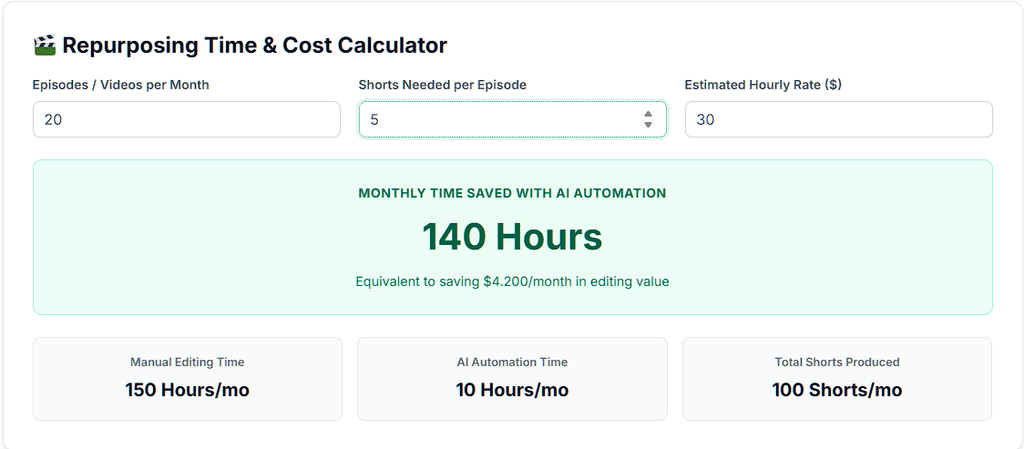
Before you change how you charge for short-form video editing, quantify exactly how much time AI automation has already saved you—or will save you once you implement it properly. Most editors underestimate this number by 60-70% because they’ve never done the explicit calculation across their full client volume.
Calculate your exact time and money saved using the ZeroSkillAI Video Repurposing Time Calculator by inputting your current client count, average monthly video volume, and manual editing time per clip. The calculator outputs your total monthly time investment under manual workflows versus automated pipelines, and translates that gap into dollar-value terms based on your target hourly rate. Run this before your next client proposal—it will permanently change how you think about per-hour and per-video pricing.
The industry benchmark for editors who’ve fully implemented the Opus Clip to CapCut two-stage pipeline: 80% reduction in production time per deliverable. That’s not a marginal efficiency gain. It’s a complete restructuring of what your time is worth, which is why the pricing model has to change alongside the tooling.
The Retainer Model: Pricing by Outcome
What Retainer Pricing Actually Means in Practice
A retainer is a fixed monthly fee in exchange for a defined, predictable scope of delivery. The client knows exactly what they’re getting and when they’re getting it. You know exactly what you’re producing and what it pays. No negotiation on individual deliverables, no invoice anxiety, no re-justifying your rates every 30 days.
When deciding how to charge for short-form video editing, retainers work best because your clients’ content needs are recurring by nature. A creator who needs 12 Shorts per month in October needs 12 Shorts per month in November, December, and March. Billing per video for a predictable, recurring workflow is operationally absurd—for both parties.
The retainer structure also shifts the client relationship in a way that dramatically increases retention and referrals. You stop being a vendor they hire for tasks and become a partner responsible for an outcome. That positioning change alone justifies a 2-3x price premium over per-video rates, because you’re no longer selling editing—you’re selling consistent, managed short-form content growth.
The Mindset Shift That Changes Your Business
The internal reframe that changes how you charge for short-form video editing is simple: you don’t edit videos. You manage your clients’ short-form content presence.
That distinction matters more than it sounds. An editor who edits videos charges for the edit. A manager who oversees short-form content growth charges for the outcome—platform presence, consistent publishing cadence, audience growth signals, and the operational peace of mind that comes from never having to think about content production. The market pricing for those two services is completely different.
Retainer clients on a 3-month minimum commitment also generate the kind of predictable cash flow that lets you invest in better tools, decline low-quality clients, and dedicate time to business development without the feast-or-famine anxiety that per-project billing creates. Predictable revenue is a business asset—one that hourly billing and per-video models structurally cannot provide.
If you’re ready to build the full infrastructure around this pricing model—client onboarding systems, production pipelines, delivery cadences, and growth strategy—[Read our complete guide on How to Build a One-Person Content Agency Using AI Tools] for the complete operating system behind a one-person AI content agency generating $5,000-15,000 in monthly retainer revenue.
3 Standard Pricing Tiers for 2026
Tier 1: Starter Package — $1,500/month
Here is the exact breakdown of what to charge for short-form video editing across three standard agency tiers in 2026.
Deliverables: 32 Shorts per month (8 per week), delivered with captions and platform formatting for 2 channels (TikTok + Instagram Reels or YouTube Shorts).
Production reality: At 45 minutes per clip using the Opus Clip to CapCut pipeline, 32 Shorts represents approximately 24 hours of production time monthly—plus 3-4 hours for client communication, revision rounds, and delivery logistics. Total time commitment: 28 hours.
Software costs: Opus Clip Starter ($15/month) + CapCut Pro ($8/month) + your share of any shared tools = approximately $30-40 attributable monthly cost at this volume.
Your effective margin: $1,500 – $40 (tools) = $1,460 on 28 hours of work. That’s $52/hour—and it increases proportionally as your automation improves without any price adjustment required.
Ideal client: Individual creators, coaches, or consultants building their first serious short-form presence. They have the content (or can produce it) but lack the production infrastructure and consistency.
Tier 2: Growth Package — $3,500/month
Deliverables: 96 Shorts per month (24 per week), delivered across 4 platforms (TikTok, Instagram Reels, YouTube Shorts, LinkedIn), with custom intros/outros, branded caption templates, and a monthly performance summary.
Production reality: 96 clips at 45 minutes each is 72 hours of production time. With client management, reporting, and delivery logistics, total monthly commitment runs 80-85 hours.
Software costs: Opus Clip Pro ($29/month) + CapCut Pro ($8/month) + scheduling tool like Buffer or Publer ($15/month) = approximately $55-65 attributable monthly cost.
Your effective margin: $3,500 – $65 (tools) = $3,435 on 80 hours. That’s $43/hour at current automation speeds—but this tier is where a second client producing identical volume generates nearly pure margin since your systems, templates, and workflow are already built.
Ideal client: Established creators scaling their distribution, businesses needing video repurposing for their existing content library, or podcasters publishing weekly who need consistent multi-platform presence without building an in-house team.
Tier 3: Full-Stack Package — $7,500/month
Deliverables: Complete short-form content operation—scripts, AI voiceover production, repurposing pipeline, multi-platform publishing, monthly content strategy review, and performance optimization. Volume is client-specific but typically 40-60 Shorts monthly at higher production quality per clip.
Production reality: This tier includes scriptwriting (3-4 hours/week), audio production (2-3 hours/week), video editing (15-20 hours/week), strategy and reporting (3-4 hours/week). Total monthly commitment: 90-110 hours.
Software costs: Full AI stack (Claude Pro + ElevenLabs Professional + Opus Clip Pro + CapCut Pro + scheduling + analytics) = approximately $200-250 attributable monthly cost.
Your effective margin: $7,500 – $250 (tools) = $7,250 on 100 hours. That’s $72/hour—and at this tier, you’re delivering a complete turnkey content operation that would cost clients $15,000-20,000 monthly to staff internally.
Ideal client: Business owners, executives, and established brands who want complete content production without any internal involvement. This client isn’t comparing your rate to a freelancer’s—they’re comparing it to a full-time hire plus benefits.
How to Upsell AI Voice Cloning for an Extra $500-1,000/Month
The Upsell That Most Editors Leave on the Table
Every client on a Starter or Growth package is a candidate for AI voiceover services—and most of them are already spending money solving this problem poorly. They’re recording voiceovers themselves (time-consuming and inconsistent), hiring a freelance narrator (expensive and slow), or posting content without narration (leaving performance on the table).
Your upsell positions AI voice cloning as the solution that costs them less than their current approach while producing more consistent output. The value proposition is obvious; the execution is where most editors get stuck.
ElevenLabs Professional tier allows you to clone a client’s voice from a 30-minute audio sample and generate unlimited narration in that voice at scale. The client’s audience hears their familiar voice on every piece of content—even content that didn’t require them to record anything. For creators who lack the time or confidence to record consistent voiceover, this is genuinely transformational.
Pricing the Voiceover Upsell Correctly
The upsell price needs to account for your ElevenLabs API costs, the time required for AI voice cloning setup and quality review, and your margin target. Getting this math wrong—quoting a flat $500 add-on without knowing your API costs for that client’s volume—is how agencies accidentally make voiceover services unprofitable.
Estimate your API margins with the ZeroSkillAI Voiceover Cost Calculator before quoting any client on voiceover services. Input the client’s monthly script volume, average word count per script, and your ElevenLabs tier to get the exact monthly API cost for that client’s audio production. Build your upsell price on top of that verified cost basis—not on a guess.
Typical voiceover upsell pricing at the Starter Package tier: $400-600/month additional for AI voiceover on all 32 Shorts. At the Growth Package tier: $800-1,200/month for 96 clips with AI voice cloning. The API costs for these volumes typically run $40-120/month depending on script length, leaving strong margins at both price points.
Introduce the voiceover upsell at month 2 or 3 of a client relationship, not during initial onboarding. Wait until they’ve seen the quality of your editing work and established trust in your delivery consistency. A well-timed upsell to a satisfied retainer client closes at 60-70% versus 15-20% from cold outreach.
Frequently Asked Questions (FAQ)
How do I transition my current hourly clients to a retainer model?
Don’t force the change mid-project. Wait for their next invoice or the end of the month. Send a professional update stating that to guarantee their monthly capacity and provide a more consistent growth strategy, you are moving entirely to retainer packages. Offer them your Starter Package as a natural next step.
What if a client only wants 2-3 videos instead of a full monthly package?
As a one-person agency, your goal is predictable revenue. One-off projects disrupt your automated workflow. You can either decline the project to focus on retainer clients, or charge a high premium “single-project rate” (e.g., $150+ per video) to make the context-switching worth your time.
How much should I charge for short-form video editing if I have no portfolio?
Even as a complete beginner, you should avoid hourly billing. Instead of lowering your rates indefinitely, offer a “Beta Starter Package” at a 50% discount (e.g., $750/month) to your first two clients in exchange for detailed testimonials and case studies. Once you have that proof, immediately raise your rates to the standard $1,500/month.
Who pays for the AI software subscriptions—me or the client?
You do. Tools like Opus Clip, CapCut Pro, and ElevenLabs are your agency’s infrastructure, just like your laptop or internet connection. You bake these operational costs into your monthly retainer packages, which is why calculating your software and API margins is so critical.
Raise Your Prices. Switch to Retainers. Do It Before Next Month.
Every week you spend billing hourly or per-video is a week your AI-augmented workflow is working against you financially.
The pricing tiers above aren’t aspirational numbers. They represent the exact market rates you should charge for short-form video editing today. They’re the market rates that editors with working AI pipelines, packaged services, and retainer-based billing are charging and closing today. The clients exist, the willingness to pay exists, and the AI tools to justify the value exist.
What’s missing for most editors is the pricing structure and the confidence to present it.
Start with Tier 1. Pick one current client, shift them to retainer pricing at $1,500/month, and deliver the 32-Short commitment for 60 days. The operational experience of running a retainer relationship—predictable production rhythm, clean delivery schedule, monthly renewal conversation—changes how you run every client engagement afterward.
The shift from freelancer to agency owner isn’t about headcount. It’s about how you charge for short-form video editing and position what you’re already building. The tools are in place. The market is ready. The only variable is whether you adjust your pricing model before your competitors do.