
Writing individual blog posts reviewing one product at a time is a dead business model in 2026—the new architecture is building a massive, database-driven automated affiliate hub that uses programmatic SEO to automatically generate thousands of product comparison pages and drip-feed them onto your site safely over time, capturing long-tail search traffic and generating affiliate commissions from Amazon and specialized retailers completely on autopilot. This guide provides the exact blueprint for transitioning from manual content creation into a systematic, AI-powered machine for generating physical product reviews at scale that compounds in value every month without requiring you to write a single page manually.
The Pivot: Why Digital Isn’t the Only Path
Digital products are an excellent starting point—zero inventory, zero fulfillment, high margin, instant delivery. But the digital product market has one significant limitation: it serves creators. Physical product affiliate marketing serves everyone else—the 95% of online shoppers who buy kitchen appliances, fitness equipment, gaming hardware, coffee gear, outdoor tools, and thousands of other categories through search-driven purchase research.
The affiliate commission economics are compelling. Amazon Associates pays 3-8% on physical products, while specialized retailers like B&H Photo, REI, or Musician’s Friend frequently offer 5-12% on high-ticket items. A single page ranking for “ASUS ROG Ally vs Steam Deck OLED battery life” can generate $200-400 monthly in passive affiliate clicks from buyers who’ve already decided to purchase and just need final comparison information.
The problem traditional bloggers face is scale—writing one comparison article takes 4-6 hours, meaning a 1,000-page site requires years of manual effort. Building an automated affiliate hub solves this by replacing manual writing with database-driven AI generation, compressing thousands of hours of content creation into a single structured workflow that deploys safely and compounds indefinitely.
The Core Engine: How the System Works
Programmatic SEO sounds technical but the core concept is elegantly simple: combine a spreadsheet of structured data with an AI-generated content template to produce hundreds or thousands of unique, targeted pages that publish on a safe, automated daily schedule rather than all at once.
Traditional blogging: one idea → research → write → publish → repeat 1,000 times.
Zero-Skill pSEO: build database once → apply template once → automate a safe, daily publishing schedule that compounds over time.
The mechanical components are: a data source (your spreadsheet of products and specifications), a content template (a structured AI prompt that transforms one row of data into one complete page), a content management system (WordPress, Webflow, or Ghost), and an import tool (WP All Import for WordPress, or direct API publishing) that maps your generated content into the CMS and drip-publishes it at a controlled, algorithm-safe velocity.
Every page in a programmatic SEO site follows the same structural template while containing genuinely unique content because each page draws from different product data. A “Best [Category] Under $[Price Point] for [Use Case]” page targeting 50 price points across 20 use cases generates 1,000 unique pages in your content pipeline automatically. Each page is legitimately different—different products, different specifications, different recommendations—because the underlying data differs even when the template structure is identical. Those pages then publish at 3-5 per day, building your automated affiliate hub into a growing, trusted authority in Google’s eyes rather than a suspicious overnight explosion of content.
Niche Selection: Data-Rich Physical Passions
Zero-Skill pSEO only generates profitable results in niches where products have highly specific, measurable, comparable technical specifications that can be structured into spreadsheet columns. The more granular and quantifiable the product differences, the more search queries exist around those specific comparisons, and the more pages your automated affiliate hub can target.
Example 1: Handheld Gaming Consoles
The handheld gaming market exploded after Steam Deck’s success and now features dozens of competing devices with granular specification differences that buyers research obsessively. Compare: display refresh rates (60Hz vs 120Hz vs 144Hz), APU thermal design power (15W vs 25W vs 45W), battery capacity (40Wh vs 50Wh vs 67Wh), weight, active cooling type, storage expandability, and operating system compatibility. Comparison queries like “ASUS ROG Ally vs Steam Deck OLED battery life,” “Lenovo Legion Go vs ROG Ally refresh rate,” and “best handheld gaming console under $500 for AAA games” generate thousands of monthly searches from buyers with high purchase intent and strong affiliate conversion rates.
Example 2: Specialized Coffee Gear
The home coffee market ranges from $30 Bialetti Moka Express pots to $3,000 prosumer espresso machines, with obsessive buyers researching extraction pressures (6-bar vs 9-bar vs 15-bar), boiler types (thermoblock vs single boiler vs dual boiler vs heat exchange), grind compatibility (fine espresso vs medium vs coarse), temperature stability metrics, and steam wand capability. The audience skews toward higher household income, spends more time researching before purchasing, and converts at premium affiliate rates because the products are expensive and the purchase decision is considered rather than impulsive.
Example 3: Home Hypertrophy Equipment
Resistance training equipment has become a data-rich comparison category as buyers demand specific technical specifications rather than vague marketing claims. Compare resistance bands by tension load at specific stretch lengths (5 lbs at 12″ vs 8 lbs at 12″), foam rollers by density (low density 1.5 lb/ft³ vs high density 3 lb/ft³) and surface texture, adjustable dumbbells by weight increment (2.5 lb steps vs 5 lb steps), and weight capacity. Parents buying home gym equipment for teenage athletes, physical therapy patients recovering from injuries, and apartment dwellers optimizing for space all search for extremely specific product comparison queries that an automated affiliate hub built on this data captures efficiently.
The Database: Building the Excel Brain
The spreadsheet is the actual product you’re building—not the website, not the content, not the domain. Every other component of your automated affiliate hub is generated from this structured database, which means the quality, depth, and accuracy of your spreadsheet determines the quality, depth, and accuracy of every page your site eventually publishes.
Building your product database:
Start with your target niche and identify 30-100 products to compare. For each product, create columns capturing:
- Product Name (exact model name as sold on Amazon/retailer)
- Brand
- Price Range (entry-level / mid-range / premium)
- ASIN or product URL (for affiliate link generation)
- Key Specification 1 (niche-specific: battery life, extraction pressure, tension load, refresh rate)
- Key Specification 2
- Key Specification 3
- Key Specification 4
- Key Specification 5
- Best For (specific use case: beginners, professionals, portability, performance)
- Primary Pro
- Secondary Pro
- Primary Con
- Secondary Con
- Overall Rating (your assessment: 3.5-5.0)
- Star Rating Context (why this rating vs. category average)
- Verdict (2-3 sentence recommendation summary)
The Zero-Skill pSEO approach to data collection uses three methods: scraping Amazon or manufacturer specification pages using Python scripts, extracting data from existing comparison sites using structured prompts in ChatGPT, or manually compiling information from manufacturer datasheets (most accurate but most time-intensive). A hybrid approach—scrape basic data automatically, then manually verify and enrich specifications—takes 8-15 hours for a 50-product database and produces the quality necessary to generate trustworthy physical product reviews. The spreadsheet is the true core of any programmatic SEO strategy because everything downstream—the AI content, the page templates, the publishing queue—derives directly from its structure and accuracy.
Once your database reaches 50+ products, you have sufficient data to generate 500-2,000 comparison and “best of” pages depending on how many different comparison angles you template. Those pages feed directly into your daily publishing queue, deploying automatically while you work on other projects.
The AI Content Factory: Turning Rows into Reviews
With your database complete, you’re ready to transform raw data rows into complete, engaging physical product reviews using AI batch processing. The key is building a content template that produces genuinely helpful, human-sounding output rather than mechanical data regurgitation that neither users nor Google trust.
The master content generation prompt:
You are a specialist product reviewer with deep expertise in [NICHE].
Using the following product data, write a 400-600 word product review section for the [PRODUCT NAME].

DATA: [paste single row from spreadsheet]

STRUCTURE:
1. Opening paragraph: Who this product is ideal for and its primary value proposition (2-3 sentences)
2. Key Strengths: Expand on the primary and secondary pros with specific, user-benefit-focused language
3. Practical Limitations: Expand on the cons with honest, helpful context for buyers
4. Ideal Buyer Profile: One paragraph describing exactly who should and shouldn't buy this product
5. Verdict: Your recommendation (use the verdict column as a starting point but expand naturally)

TONE: Expert but accessible. Honest, specific, and never vague. Write as if recommending to a friend who trusts your opinion.
FORBIDDEN: Never use the phrases "game-changer," "at the end of the day," "in conclusion," or "in today's market."
Feed this prompt through ChatGPT’s Advanced Data Analysis with your full spreadsheet, and the AI generates complete review content for every row sequentially. For large databases (200+ products), use OpenAI’s batch API—which processes requests asynchronously at 50% lower cost than real-time API calls—to generate content for every product overnight.
Output each generated review to a corresponding column in your spreadsheet (“Generated Review Content”), then use this combined data for page-level template assembly. Each page template includes: the AI-generated review content, automatically inserted specification tables from your data columns, affiliate links built from ASIN numbers, comparison module code pulling related products from the same spreadsheet, and structured data markup (JSON-LD for review schema) that enhances SERP appearance.
This AI content factory transforms your Zero-Skill pSEO database from a spreadsheet into a complete pipeline of physical product reviews ready to deploy—not all at once, but steadily and sustainably through your daily drip schedule.
The Deployment: The “Daily Drip” Automation Strategy
Here’s the mistake that kills otherwise well-built programmatic SEO sites before they ever rank: dumping 1,000 AI-generated pages onto a domain in a single afternoon.
Google’s spam detection systems in 2026 are sophisticated enough to identify unnatural publishing velocity as a primary spam signal. A domain that published zero content yesterday and suddenly indexes 1,000 pages today doesn’t look like a legitimate editorial operation—it looks like a content farm, because that’s exactly what content farms do. The algorithmic response is swift: the site gets sandboxed, indexation stalls, and months of database-building work produces zero organic traffic while you wait for Google’s trust to recover. Some sandboxed sites never fully recover.
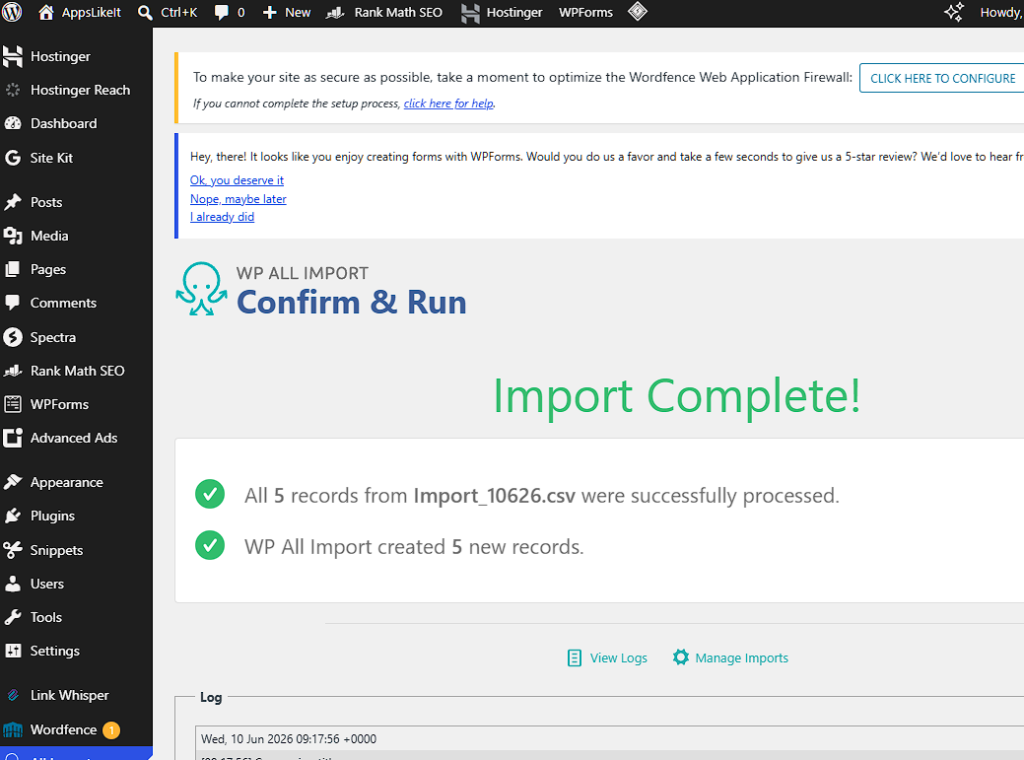
The professional Zero-Skill pSEO approach uses the same WP All Import infrastructure but executes through disciplined micro-batching rather than bulk deployment.
How to execute the Daily Drip method:
WP All Import allows you to import specific row ranges from your CSV rather than processing the entire file simultaneously. Instead of importing rows 1-1,000 in a single run, you import rows 1-5 on Monday, rows 6-10 on Tuesday, rows 11-15 on Wednesday, and so on. This creates a publishing cadence that looks, to Google’s crawlers, indistinguishable from a human editor publishing 3-5 carefully written reviews each day.
The practical workflow:
- Complete your full database and generate all AI content as described in the previous section—the full 1,000-row CSV with complete generated review content for every product
- Install WP All Import and configure your full template mapping once (this setup happens once and never needs to change)
- Create a recurring calendar reminder or automation trigger (a simple Make.com scenario works perfectly) to run a partial import of 3-5 rows daily
- Each daily import pulls the next sequential batch from your CSV, publishes those pages, and stops—mimicking organic editorial publishing velocity precisely
- Submit your XML sitemap to Google Search Console once during initial setup; it updates automatically as new pages publish
The micro-batch size matters less than consistency. Three pages daily on a strict schedule signals a reliably active site. Five pages daily signals a productive small team. Either is safe. Fifty pages daily starts attracting algorithmic scrutiny. One thousand pages in a single session is a spam flag.
The compounding math that makes this strategy powerful:
Five pages published daily equals 150 targeted physical product reviews monthly. Over six months, that’s 900 indexed comparison pages capturing long-tail search traffic across hundreds of specific buyer queries. By month twelve, you have 1,800 pages of programmatic SEO content—a topically authoritative automated affiliate hub that Google’s systems have been watching grow steadily and organically for an entire year, which is precisely the trust signal that unlocks competitive ranking positions.
The psychological shift required here: stop thinking about deployment as a one-time event and start treating it as a passive background process. Your database is already built. Your templates are already configured. The Daily Drip runs automatically while you work on other projects, link-building, or the next database. The site builds itself at a pace Google respects.
Sites like AppsLikeIt demonstrate this sustainable approach in practice—an automated affiliate hub running the Daily Drip method builds authority incrementally across its product comparison library without triggering penalties, allowing each newly published page to benefit from the growing domain trust that careful, consistent publishing accumulates over time.
What to do while the drip runs:
The 6-12 month indexation window isn’t dead time. Use it to build topical authority signals that accelerate ranking for pages as they publish: acquire 3-5 backlinks monthly from relevant niche publications or resource pages, internally link newly published pages to existing ones using a simple internal linking template, and build out your highest-priority comparison pages first so they accumulate ranking time while lower-priority pages are still queued.
The Daily Drip transforms the Zero-Skill pSEO deployment from a risky bulk operation into a compounding, self-building asset that Google treats with increasing respect the longer it runs. Patience at deployment is what separates sandboxed failures from sites generating consistent affiliate commissions twelve months later.
Frequently Asked Questions (FAQ)
What is programmatic SEO (pSEO) for affiliate marketing?
Programmatic SEO is the process of using a structured database (like an Excel spreadsheet) combined with an AI template to generate and publish hundreds or thousands of physical product reviews and comparison pages simultaneously, rather than writing them one by one.
Do I need to know how to code to build an automated affiliate hub?
No. The Zero-Skill pSEO approach relies on simple spreadsheet logic, ChatGPT’s Advanced Data Analysis for content generation, and drag-and-drop WordPress plugins like WP All Import to deploy the pages. No Python or PHP knowledge is strictly required to launch.
How long does it take for an automated affiliate hub to rank?
For a brand-new domain, Google typically takes 2 to 6 weeks to crawl and index a large batch of programmatic pages. However, because you are targeting highly specific, low-competition long-tail keywords (like specific product comparisons), these pages often rank faster than broad, traditional blog posts.
The Verdict: The Ultimate Passive Asset
Building the database, designing templates, and configuring your Daily Drip publishing pipeline requires 40-80 hours of focused work. That’s the full investment. After setup, your automated affiliate hub captures organic search traffic 24 hours daily, 365 days annually, from buyers actively researching purchase decisions—growing by 3-5 new targeted pages every single day without any additional effort from you.
The compounding mechanics are extraordinary. Programmatic SEO sites gain domain authority as individual pages accumulate backlinks and user engagement signals, which benefits all other pages on the same domain. A physical product reviews site that ranks 50 pages in year one often finds 300+ pages ranking in year two without publishing additional content—the domain authority lift from early success accelerates ranking for the remaining pipeline, and the Daily Drip keeps feeding new pages into that rising authority environment automatically.
This is the evolution of the Zero-Skill pSEO income model from active effort to passive infrastructure. Digital product stores require constant new product creation to maintain momentum. A programmatic SEO affiliate site, configured once and drip-fed daily, generates affiliate commissions from traffic it earned months or years ago while you focus on expanding the database or building the next system entirely.
The Daily Drip isn’t a compromise on ambition—it’s the strategy that actually works. Publishing 5 pages daily builds more sustainable organic authority than dumping 1,000 pages instantly, because Google rewards velocity that looks human and punishes velocity that looks automated. The apparent paradox of this approach is that moving slower at deployment makes everything scale faster in the long run.
Build the database once. Configure the drip once. Collect commissions indefinitely. That’s the automated affiliate hub model. Start your spreadsheet today.
Pingback: Automated Newsletter Empire: 5 Proven Steps to Build a Profitable Media Business -
Underrated cost in this pipeline: token burn from AI generation. Each page consumes thousands of tokens. We track prompt efficiency closely in our own automated content workflows to keep API bills predictable.