
You’ve heard the horror stories: a blogger’s traffic tanks overnight after Google flags their content, or a freelancer loses a client because their “human-written” article scored 94% AI on a detection tool. That fear is exactly why AI humanizer tools have exploded in popularity. Simply put, an AI humanizer is software that rewrites AI-generated text to sound more natural, varied, and human — specifically designed to lower or eliminate detection scores from tools like Turnitin, GPTZero, and Originality.ai.
But do they actually work, or are you paying $20 a month for false confidence? Let’s break down exactly how these tools function, test one in real time, and find out which ones are actually worth your money.
What Exactly is an AI Humanizer?
At the technical level, an AI humanizer doesn’t “trick” a detector in some clever hacker sense. It restructures your text’s statistical fingerprint — the measurable patterns that make writing feel machine-generated in the first place.
Two concepts explain almost everything here, and neither requires a computer science degree to understand.
Perplexity measures how predictable your word choices are. AI models tend to pick the statistically “safest” next word every time, which creates suspiciously smooth, low-surprise sentences. Humans, by contrast, make weirder, more unexpected word choices constantly — that unpredictability is high perplexity.
Burstiness measures sentence rhythm. Human writers naturally mix short punchy sentences with long, winding ones. AI text tends to produce sentences of nearly identical length and structure, one after another, creating a flat, metronomic rhythm that detectors are specifically trained to catch.
When testing which ai humanizer is best, remember that a genuine ai humanizer works by deliberately injecting higher perplexity (less predictable phrasing) and more burstiness (varied sentence length) back into the text — mimicking the natural inconsistency of human writing.
The Anatomy of AI Writing: Dead Giveaways
Before you even run text through a tool, you can often spot AI writing with the naked eye. Here’s what gives it away every time:
- The vocabulary tics: words like “delve,” “testament,” “tapestry,” “boast,” and “realm” appear at a rate wildly disproportionate to normal human writing
- Rigid three-part rhythm: sentences that build in an almost sing-song “not only X, but also Y” pattern
- Zero emotional friction: no hedging, no contradictions, no admission of uncertainty — just smooth, confident, faintly robotic authority
- Overuse of transitional phrases: “Moreover,” “Furthermore,” and “In today’s fast-paced world” showing up like clockwork
- Suspiciously balanced paragraphs: every point gets exactly three supporting details, every single time
A Real Test: Before vs. After Humanizing
Here’s a typical paragraph straight out of ChatGPT with no editing:
“In today’s fast-paced digital landscape, content creators must delve into the realm of search engine optimization to boast a competitive edge. Moreover, it is important to note that quality content serves as a testament to a brand’s credibility. Furthermore, this approach not only enhances visibility but also fosters long-term audience trust.”
Now here’s a humanized version, with structural changes highlighted:
“Most creators still treat SEO like an afterthought — and it shows. Good content isn’t just a ranking trick. It’s proof you actually know what you’re talking about, and readers can tell the difference within a sentence or two.”
What actually changed structurally:
- Sentence length varied dramatically — from a 9-word punchy opener to a longer, more conversational second sentence
- Banned vocabulary removed entirely — no “delve,” “realm,” “boast,” “testament,” or “moreover”
- An opinion was inserted (“still treat SEO like an afterthought”) — something a pure information-generator rarely does unprompted
- A conversational aside was added — “and it shows” — which introduces exactly the kind of emotional friction and informality that raises perplexity
Do AI Humanizers Actually Bypass AI Detection?
The honest answer: it depends entirely on the tool and the detector, and the gap between marketing claims and independent test results is often significant.
This is a genuine arms race. Every time a humanizer tool finds a pattern that fools GPTZero or Originality.ai, those detection companies update their models to catch it — then humanizer companies adjust again. Nothing in this space is permanent, and a tool that beats a detector this month may fail against an updated version next month.
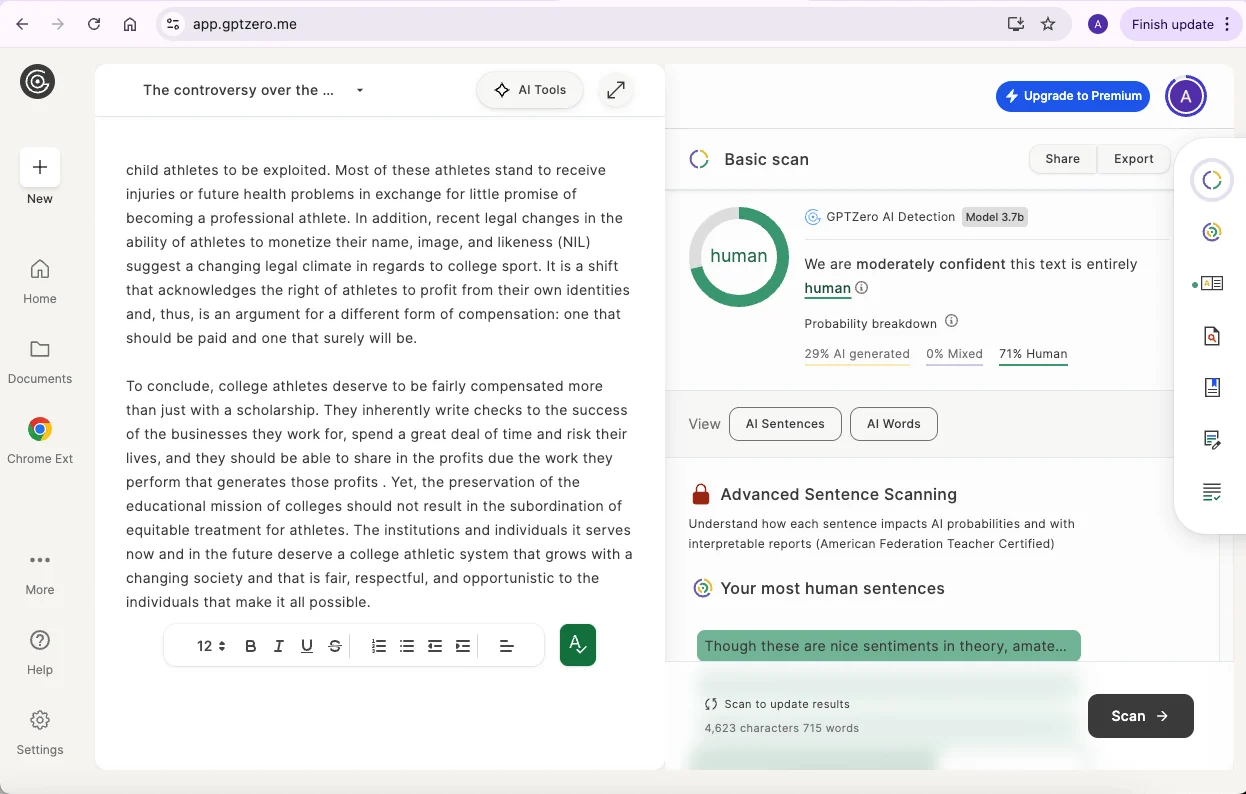
Independent 2026 testing makes this concrete. Turnitin’s late-2025 update specifically targeted humanizer output patterns, and bypass rates across the board dropped noticeably afterward. Some tools now pass GPTZero reliably while failing Originality.ai, and vice versa — there is no single tool that beats every detector every time.
Google’s Real Stance on AI Content
Here’s the part most humanizer marketing pages conveniently leave out: Google has never said it penalizes AI-written content specifically.
Google’s official Search guidance is explicit — it rewards helpful, experience-driven, people-first content regardless of how it was produced, and it penalizes low-value, mass-produced content designed to manipulate rankings, regardless of whether a human or an AI typed it.
In other words, running bad, generic content through a humanizer doesn’t fix the actual problem. If your content lacks original insight, real experience, or genuine usefulness, no amount of sentence-rhythm variation will save it from Google’s spam systems. The humanizer treats a symptom; it doesn’t create E-E-A-T (Experience, Expertise, Authoritativeness, Trustworthiness) that wasn’t there to begin with.
The 3 Best AI Humanizer Tools to Try Today
| AI Humanizer Tool | Best For | Bypass Rate | Starting Price | ZeroSkillAI Verdict |
| Undetectable AI | High accuracy & preserving meaning | 82–87% (vs GPTZero) | $9.99 / mo | 🏆 Top Pick: Best balance of bypass reliability and natural readability. |
| HIX Bypass | Academic writing & Turnitin workflows | 49–80% (Variable) | $14.99 / mo | ⚖️ Alternative: Usable for specific detectors, but inconsistent overall. |
| StealthWriter | Manual sentence-by-sentence rewrites | Low (High flag rates) | $20.00 / mo | ❌ Skip: Expensive with poor bypass rates in recent independent testing. |
1. Undetectable AI
Strengths: Currently the strongest all-around performer in independent testing, with 82–87% bypass rates against GPTZero specifically — the highest of any tool tested. It processes large batches fast (a 10,000-word document in under four minutes) and preserves meaning noticeably better than competitors, scoring 8.4/10 on meaning preservation versus lower scores elsewhere.
Limitation: Performance drops meaningfully against Turnitin and Originality.ai (54–67% bypass range), and GPTZero’s most advanced scan mode can still flag its paraphrased patterns in some cases.
Pricing reality: Starts at $9.99/month for 10,000 words (or $5/month billed annually), scaling to $42/month for 50,000 words. A genuinely free tier exists with no signup required, plus a 3-day trial with 250 credits.
2. StealthWriter
Strengths: The interface lets you click individual sentences to see alternate rewrites, giving you more manual control than most competitors — useful if you want to fine-tune rather than accept a full auto-rewrite.
Limitation: This is where honesty matters more than hype. Independent 2026 testing found GPTZero detected StealthWriter’s output as AI-generated 100% of the time in controlled trials, and Originality.ai flagged rewritten text at 28% AI — well above typical institutional flagging thresholds. It also sits at a 3.7/5 Trustpilot rating, with recurring billing and cancellation complaints.
Pricing reality: Free tier offers 10 daily humanizations at a 1,000-word limit. Paid Starter tier is $20/month for 50 daily humanizations and a 5,000-word limit.
3. HIX Bypass
Strengths: Built specifically around Turnitin workflows, making it a common choice among students and academic writers specifically targeting that detector.
Limitation: Bypass rates swing widely depending on the detector used (49–80%), and user ratings are modest at 2.4/5 across available reviews — consistency is not this tool’s strongest asset.
Pricing reality: $14.99/month standard, or $9.99/month if billed annually.
How to Turn ChatGPT to Human Text (Without Paying for Tools)
You don’t always need a paid ai humanizer subscription to fix these problems. Better prompting acts as a free ai humanizer, handling a large percentage of the issue.
- Ask for a specific, narrow tone: instead of “write about X,” try “write like you’re explaining this to a friend over coffee, with some genuine opinions mixed in”
- Demand sentence variation explicitly: add “vary sentence length dramatically — mix short punchy sentences with longer explanatory ones”
- Insert a real anecdote or specific detail: AI can’t fabricate genuine personal experience convincingly, so add your own specific detail and ask it to build around that fact
- Ban the obvious words directly in your prompt: “never use delve, tapestry, testament, boast, or moreover”
- Ask it to include one hedge or contradiction: genuine human writing admits uncertainty; prompt for “one point where you push back on the conventional wisdom”
This won’t guarantee a 0% detection score, but it meaningfully improves both the reading experience and your odds against most detectors — for free.
Frequently Asked Questions
Is using an AI humanizer cheating?
It depends entirely on context. If you’re a blogger or marketer using AI to draft content that you then edit, fact-check, and personalize before publishing, running it through a humanizer for tone is a content workflow choice, not fraud. If you’re a student submitting AI-generated work as your own original academic effort, that’s a different situation entirely — it violates academic integrity policies regardless of whether a detector catches it, because the deception is about authorship, not detectability.
Will Google penalize AI content?
Not specifically for being AI-generated. Google penalizes low-value, spam-like content produced at scale to manipulate rankings — a category that includes plenty of human-written content too. Focus on genuine usefulness and real expertise; that matters more than your text’s origin.
Can AI detectors give false positives on genuine human writing?
Yes, and this happens more often than detector companies like to admit. Non-native English speakers, writers with very formal or repetitive personal styles, and technical writers producing structured content are all flagged at higher-than-average rates. No AI detector is reliable enough to be used as the sole basis for serious academic or professional consequences.
What is the single best prompt to humanize text directly inside ChatGPT?
Try this: “Rewrite this with dramatically varied sentence length, remove all AI-cliché vocabulary like delve/tapestry/testament/moreover, add one specific concrete detail or mild opinion, and let at least one sentence sound slightly informal or conversational.” This single prompt addresses perplexity, burstiness, and vocabulary red flags simultaneously.
Do these tools work in languages other than English?
Most major humanizers, including Undetectable AI, support multiple languages, but performance is measurably weaker outside English. Detection tools themselves are also less mature for non-English text, which cuts both ways — lower detection accuracy sometimes means lower humanizer effectiveness too, since there’s less established statistical pattern to disrupt in the first place.
The Verdict
For most regular creators and bloggers, a dedicated AI humanizer is worth it only if you’re already producing genuinely valuable content and just want it to read more naturally — not as a substitute for actual expertise or original insight. Undetectable AI is the clear performance leader right now based on independent testing, while StealthWriter’s documented detection failures make it hard to recommend despite its lower entry price. Before paying for any of them, try the free prompting fixes first — for a huge share of creators, better prompts solve 80% of the problem without a subscription at all.