
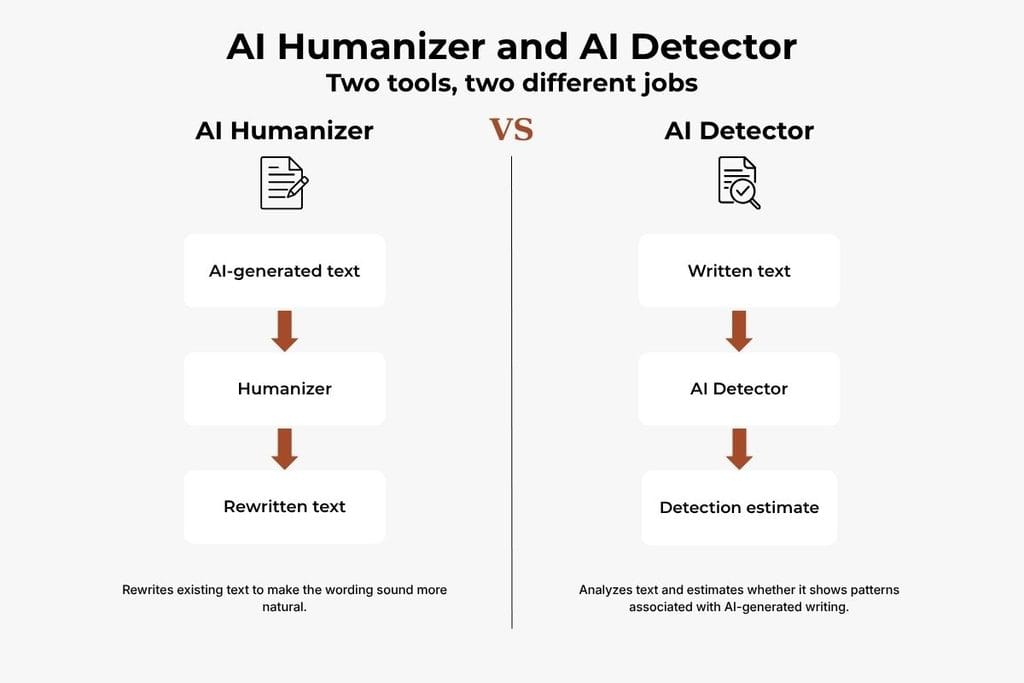
AI humanizer vs AI detector — these two tools may appear in the same conversations about AI-assisted writing, but they perform very different jobs. A humanizer rewrites text to make it sound more natural, while a detector analyzes text and estimates whether it shows patterns associated with AI-generated writing.
People often confuse the two because they appear in the same discussions about AI-assisted writing. But they serve very different purposes.
This guide explains what AI humanizers and AI detectors actually do, how their approaches differ, why detector results can vary, and when you might realistically use either type of tool.
What Is an AI Humanizer?
An AI humanizer takes AI-generated or AI-assisted text and rewrites it to make the wording, sentence structure, and overall style sound more natural. It is essentially a rewriting tool rather than an authentication tool.
Typical reasons someone might use an AI humanizer include:
- AI-assisted drafts can sound repetitive or overly formal
- Sentence length and rhythm can feel mechanically uniform
- Some AI-generated phrasing can make content feel generic
- Writers may want a faster starting point for editing rather than beginning from a blank page
The main potential benefit of a humanizer is improved readability and stylistic variation, not a guaranteed result against any particular AI detection system.
Quality also varies between tools. Heavy rewriting can sometimes change the meaning or tone of a sentence, so reviewing the output yourself is important regardless of which tool you use.
For a broader explanation of how these tools work and what to consider when choosing one, see our complete AI humanizer guide.
What Is an AI Detector?
An AI detector analyzes a piece of text and estimates whether it resembles writing generated by an AI system.
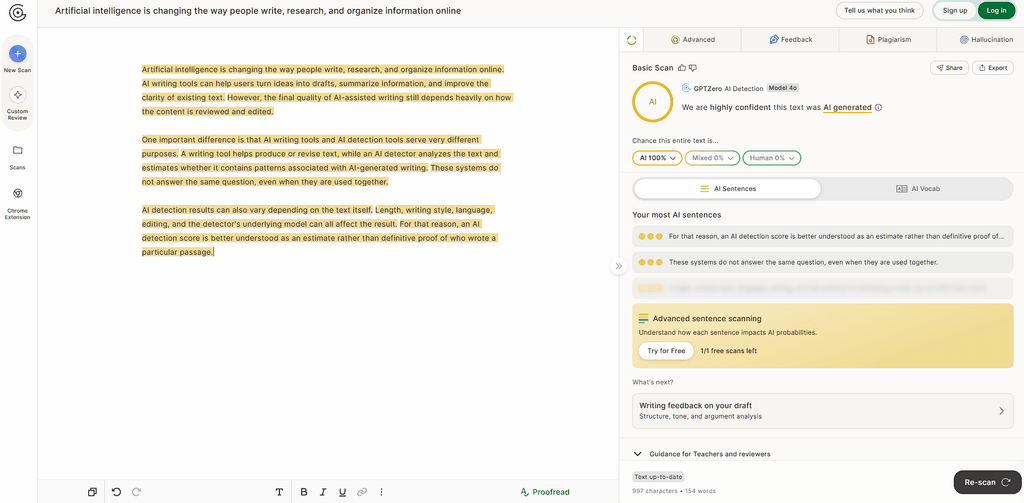
Different detectors use different approaches, but AI detection systems generally analyze linguistic or statistical patterns in text and compare them with patterns associated with human-written and AI-generated material.
That distinction is important: a detector produces an assessment based on patterns. It does not have direct access to the history of who wrote a document.
A detector therefore cannot independently verify authorship in the way that a document’s revision history, drafts, or other records might.
Different detectors can also produce different results for the same text. They may use different models, datasets, detection methods, and update schedules. Even the same detector can change its results when its underlying model is updated.
Turnitin, for example, states that its AI writing assessment may not always be accurate and should not be used as the sole basis for adverse action against a student.
AI Humanizer and AI Detector: What Is the Difference?
AI humanizer and AI detector tools serve different purposes. A humanizer rewrites text to make it sound more natural, while a detector analyzes text and estimates whether it contains patterns associated with AI-generated writing.
| AI Humanizer | AI Detector | |
|---|---|---|
| Primary purpose | Rewrite text to sound more natural | Estimate whether text shows patterns associated with AI-generated writing |
| What it does | Transforms and restructures writing | Analyzes existing writing |
| Input | AI-generated or AI-assisted text, although some tools accept other text too | A piece of text |
| Output | New, rewritten text | A probability, score, or classification |
| Typical use | Improving readability, flow, and stylistic variation | Evaluating text for possible AI-generated patterns |
| Main limitation | Rewriting can alter meaning or tone and cannot guarantee a particular detector result | Results are probabilistic and can vary between tools and circumstances |
The simplest way to remember the difference is:
AI humanizer → changes the text.
AI detector → evaluates the text.
AI Detector vs AI Humanizer: How Do They Work?
Both tools can be understood through a simple input-to-output flow, although their underlying processes are different.
AI humanizer workflow
AI-assisted draft → rewriting/transformation → revised wording and sentence structure → new text
A humanizer may change word choice, sentence structure, phrasing, rhythm, or other stylistic characteristics. The exact approach depends on the product.
AI detector workflow
Text → linguistic/statistical analysis → comparison with learned patterns → probability, score, or classification
The precise methodology also depends on the detector. It is therefore better to think of AI detection as classification or estimation, rather than a system that knows whether a human or AI physically wrote the document.
Neither process verifies authorship.
A humanizer does not need to know whether a particular passage was originally written by a person or an AI system. It applies its rewriting process to the input.
Likewise, an AI detector does not have direct knowledge of the author’s identity or writing process. It evaluates the characteristics of the submitted text.
Can an AI Detector Detect Humanized Text?
Sometimes yes, sometimes no. There is no universal result because the outcome depends on both the rewriting tool and the detection system.
Rewriting changes the linguistic patterns that a detector analyzes. As a result, a humanized version of a passage can receive a different assessment from the original version.
However, several important caveats apply.
- Different detectors can respond differently to the same rewritten text. A passage may receive different assessments from different detection systems.
- Detection models change over time. Companies update their systems as AI writing technology evolves. Turnitin, for example, says it regularly updates its AI writing detection model to keep pace with newer generative AI systems.
- A lower detection score does not prove human authorship. It represents a change in an automated assessment, not a verified record of who wrote the text.
- No humanizer can guarantee a particular result across every detector. Different systems use different methods and can respond differently to the same text.
Turnitin’s current documentation also specifically distinguishes between AI-generated text and text that has been AI-paraphrased or modified using an AI paraphrasing tool.
This is why it is more useful to understand how detection works than to treat any particular detector score as a definitive answer.
Why AI Detector Results Can Vary
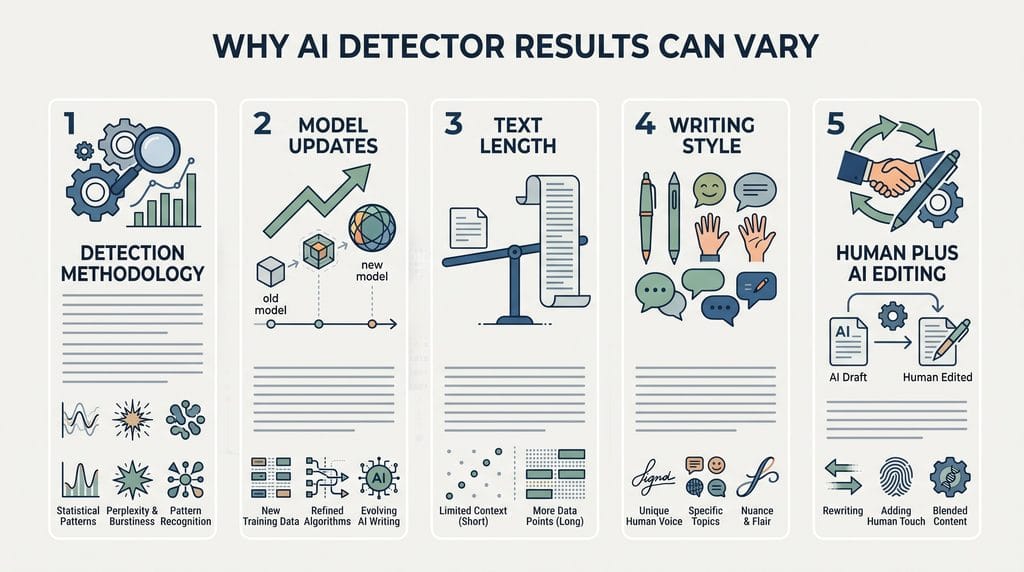
Several factors can affect how an AI detector evaluates a piece of text.
Different detection methodologies
AI detectors do not all use the same model or methodology. Different systems can therefore place different weight on linguistic and statistical characteristics.
This means that identical text can receive different results from different detectors.
Model updates over time
Detection systems are updated as AI writing technology changes.
For example, Turnitin says its AI writing detection model is regularly updated to keep pace with newer large language models. Its current documentation also explains that the AI Writing Report can identify text classified as likely AI-generated as well as text identified as likely AI-generated and subsequently modified by an AI paraphrasing tool.
As a result, a result produced by a detector at one point in time should not necessarily be assumed to remain identical after the system has been updated.
Text length and content characteristics
The amount and type of text being analyzed can affect detection.
Turnitin’s current AI Writing Report supports up to 30,000 words of qualifying text, and its documentation explains that results below 20% are not displayed as an exact percentage because of a higher incidence of false positives in that range.
This does not mean that a score above or below a particular threshold proves authorship. It means the detector itself treats some results as less reliable than others.
Writing style and language
Writing style and language can also affect detection performance.
A 2023 study published in Patterns by researchers including Stanford University’s Weixin Liang examined several GPT detectors and found that they frequently misclassified writing by non-native English speakers as AI-generated. The researchers linked this pattern to characteristics of non-native English writing rather than actual AI authorship.
This is an important finding, but it should be interpreted in context: the study evaluated detectors available at the time of the research, rather than every AI detector currently available in 2026.
More recent research continues to examine the reliability and fairness of AI detection in different writing contexts, illustrating why detector results should be interpreted carefully rather than treated as universal proof.
Mixed human and AI authorship
Text that combines human-written and AI-generated passages can also create challenges for detection systems.
Turnitin’s published 2023 testing reported that sentence-level false positives were more common in documents containing a mixture of human and AI-written content, particularly around transitions between the two.
This is another reason why a single detector score should not automatically be interpreted as a definitive statement about authorship. Check Turnitin’s AI Writing Report guidance.
Editing and revision
Manual editing can also change the characteristics of a piece of writing.
When someone substantially revises wording, sentence structure, or organization, the resulting text is different from the original version a detector might have analyzed. Consequently, the assessment can change even when the underlying writing process is not captured by the detector.
AI Humanizer vs AI Detector: Which Tool Do You Need?
Neither tool is a universal solution. The right choice depends on what you are trying to accomplish.
You may want an AI humanizer if:
- Your AI-assisted text sounds repetitive, robotic, or overly formal
- You want to revise wording and improve natural flow
- You want more variation in sentence structure
- You need a starting point for further manual editing
A humanizer is primarily a writing and rewriting tool.
You may want an AI detector if:
- You are reviewing content and want an additional signal about possible AI involvement
- You are researching how AI detection technology works
- You are an educator or editor who needs one additional data point when reviewing content
- You want to understand how a particular detector evaluates your writing
An AI detector is primarily an analysis tool.
In either case, treat the result as information rather than absolute proof.
A humanizer changes phrasing. A detector estimates whether text resembles AI-generated writing. Neither one provides a definitive record of authorship.
How to Use AI Writing Tools Responsibly
A few practical habits can make AI-assisted writing more reliable regardless of which tools you use.
Review the output yourself
Read AI-generated or humanized text before publishing, submitting, or sending it. Automated rewriting can miss context or change the intended meaning.
Fact-check specific claims
AI generation and automated rewriting can introduce or alter factual details. Check important claims against reliable sources before publishing them.
Add your own insight and voice
AI tools can assist with wording and structure, but original analysis, experience, examples, and judgment can make content more useful.
Follow the rules that apply to you
Schools, employers, publishers, and platforms may have their own policies regarding AI-assisted writing. Check the rules that apply to your specific situation rather than assuming one general policy applies everywhere.
Don’t treat a detector score as definitive proof
AI detection results can contain false positives and false negatives. Even Turnitin states that its AI writing assessment may not always be accurate and should not be used as the sole basis for adverse action against a student.
Google’s own guidance also emphasizes creating helpful, reliable, people-first content and evaluating content for originality, usefulness, and trustworthiness rather than simply producing material for search engines.
Related AI Humanizer Guides
If you’re researching AI humanizer tools, our comparison of the best AI humanizers in 2026 covers seven popular options based on their publicly documented features and pricing.
If cost is your main concern, our guide to the best free AI humanizer options explains the difference between recurring free plans and limited trials.
You can also read our broader AI humanizer guide for an introduction to how these tools work.
Frequently Asked Questions (FAQ)
What is the difference between an AI humanizer and an AI detector?
An AI humanizer rewrites text to make it sound more natural or stylistically varied. An AI detector analyzes text and estimates whether it resembles AI-generated writing.
In simple terms, one changes text while the other evaluates text.
Can an AI detector detect text rewritten by an AI humanizer?
Sometimes. Rewriting changes the linguistic patterns that a detector analyzes, so the assessment may change. However, results vary between detection systems, and no humanizer can guarantee a particular result across every detector.
Are AI detectors accurate?
Accuracy varies depending on the detector, the type and length of the text, the language, and other conditions.
Even providers such as Turnitin acknowledge that AI detection can produce false positives and false negatives. Its current documentation specifically warns that low AI scores can be less reliable and says its AI writing assessment should not be treated as the sole basis for adverse action.
Independent research has also identified cases where detectors perform differently across writing populations and conditions.
Can AI detectors prove that someone used AI?
No. A detector can provide an assessment of whether text resembles AI-generated writing, but that is not the same as independently verifying who wrote it or how the text was produced.
Other evidence, such as drafts, revision history, and the circumstances surrounding the document, may provide additional context.
Do AI humanizers remove AI detection?
Not reliably or universally.
A humanizer can change the linguistic characteristics of text and may therefore affect how a particular detector evaluates it. But different detection systems can produce different results, and both humanizers and detectors change over time.
There is no universal guarantee that humanized text will be classified as human-written.
Should I trust an AI detector score?
Treat it as one signal rather than a final verdict.
A detector score can provide useful information, but it should be interpreted alongside the context in which the text was created and any other relevant evidence. A single automated score is particularly inappropriate as the sole basis for a serious decision.
Is using an AI humanizer the same as editing AI-generated text?
They are related but not identical.
Manual editing involves a person directly reviewing and changing the text. A humanizer applies automated rewriting patterns to the input. It may improve wording or readability, but the output should still be reviewed by a person.
Can AI humanizers avoid AI detection?
AI humanizers may change wording, sentence structure, and other characteristics of AI-assisted text, but they cannot guarantee that a piece of text will avoid AI detection. Detection systems use different methodologies and models, and their results can vary depending on factors such as text length, language, writing style, and editing.
For that reason, an AI humanizer should not be treated as a guaranteed way to pass an AI detector. Its more practical purpose is to help improve clarity, readability, and the natural flow of AI-assisted writing.
Is an AI detector the same as a plagiarism checker?
No. An AI detector and a plagiarism checker look for different things. An AI detector estimates whether writing shows patterns associated with AI-generated text, while a plagiarism checker compares text against existing sources or databases to identify potential matching content. A passage can therefore be original but receive an AI-related signal, or contain copied material without necessarily being classified as AI-generated.
Conclusion
An AI humanizer changes and rewrites text. An AI detector analyzes text and estimates whether it shows patterns associated with AI-generated writing.
They solve different problems.
A humanizer can help with wording, readability, and stylistic variation, but it cannot guarantee a particular result against an AI detector. A detector can provide an assessment of text, but that assessment is not the same as definitive proof of authorship.
Understanding this distinction is more useful than treating either tool as a perfect solution.