
Do AI humanizers actually work? The short answer is: sometimes, but not in the way their marketing often suggests.
AI humanizers can substantially rewrite AI-generated text. Research has also shown that paraphrasing and humanization can make some AI-generated text harder for AI detectors to classify correctly. However, that does not mean humanized text becomes genuinely human-written, nor does it guarantee that the same text will avoid every AI detector.
The difference matters.
An AI humanizer can change wording, sentence structure, rhythm, and other characteristics of a piece of writing. Those changes can affect what an AI detector sees. But detector results vary by tool, model, language, text type, and the amount of rewriting involved.
So, do AI humanizers work? The research suggests that they can work as rewriting tools and can sometimes reduce the effectiveness of AI detection systems. They are much less reliable as a guarantee of “undetectable” AI writing.
What Does an AI Humanizer Actually Do?
An AI humanizer is a writing tool designed to rewrite existing text so that it reads more naturally or resembles a particular human writing style.
Depending on the tool, this can involve changing:
- Word choice
- Sentence structure
- Sentence length
- Paragraph structure
- Transitions
- Repetition
- Tone and phrasing
- Overall writing rhythm
Some tools make relatively light changes, while others produce a much more extensive rewrite.
This is important because “humanizer” is not a precise technical category. Two tools can both describe themselves as AI humanizers while using very different approaches.
Some may rely mainly on paraphrasing and rewriting. Others may use language models to regenerate substantial portions of the text.
The result can therefore range from a lightly edited version of the original to a substantially different piece of writing.
That also creates an important trade-off: the more aggressively a tool rewrites text, the greater the possibility that it changes the original meaning, tone, or factual details.
If you’re specifically looking for free options, see our guide to the best free AI humanizer tools.
Do AI Humanizers Actually Work?
Yes, in a limited and measurable sense. To answer whether do AI humanizers actually work, it helps to separate rewriting quality from AI detection performance.
If by “work” you mean change AI-generated text enough to alter how an AI detector classifies it, there is research showing that this can happen.
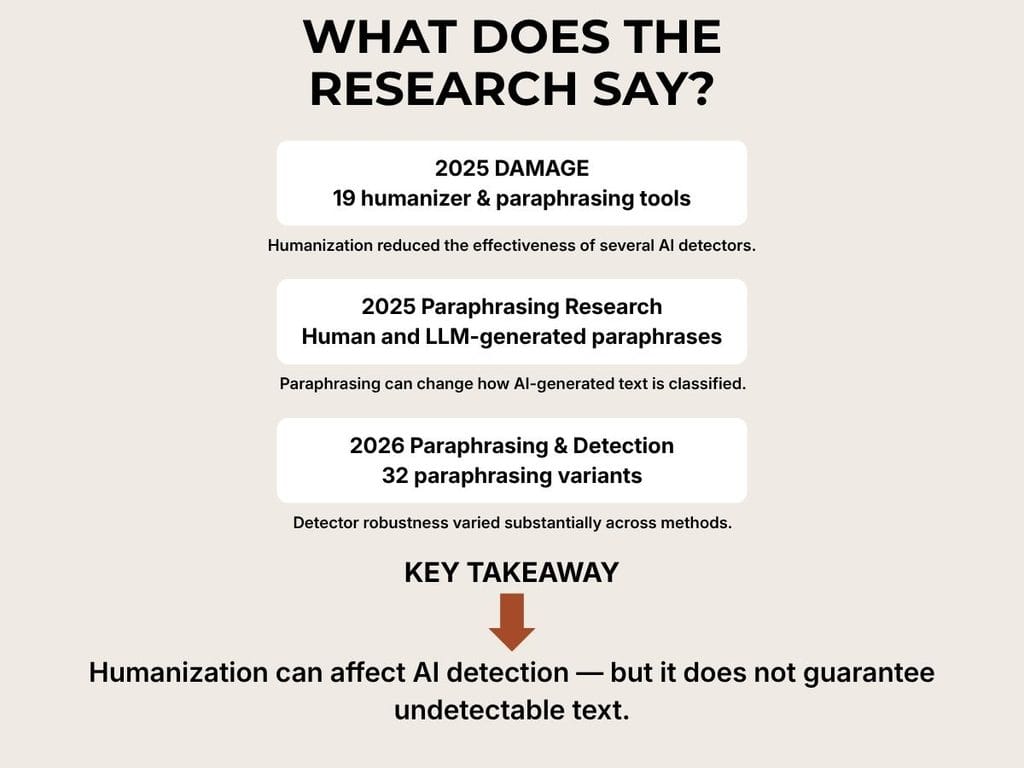
A 2025 study called DAMAGE: Detecting Adversarially Modified AI Generated Text examined 19 AI humanizer and paraphrasing tools. The researchers found that many existing AI detectors became substantially less effective when analyzing humanized AI text. They also found that a detector specifically trained to recognize humanized AI text could be considerably more robust.
This is an important finding because it demonstrates two things at the same time:
- Humanization can interfere with some detection systems.
- Detection systems can be designed to become more resistant to humanization.
In other words, the research does not support a simple “humanizers work” or “humanizers don’t work” conclusion.
It points toward an ongoing detection-versus-rewriting cycle.
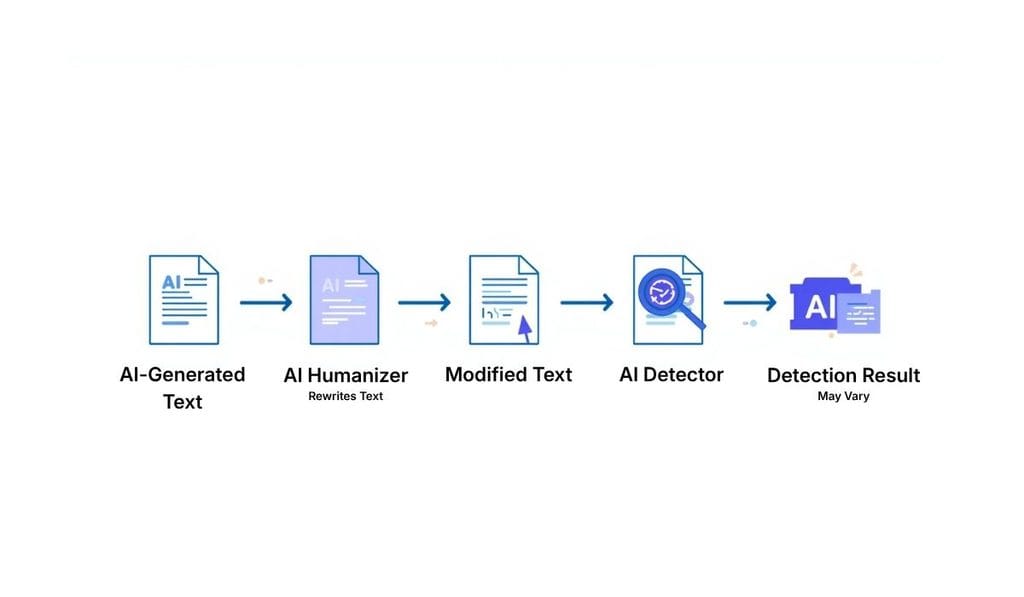
A 2026 study published in Intelligent Systems with Applications reached a similar conclusion from another direction. Researchers evaluated different paraphrasing approaches against several AI detection methods and found that some paraphrasing attacks substantially reduced detector performance. At the same time, neural detectors were more resistant than some feature-based approaches.
That distinction is central to understanding the current state of AI humanizers.
What Does Research Say About AI Humanizer Effectiveness?
One of the clearest pieces of evidence comes from the DAMAGE study. This research is particularly relevant to AI humanizer detection, because it examines what happens when AI-generated text is rewritten before it reaches an AI detector.
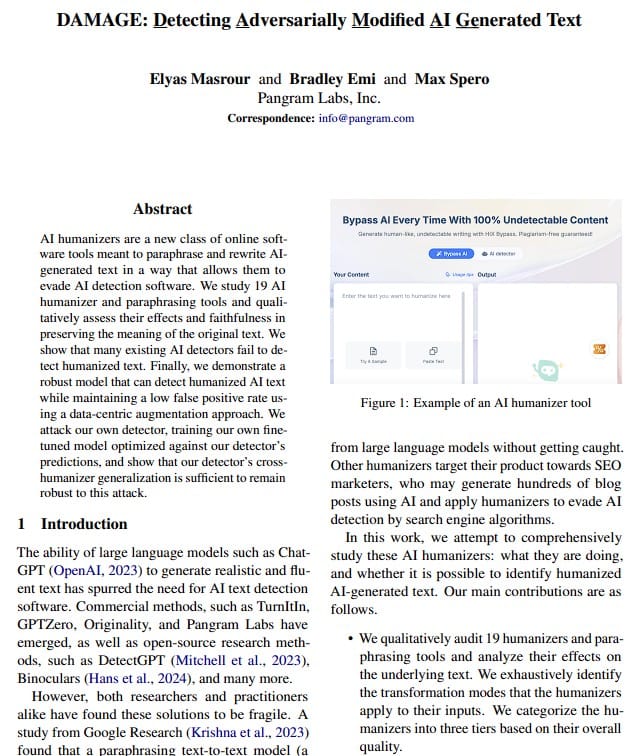
A 2025 study called DAMAGE: Detecting Adversarially Modified AI Generated Text examined 19 AI humanizer and paraphrasing tools. The researchers found that many existing AI detectors struggled with humanized text, while a detector trained with humanized AI examples was substantially more robust.
The researchers also tested a detector specifically designed with humanized AI text in mind.
That detector performed much better on modified text than several existing detection approaches.
This tells us something broader about AI detection: a detector’s performance depends heavily on what it has been trained to recognize.
If a detector primarily learns characteristics of unmodified AI-generated text, substantial rewriting can remove some of those characteristics.
If the detector has been trained on humanized or paraphrased AI text, it may be more resistant to those changes.
A separate 2025 study on paraphrasing attacks also found that different detection approaches have different levels of resilience. The researchers concluded that detector performance and resistance to paraphrasing can vary substantially depending on the underlying detection method.
The Intelligent Systems with Applications‘ study mentioned above continues to explore this problem. This recent study evaluated 32 low-resource paraphrasing variants and found that some approaches significantly reduced detector performance while preserving much of the original text’s quality and semantic content. However, the researchers also found differences between feature-based and neural detection systems.
So the evidence points in one direction:
Rewriting can change the signals detectors rely on, but no single result applies universally to every detector or every piece of text.
Taken together, these findings suggest that do AI humanizers actually work is not a simple yes-or-no question.
Can AI Humanizers Bypass AI Detectors?
Sometimes, but “bypass” is too broad a word to describe the research accurately.
A humanizer may reduce the probability that a particular detector classifies a passage as AI-generated. That does not mean the same passage will receive the same result from another detector.
For example, one detector may rely heavily on statistical characteristics of the writing, while another may use a machine-learning classifier trained on different examples.
The two systems can therefore reach different conclusions about exactly the same passage.
This is one reason why claims such as “100% undetectable” should be treated skeptically.
There is no universal AI detector that all humanizers need to defeat. There are multiple detection systems, and they can change over time.
In fact, detector developers are increasingly studying modified and paraphrased AI text specifically.
For example, GPTZero announced in September 2026 that its GPTZero 4o model was designed to handle mixed and modified AI text, including text that has been paraphrased.
That illustrates the broader problem: humanizers are not operating against a fixed target.
As rewriting techniques change, detection systems can also change.
Why Does AI Humanizer Effectiveness Vary?
There are several reasons why one humanizer may produce a very different result from another.
1. Different rewriting methods
A simple paraphraser may replace words and restructure a few sentences.
A more advanced humanizer may rewrite entire paragraphs.
Those approaches can produce very different outputs and therefore affect AI detection differently.
2. Different AI detectors
There is no single universal detection methodology.
Different detectors can use different models, linguistic features, statistical measurements, training data, or combinations of techniques.
Consequently, a piece of text that receives one result from a detector may receive another result elsewhere.
3. The original AI model matters
AI-generated text is not identical across models.
Text produced by different language models can have different vocabulary, sentence structures, repetition patterns, and stylistic characteristics.
That means the same humanizer may also behave differently depending on the source text.
4. The type of writing matters
An academic paragraph, product description, news article, personal reflection, and technical explanation do not have the same writing characteristics.
A humanizer that works reasonably well on one type of text may produce awkward or unnatural results on another.
5. How aggressively the text is rewritten matters
Light rewriting may preserve the original meaning and readability better, but may leave more of the original structure intact.
Heavy rewriting can make more substantial changes, but it also increases the possibility of awkward phrasing, incorrect emphasis, or meaning changes.
This creates a fundamental trade-off between modification and fidelity.
6. Language matters
AI detection research increasingly looks at multilingual and cross-lingual settings.
Recent research has shown that factors such as language, domain, text length, generator, and editing operations can all influence detector performance.
Therefore, results from English text should not automatically be treated as universal evidence for every other language.
AI detection is also not a completely static technology. For example, Turnitin’s 2026 release notes document updates to its AI writing detection model, including changes intended to improve recall while maintaining a low false-positive rate.
Does Humanized AI Text Become Truly Human-Written?
No.
This is probably the most important distinction in the entire topic.
A humanizer can modify AI-generated text. It can change its vocabulary, sentence structure, rhythm, and phrasing.
But rewriting does not change the history of how the text was produced.
A detector score also cannot establish authorship with certainty.
Consider two separate questions:
Question 1: Has the text been substantially rewritten?
A humanizer may be able to change the answer from “very little” to “yes.”
Question 2: Was the final text actually written by a human?
A rewriting tool cannot establish that.
These are different questions.
This distinction becomes particularly important when AI detection is used for academic, professional, or institutional decisions. A detector output should not automatically be interpreted as definitive proof of authorship.
Even commercial AI detection systems acknowledge limitations. Turnitin states that its AI writing detection model may misidentify human-written, AI-generated, and AI-paraphrased text, and says its report should not be used as the sole basis for adverse decisions.
Your previous guide, AI Humanizer vs AI Detector: What’s the Difference in 2026?, explains this distinction in more detail.
Can AI Humanizers Make AI Text Undetectable?
They cannot guarantee that.
The research shows that humanization can reduce the effectiveness of some detectors, sometimes substantially. But other detection approaches can remain more resistant, and detector models can be updated to account for modified AI text.
This means that “undetectable” is not a stable property of a piece of writing.
A text might receive one result today and another result after a detector updates its model.
It might also receive different results from two detectors at the same time.
For that reason, a more accurate description is:
AI humanizers can change the characteristics that AI detectors analyze, but they cannot guarantee a particular detection result.
That is a much more defensible conclusion than saying that humanizers make AI writing invisible to detection.
What Are AI Humanizers Actually Useful For?
The most practical use of an AI humanizer is not necessarily AI detection.
It can be useful as a rewriting and editing tool.
For example, someone might use an AI humanizer to:
- Make an overly formal paragraph easier to read
- Reduce repetitive phrasing
- Improve sentence flow
- Rewrite a rough AI-generated draft
- Adjust the tone of existing text
- Create a more conversational version of a paragraph
- Produce alternative wording for an existing draft
These uses are much easier to evaluate because you can directly inspect the output.
Does it read better?
Does it preserve the original meaning?
Does it sound appropriate for the intended audience?
Does it introduce factual or grammatical problems?
Those are questions a reader can actually answer.
The situation is different when the only goal is to obtain a particular AI detector score.
That score is controlled by a third-party system, and its methodology may change without notice.
If you’re comparing different tools, our guide to the best AI humanizers looks at the features and approaches offered by several popular options.
AI Humanizer vs AI Detector
AI humanizers and AI detectors perform fundamentally different jobs.
| AI Humanizer | AI Detector |
|---|---|
| Rewrites existing text | Analyzes existing text |
| Changes wording and structure | Looks for patterns associated with AI-generated writing |
| Produces a modified version | Produces an estimate or classification |
| Can affect readability and style | Can affect how text is interpreted by the detection system |
| Cannot guarantee human authorship | Cannot reliably prove authorship by itself |
This is why the two tools should not be treated as opposite sides of a simple “AI versus human” test.
A humanizer changes the input.
A detector evaluates the resulting input.
Change the text, and the detector’s result may change.
That does not necessarily mean either system is broken.
It means that detection is being performed on a different version of the text.
Do AI Humanizers Work Better Than Manual Editing?
Not necessarily.
Manual editing has one major advantage: a person can make changes based on the actual meaning and purpose of the text.
A human editor can recognize when a sentence sounds unnatural, when an example is inaccurate, or when a rewritten sentence changes the intended meaning.
An automated humanizer does not necessarily have that level of contextual judgment.
On the other hand, automated rewriting can be much faster for large amounts of text.
The better choice therefore depends on the task.
If the goal is simply to improve clarity or remove repetitive language, an AI-assisted rewrite can be useful.
If the text is important, factual, highly personal, or subject to specific authorship requirements, human review remains important.
Should You Use an AI Humanizer?
That depends on what you want it to accomplish.
If your goal is better readability, an AI humanizer can be useful as one stage in an editing workflow.
If your goal is rewriting an awkward AI draft, it can also be useful.
If your goal is guaranteeing that a detector will classify the text as human, the research does not support that guarantee.
And if the text is being submitted in an environment with rules about AI assistance, rewriting the text does not automatically remove those obligations. The applicable policy still matters.
The most sensible way to evaluate a humanizer is therefore not just to ask:
“Can it beat an AI detector?”
Instead, ask:
- Does the rewritten text preserve the original meaning?
- Does it improve readability?
- Does it avoid awkward or unnatural phrasing?
- Does it preserve important facts?
- Does it produce a useful final draft?
- Is its use appropriate under the rules that apply to the content?
Those questions are more useful than focusing on a single detector percentage.
Frequently Asked Questions
Do AI humanizers actually work?
Do AI humanizers actually work? Yes, but their effectiveness depends on what you mean by “work.” Research shows that humanization and paraphrasing can reduce the effectiveness of some AI detectors. However, results vary by detector, text, language, rewriting method, and model. Humanizers cannot guarantee a particular detector result.
Can AI humanizers bypass AI detectors?
They can sometimes make AI-generated text harder for certain detectors to identify. However, a humanized passage may still be detected by another system, and newer detectors can be designed to handle modified AI text more effectively.
Do AI humanizers make AI text undetectable?
No tool can reliably guarantee that. Humanization changes the text and can alter detection results, but “undetectable” depends on the specific detector and its current methodology.
Are AI humanizers effective for all types of writing?
No. Results can vary depending on the writing style, text length, language, domain, original AI model, and amount of rewriting. Research on multilingual and modified AI text also shows that detection performance can change across languages and writing conditions.
Is humanized AI text the same as human-written text?
No. Humanized AI text is AI-generated or AI-assisted text that has been rewritten or modified. A rewritten passage may sound more natural without establishing that a human originally authored it.
Can a humanizer improve the quality of AI writing?
It can. Rewriting may improve sentence flow, reduce repetition, or make wording more natural. However, automated rewriting can also introduce awkward phrasing or alter meaning, so the output should still be reviewed.
Conclusion: Do AI Humanizers Actually Work?
So, do AI humanizers actually work?
The research gives a qualified yes.
AI humanizers can substantially modify AI-generated text, and controlled studies have shown that paraphrasing or humanization can reduce the performance of some AI detection systems.
But that is only part of the story.
They do not reliably make AI text indistinguishable from human writing. They do not guarantee a particular result across AI detectors. And a lower AI detection score is not the same thing as proof of human authorship.
The most useful way to think about an AI humanizer in 2026 is therefore as a rewriting tool that can also change how automated detection systems interpret text.
That distinction matters.
If you use one to improve clarity, flow, or tone, the quality of the final writing is something you can evaluate directly. If you use one solely because it promises to make AI writing “undetectable,” the research suggests that promise is much harder to support.
The technology is evolving on both sides. Humanizers are getting better at rewriting, while AI detectors are increasingly being developed and evaluated against modified and paraphrased AI text.
For now, the evidence supports a more nuanced conclusion than either extreme:
AI humanizers can work. They just cannot guarantee what their marketing often promises.
Sources
- Masrour, Emi & Spero (2025), DAMAGE: Detecting Adversarially Modified AI Generated Text
- Lau & Zubiaga (2025), Understanding the effects of human-written paraphrases in LLM-generated text detection
- Shportko & Verbitsky (2025), Paraphrasing Attack Resilience of Various AI-Generated Text Detection Methods
- Rydell et al. (2026), Low-resource single-pass paraphrasing attacks on AI-generated text detection
- DetectRL-X (2026), research on multilingual and real-world AI-generated text detection