
Twelve months ago, building a content agency meant hiring editors, scriptwriters, a voiceover artist, a video editor, and a social media manager before you landed your first real client. Today, one person with a laptop, the right AI tools, and a system can produce more content than that entire team—and keep 90% of the margin. This guide is the exact blueprint for building that business.
The “One-Person Content Agency” model isn’t a side hustle. It’s a structural innovation made possible by AI tools that have compressed a 40-hour content production cycle into 8 hours of systems management. The creators, coaches, and brands flooding the content economy in 2026 need more videos, more shorts, more podcasts, and more scripts than any traditional agency can deliver at competitive prices. You, operating on AI infrastructure, can undercut those agencies on price and outperform them on turnaround time simultaneously.
By the end of this guide, you’ll have the complete operating system for a one-person content agency: ideation and scriptwriting at scale, professional-grade audio production, automated video repurposing, and a pricing model that generates $5,000-15,000 monthly in retainer revenue without hiring a single employee.
Let’s build it phase by phase.
Phase 1: Ideation & Scriptwriting at Scale
Why Most Agency Scripts Fail Before They’re Written
The most expensive mistake in content agencies isn’t bad video editing or poor audio quality. It’s mediocre ideation—generating topic lists and script outlines that clients accept because they don’t know better, then wondering why the content doesn’t perform.
Clients hire content agencies to solve a growth problem. If your scripts don’t produce views, followers, or conversions, your retainer renewal rate will confirm it within 90 days. Scale of production means nothing without quality of output at the top of the funnel.
The scriptwriting phase is where your AI-augmented workflow either creates durable competitive advantage or produces polished mediocrity at high volume.
Using ChatGPT and Claude as Research-First Scripting Partners
The correct workflow for client scripts is research-before-writing, not prompt-and-publish. Before touching a script template, use ChatGPT‘s web search or Perplexity Pro to pull the three most recent developments in the client’s industry. Feed those findings into Claude with the client’s brand voice document, their top-performing content examples, and their target audience demographics as context.
Your system prompt should function like a briefing document, not a casual request. Include the client’s positioning, their audience’s specific pain points, their content format (educational, entertainment, authority-positioning), and the platform the video will live on. The output quality difference between a generic prompt and a structured brief is substantial enough to justify spending 15 minutes per client building their permanent system prompt template.
Structure every script around the problem-agitation-solution architecture with one modification for short-form: compress the problem and agitation into the opening 3 seconds. The rest of the script exists only because the hook worked.
The First 3 Seconds Are the Entire Business Model
Here’s a truth most content agencies sell around rather than through: every piece of content your agency produces will succeed or fail based on the first sentence. Algorithm, production value, posting cadence, caption strategy—none of it matters if the hook doesn’t stop the scroll.
Developing hooks that genuinely work across different niches, audiences, and content formats is a distinct skill that takes experienced creators months to develop through trial and error. As a one-person agency managing 5-10 clients simultaneously, you don’t have that trial-and-error runway for each account.
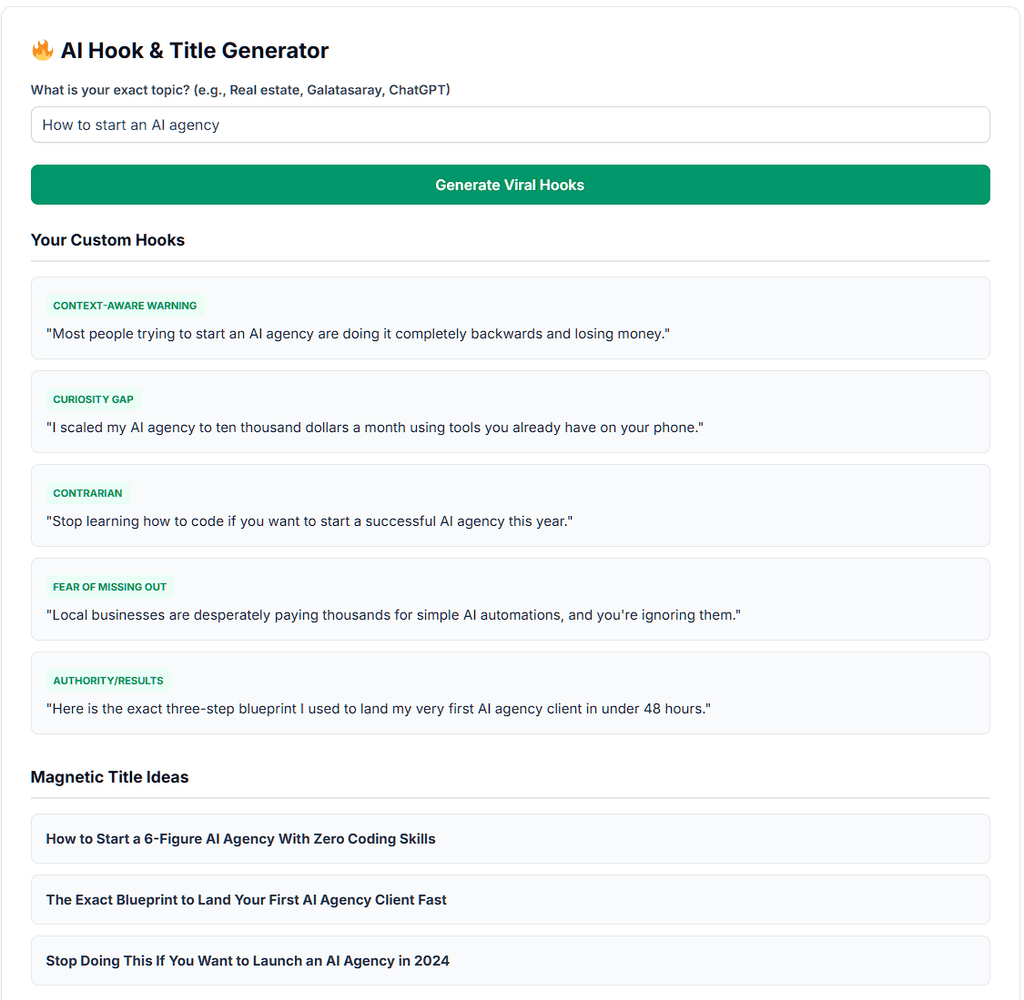
This is why hook generation and scriptwriting needs to be systematized from day one. Rather than guessing which format works for a fitness coach versus a SaaS founder versus a real estate agent, use a system trained specifically on viral hook patterns. Try the ZeroSkillAI Free Hook Generator to generate context-aware hooks for any niche in seconds—input your client’s topic, target audience, and platform, and the tool outputs multiple hook variations across the psychological frameworks (negative curiosity, contrarian, hidden secret, time-travel regret) that consistently outperform generic openers.
For one-person content agency owners managing multiple client accounts, this tool becomes part of your weekly content batch. Run each client’s planned topics through the generator at the start of the week, select the strongest 3-5 hook variations per topic, then use those as the foundation for script development. Your ideation phase drops from 3 hours to 45 minutes.
Building a Scalable Client Script System
Develop a permanent “Script Factory” setup for each client: a Claude Project configured with the client’s brand voice, a content calendar template, their topic cluster strategy, and their top-performing scripts as style references. Every new script starts from that configured base rather than a blank page.
Deliver your scriptwriting work as Google Docs with inline commenting enabled. Clients can request changes without calls. Your revision cycle drops to one round rather than three.
Phase 2: Professional Audio & Voice Cloning
Why Faceless Agencies Are the Fastest-Growing Model in 2026
The content creator economy bifurcated in 2024-2025. One path: personality-driven content where the creator’s face, voice, and presence is the product. Second path: information-driven content where the value is the information, not the messenger, and voice cloning handles delivery.
For agencies, the second path is infinitely more scalable. You’re not recreating a personality for every client—you’re delivering a consistent, professional audio layer that clients can review, approve, and publish without a recording studio or a talent relationship.
Faceless content channels on YouTube and TikTok are consistently outperforming creator-fronted channels in educational niches, business topics, financial information, and how-to content. The audience for this content cares about the value of information, not who’s delivering it. This is your agency’s structural advantage.
Building Your Agency Audio Stack with the Best AI Tools
ElevenLabs is the non-negotiable anchor tool for any serious content agency in 2026. The voice cloning quality at the Professional tier has crossed the threshold where listeners can’t reliably distinguish AI voice from human narration—which is the only threshold that matters for commercial use.
For agency operations, you’ll work across three voice use cases: cloned client voices (the client records a 30-minute voice sample; ElevenLabs clones it so all content sounds authentically like them), licensed voice library voices for clients who want professional narration without a personal voice, and multilingual expansion where the same script gets rendered in Spanish, French, German, or Portuguese for global audience targeting.
Murf.ai is the alternative worth considering for teams working in specific professional niches—its corporate and documentary voice styles have distinctive quality that ElevenLabs’ more natural voices occasionally don’t match for formal content types.
Calculating Your Audio Budget Before You Scale
Here’s where many first-time agency owners make a costly mistake: they price audio production without understanding the API cost structure behind it. ElevenLabs charges per character generated—not per minute of finished audio. Different voice models have different per-character rates. A client requiring 10 videos monthly at 800-word scripts each generates a predictable character count that directly determines your monthly API cost.
Understanding this math is the difference between a 70% margin and a 40% margin on your audio production line. Before you price a new client retainer, you need to know exactly what their monthly audio volume will cost you in API fees, then build your margin on top of that number.
Use the ZeroSkillAI Voiceover Cost Calculator to project your exact monthly audio budget before onboarding a new client. Input the number of scripts, average word count, and your chosen ElevenLabs tier, and the calculator outputs your monthly API cost, per-video audio cost, and recommended minimum pricing for that client’s package to maintain your target margin. Running this calculation before every client proposal prevents the painful discovery that a client’s requested volume is unprofitable at the rate you quoted.
Phase 3: Video Editing & AI Repurposing (The Real Bottleneck)
Manual Editing Is Killing Your Capacity
Let’s talk about the math that breaks most one-person content agency owners within 6 months of their first serious client acquisition.
A single 60-minute podcast episode contains enough raw material for 10-15 Shorts across platforms. A client who publishes one podcast weekly needs 10-15 Shorts weekly—that’s their minimum viable social presence. Three clients with that requirement means 30-45 Shorts weekly, each requiring transcript review, moment identification, rough cut, caption styling, format adjustment for each platform, and export.
At manual editing speeds, that’s 20-30 hours weekly on repurposing alone—before you’ve touched scriptwriting, audio production, client communication, or any business development activity. This is the exact bottleneck that kills one-person agencies before they reach profitability.
The resolution isn’t hiring an editor. It’s eliminating the manual video editing stage through AI automation.
Two-Stage Editing Architecture: Opus Clip Into CapCut
The professional workflow for a one-person agency in 2026 is a two-stage pipeline, not a single-tool approach.
Stage 1 (Discovery and clip generation): Opus Clip. Upload the raw podcast or long-form video. Set target audience, content category, and clip length parameters. Opus processes the full recording, identifies the highest-virality moments using its AI detection system, and produces 10-15 scored, captioned clips with active speaker detection and auto-reframing for vertical format. Your involvement: 10-15 minutes of review and approval, not 3 hours of scrubbing.
Stage 2 (Polish and brand application): CapCut. Take the Opus-generated clips into CapCut for brand template application, caption style customization, intro/outro sequences, and platform-specific final formatting. This stage takes 5-8 minutes per clip when you’ve built client-specific templates in advance—not the 25-40 minutes per clip that manual editing from raw footage requires.
Total production time per episode using this pipeline: 90 minutes to produce 12 Shorts. Manual equivalent: 4-6 hours minimum.
Quantifying What This Automation Is Worth to Your Business
The time you save through automated repurposing isn’t an abstract productivity gain—it’s a directly calculable expansion of your agency’s client capacity. Every hour recovered from manual editing is an hour available for new client onboarding, which translates to additional retainer revenue.
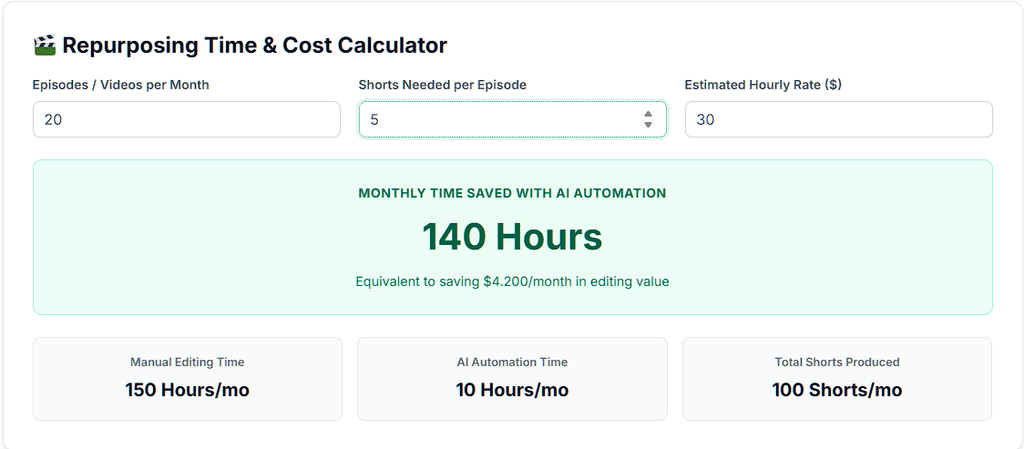
Use the ZeroSkillAI Video Repurposing Time Calculator to see exactly what this math means for your specific operation. Input your current client count, average monthly video volume per client, manual editing time per video, and your target hourly rate. The calculator outputs your current monthly time investment in editing, your post-automation time investment, and the dollar value of recovered hours—which is also the revenue capacity you’ve freed up for additional client acquisition.
Most agency owners running this calculation for the first time discover they’re spending $3,000-6,000 worth of their time monthly on video editing that Opus Clip and CapCut can replicate in 20% of that time. The calculator makes that invisible cost visible and creates the business case for immediately investing in the AI editing stack.
Phase 4: Client Acquisition & Pricing
Packaging AI Services for Maximum Client Perceived Value
A one-person contenty agency fails at acquisition for one predictable reason: they sell tools instead of outcomes. Telling a potential client “I use Opus Clip and ElevenLabs” communicates nothing they care about. Telling them “I turn your weekly podcast into 12 platform-ready Shorts delivered every Friday, with AI voiceover in your cloned voice, distributed to TikTok, Instagram, YouTube Shorts, and LinkedIn simultaneously” speaks directly to their growth goal.
Package your services by outcome and delivery frequency, not by tool or task. Clients who understand what they’re getting and when they’re getting it convert at 3-4x the rate of clients evaluating a vague “content creation” proposal.
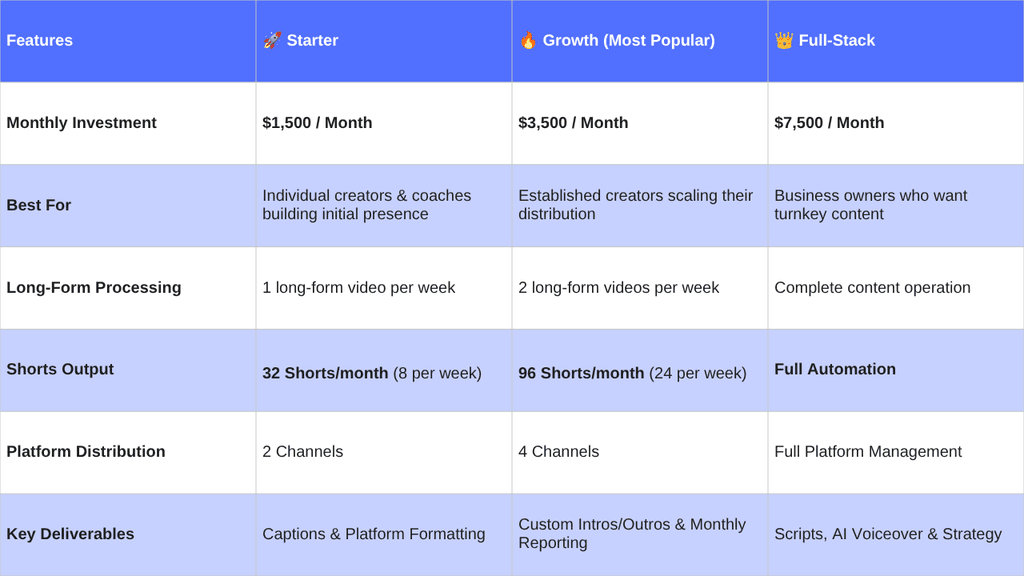
Three packaging tiers work well for most one-person agencies:
The Starter Package ($1,500-2,500/month): 1 long-form video per week repurposed into 8 Shorts, delivered with captions and platform formatting for 2 channels. Ideal for individual creators and coaches building initial presence.
The Growth Package ($3,000-5,000/month): 2 long-form videos per week repurposed into 12 Shorts each, delivered across 4 platforms, with custom intros/outros and monthly performance reporting. Ideal for established creators scaling their distribution.
The Full-Stack Package ($6,000-10,000/month): Complete content operation—scripts, voiceover, short-form repurposing, long-form editing, monthly content strategy, and platform management. Designed for business owners and executives who want turnkey content without involvement in production.
Retainers vs. Per-Video: The Pricing Model Decision
Per-video pricing feels safer to agency beginners but creates the worst business model at scale. Variable monthly revenue makes planning impossible, clients negotiate price on every deliverable, and slow months create cash flow problems that threaten operations.
Retainer pricing solves every one of these problems. The client commits to a monthly volume, you commit to delivery, and the financial relationship is predictable for both parties. Retainers also create natural switching costs—a client on a 3-month retainer has their voice cloned, their brand templates built, their content calendar integrated into your workflow, and their approval process established. Leaving means starting that entire setup over with a new agency.
Price your retainers at a minimum of 3x your actual production cost (API fees, software subscriptions, time at your target hourly rate). A $3,000 monthly retainer should cost you no more than $1,000 in combined tool costs and time—your $2,000 margin is what funds your business development, personal income, and operational buffer.
Where to Find the First Three Clients
The fastest acquisition path for a new one-person content agency is adjacent to what you’re already building. If you’re documenting your own content creation process on social media—showing how you use Opus Clip to generate 12 Shorts from one podcast, how ElevenLabs produces undetectable AI narration, how your Make.com pipeline automates delivery—you’re demonstrating the exact service that your target clients want to buy.
Three acquisition channels that convert fastest for this specific service type:
LinkedIn outreach to coaches and course creators with 10,000+ followers who post inconsistently—they have the audience and the content ideas but lack the production infrastructure. Your service solves their exact problem.
Podcast communities and Discord servers where creators discuss production workload. A genuine case study showing episode-to-Shorts conversion rates lands better than any cold pitch.
Direct YouTube channel audits for channels publishing long-form content but no Shorts. Identify 20 channels in a niche, produce a sample batch of 3 Shorts from one of their existing videos using your full pipeline, and send them the deliverable as a free trial. The quality of your output is the pitch.
The One-Person Agency Operating System: Putting It All Together
The complete ZeroSkillAI one-person content agency stack looks like this in production:
Monday: Run all client topics through the ZeroSkillAI Hook Generator, build the week’s script briefs in Claude, deliver final scripts to clients for approval by EOD.
Tuesday: Produce approved audio through ElevenLabs client voice libraries, generate B-roll and visual elements, prepare complete raw video files for editing.
Wednesday: Run all raw footage through Opus Clip for automated Short generation, apply brand templates in CapCut, complete platform formatting and caption review.
Thursday: Deliver all client deliverables, collect approvals, schedule publishing through Buffer or Publer for the following week’s cadence.
Friday: Business development, new client proposals, system optimization, and performance reporting for active clients.
That’s the full production cycle for 5-8 clients operating on weekly delivery schedules—compressed into a 4-day week with Friday reserved entirely for growth activities. Total active production hours: 25-30. Revenue potential at those client counts: $10,000-30,000 monthly.
The Verdict: Your Agency, Your Timeline
The one-person content agency enabled by AI tools isn’t a future business model. It’s the current dominant structure for solo founders who understand that automation infrastructure compounds in value with every client added, while manual production structures collapse under the same weight.
All the AI tools mentioned in this guide exists, works today, and is accessible at price points that make the agency model profitable from your first retainer client. The scriptwriting stack (ChatGPT + Claude) is available for under $40 monthly. ElevenLabs professional-tier voice cloning starts at $99 monthly. Opus Clip’s automation begins at $15 monthly. CapCut’s final production suite runs $8 monthly. Total infrastructure cost: under $200 monthly for a system capable of generating $10,000+ in monthly retainer revenue.
The gap between building this agency and not building it isn’t technical skill, capital, or market opportunity. It’s execution sequence.
Start today: Use the ZeroSkillAI Free Hook Generator to produce 10 viral hook variations for your own content niche. Posting that content is simultaneously your client acquisition strategy and your portfolio. Run your planned audio volume through the ZeroSkillAI Voiceover Cost Calculator to build your first retainer pricing model before your first proposal conversation. Use the ZeroSkillAI Video Repurposing Time Calculator when you land that first client to quantify exactly how much capacity you’ve created for clients 2, 3, and 4.
A true one-person content agency isn’t a solo operation. It’s a systems management role where your team is AI infrastructure, your product is reliable content delivery, and your margin is the difference between what clients pay for professional output and what it costs an AI-augmented operator to produce it.
Build the system once. Scale the clients on top of it. The business model works. The tools work. The only variable is whether you execute before the next person reading this guide does.
Bookmark this guide. Come back to each phase as you implement. The one-person content agency you build in the next 90 days is the one generating passive retainer income in 2027.