
Finding the best plagiarism checker is no longer optional in 2026—it’s survival. Amazon KDP is rejecting books with AI-detected plagiarism, Etsy is suspending sellers for duplicate descriptions, and Google’s Helpful Content Update is deindexing programmatic pages that trigger duplicate content penalties. AI-generated text from ChatGPT, Claude, or Gemini often contains overlapping phrases that plagiarism checker tools flag, even when you never copied from an existing source, making verification tools essential before publishing any AI-created product, listing, or website page.
The Threat: Why Platforms Are Banning AI Content
Here’s the uncomfortable reality: platforms are cracking down hard on low-quality AI content in 2026.
The risk of duplicate content penalty is real:
- Amazon KDP: Rejecting submissions with high plagiarism scores (even from your own previously published books)
- Etsy: Suspending accounts for duplicate product descriptions across multiple listings or shops
- Google: Deindexing programmatic pages that share templated paragraphs with insufficient unique value
- Medium/Substack: Removing articles flagged as AI-generated spam
Why AI triggers plagiarism filters:
AI models like ChatGPT and Claude are trained on the same internet data. When millions of users prompt “write a product description for a minimalist planner,” the AI generates similar phrases because it learned from the same corpus of existing planner descriptions. This creates unintentional overlap—you didn’t plagiarize, but the detector thinks you did because 15 other sellers used AI to write nearly identical text.
The cascade failure:
- You generate 100 products with AI (Etsy listings, KDP books, programmatic pages)
- You publish without checking
- Platform detects duplication or AI patterns
- Your account gets suspended or content deindexed
- Months of work vanishes overnight
The solution: Whether you’re building AI digital product workflows for Etsy or scaling AI programmatic SEO workflows for a 1,000-page site, verification is the final bottleneck. You must check every piece of content before it goes live.
That’s where the best plagiarism checker becomes your insurance policy. Let’s review the 7 tools that can save your business.
The 7 Tools: Comprehensive Reviews
1. Originality.AI: Best Plagiarism Checker for AI Content at Scale
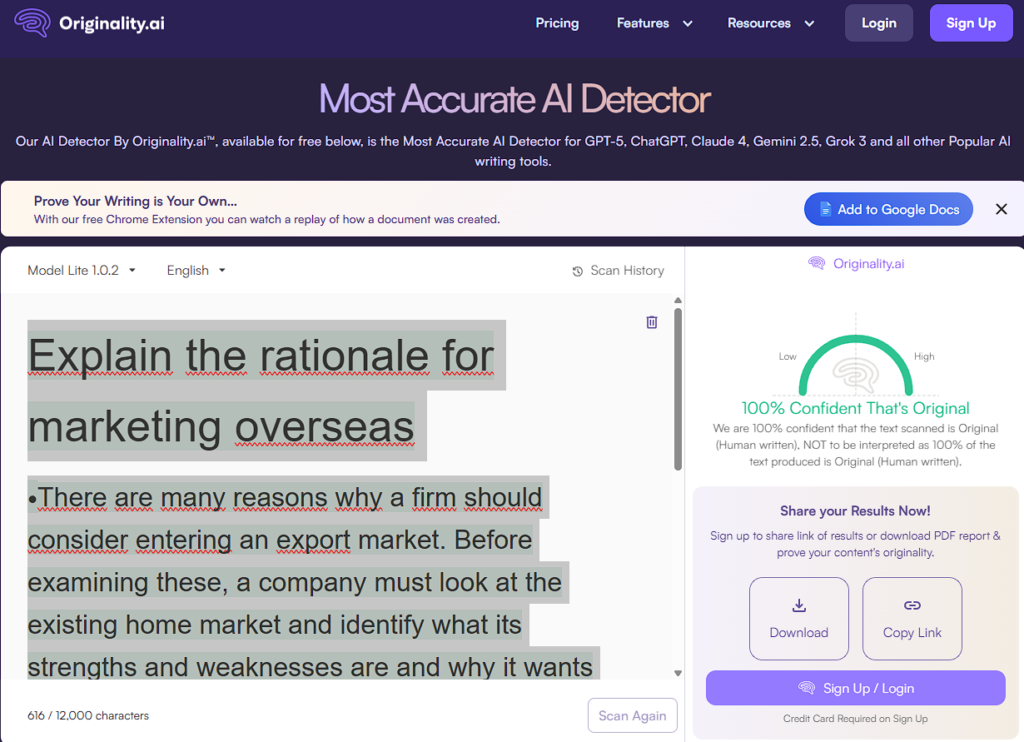
Originality.AI is purpose-built for detecting AI-generated content and plagiarism simultaneously—the exact combination creators need in 2026.
How it works:
Upload your text or paste directly. Originality.AI runs two scans: one for plagiarism (compares against billions of web pages) and one for AI detection (identifies ChatGPT/GPT-4 patterns). You get two scores: originality score (0-100% original) and AI probability (0-100% AI-written).
Pros:
- Dual scanning (plagiarism + AI detection in one tool)
- Batch scanning API (check 1,000+ pages programmatically)
- Team accounts (multiple users for agencies)
- Chrome extension (check content before publishing)
- Detailed reports showing exact matched sources
Cons:
- No free tier (pay-per-scan model only)
- AI detection occasionally flags heavily edited human text
- Expensive at scale ($0.01 per 100 words adds up for 10,000+ pages)
Pricing: $0.01 per 100 words (approximately $10 for 100,000 words)
The Verdict: The best plagiarism checker if you’re running high-volume operations and need API integration for automated workflows.
2. Copyscape: Best Plagiarism Checker for Duplicate Content Penalty Risks
Copyscape is the industry standard plagiarism checker, trusted by publishers and SEO professionals since 2004.
How it works:
Copyscape searches the entire internet for text matching your content. It identifies not just exact copies but also paraphrased duplicates. The Premium version offers batch checking and API access for integration into publishing workflows.
Pros:
- Most comprehensive web database (billions of pages indexed)
- Batch comparison (compare multiple documents against each other)
- Copyscape Premium API (integrate into automation workflows)
- Clear reports showing matched URLs and overlap percentage
- Trusted by major publishers
Cons:
- No AI detection capability (plagiarism only)
- Premium requires credits (3-5 cents per search)
- Batch features only in Premium version
- Cannot check unpublished content against itself (needs URL or file upload)
Pricing: Free basic scan (limited), Premium starts at $0.03-0.05 per search
The Verdict: Essential plagiarism checker for detecting duplicate content penalty risks across published web pages, but pair with an AI detector for complete protection.
3. Winston AI: Best for Content Humanization Verification
Winston AI specializes in detecting AI-generated content with high accuracy, helping creators verify their content humanization efforts worked.
How it works:
Winston AI uses proprietary models trained specifically to detect GPT-4, Claude, and Gemini output patterns. It provides a human score (0-100%) and highlights specific sentences likely AI-generated. The “Readability” feature also scores how natural the text sounds.
Pros:
- Extremely accurate AI detection (95%+ claimed accuracy)
- Highlights specific AI-written sentences (not just overall score)
- Supports multiple languages
- Plagiarism check included in higher tiers
- File upload (supports DOC, PDF, not just text paste)
Cons:
- More expensive than competitors for plagiarism alone
- Limited free scans (2,000 words/month on free tier)
- No API access in basic plans
- Occasionally flags technical writing as AI (false positives in specialized domains)
Pricing: Free tier (2,000 words/month), Essential $12/month (80,000 words), Advanced $19/month (200,000 words)
The Verdict: Best for creators who need to verify their content humanization techniques are working before publishing Etsy listings or Amazon descriptions.
4. Grammarly Plagiarism Checker: Best for Integrated Writing Workflow
Grammarly includes a plagiarism checker in its Premium and Business tiers, making it convenient for creators already using it for grammar checking.
How it works:
As you write or paste content, Grammarly scans against billions of web pages and academic databases. It highlights duplicated passages and provides source links. The integration works across Google Docs, Microsoft Word, and web browsers.
Pros:
- Integrated grammar + plagiarism + tone checking (all-in-one)
- Works everywhere (browser extension, desktop apps, mobile)
- Excellent for academic writing (checks scholarly databases)
- User-friendly interface
- Real-time checking while you write
Cons:
- Requires Premium subscription ($12-15/month minimum)
- Plagiarism checker unavailable in free tier
- No AI detection capability
- Limited batch checking (designed for individual documents)
- More expensive than dedicated plagiarism tools
Pricing: Premium $12/month (annual), Business $15/user/month
The Verdict: Convenient if you already use Grammarly for editing, but not the best plagiarism checker if you need specialized AI detection or bulk processing.
5. Turnitin: Best Plagiarism Checker for Academic and Educational Content
Turnitin is the gold standard plagiarism checker in academic circles, used by universities worldwide.
How it works:
Turnitin compares submissions against the largest academic database (billions of student papers, journals, and web content). In 2023, Turnitin added AI detection capabilities specifically for ChatGPT/GPT-4 content. It provides detailed similarity reports with color-coded highlights.
Pros:
- Most comprehensive academic database
- AI writing detection included
- Trusted by educational institutions globally
- Extremely detailed reports (sentence-by-level analysis)
- Checks against submitted student work (prevents recycling)
Cons:
- Institutional access only (individuals cannot subscribe)
- Expensive for schools ($3-5 per student annually)
- Overkill for commercial content (designed for essays/research papers)
- No API for commercial integration
- Slow turnaround (batch processing can take hours)
Pricing: Institutional licensing only (not available for individual creators)
The Verdict: Only relevant if you’re creating educational content for schools or universities—not practical for Etsy/KDP/SEO workflows.
6. QuillBot Plagiarism Checker: Best Budget Option
QuillBot offers an affordable plagiarism checker alongside its popular paraphrasing tools.
How it works:
QuillBot scans your text against billions of sources and provides a similarity percentage. It’s integrated with their paraphrasing tool, making it easy to rewrite flagged sections and immediately recheck.
Pros:
- Affordable ($8.33/month annually)
- Integrated paraphrasing tool (rewrite and recheck in same interface)
- Browser extension available
- Unlimited plagiarism checks on Premium
- Clean, simple interface
Cons:
- No AI detection capability
- Smaller database than Copyscape or Turnitin
- No batch processing or API
- Reports less detailed than competitors
- Paraphraser can introduce awkward phrasing (use carefully)
Pricing: Free (limited), Premium $8.33/month (annual) or $19.95/month (monthly)
The Verdict: Good budget plagiarism checker for checking originality score on small batches of content, but lacks the AI detection needed for comprehensive protection in 2026.
7. ZeroGPT: Best Free AI Detection Tool
ZeroGPT is a free AI detection tool that helps creators verify content doesn’t trigger AI flags before publishing.
How it works:
Paste text (up to 15,000 characters in free tier) and ZeroGPT analyzes patterns to determine if it’s AI-generated. It provides a percentage score and highlights suspicious sentences. No plagiarism checking—purely AI detection.
Pros:
- Completely free for basic use (15,000 characters)
- No registration required
- Fast results (5-10 seconds)
- Highlights specific AI-written sentences
- API available for developers
Cons:
- No plagiarism detection (AI detection only)
- Lower accuracy than paid tools like Winston AI or Originality.AI
- Character limit on free tier (15,000 = ~3,000 words)
- Frequent false positives on technical or formal writing
- No batch processing in free version
Pricing: Free (15,000 characters), Premium $9.99/month (100,000 characters)
The Verdict: Useful free option for spot-checking AI content before publishing, but not a comprehensive plagiarism checker solution—pair it with Copyscape or Originality.AI for full protection.
| Tool Name | Best For | AI Detection Rating | Price |
|---|---|---|---|
| Originality.AI | High-volume operations & API integration | ⭐⭐⭐⭐⭐ Excellent (95%+ accuracy) | $0.01 per 100 words (~$10 for 100,000 words) |
| Copyscape | Detecting duplicate content across the web | ❌ No AI detection | Free basic / Premium $0.03-0.05 per search |
| Winston AI | Content humanization verification | ⭐⭐⭐⭐⭐ Excellent (95%+ accuracy) | Free (2,000 words/month) / $12-19/month |
| Grammarly | Integrated writing workflow | ❌ No AI detection | Premium $12/month / Business $15/user/month |
| Turnitin | Academic and educational content | ⭐⭐⭐⭐ Very Good (ChatGPT/GPT-4 detection) | Institutional licensing only |
| QuillBot | Budget-conscious creators | ❌ No AI detection | Free (limited) / Premium $8.33/month |
| ZeroGPT | Free AI detection spot-checking | ⭐⭐⭐ Good (occasional false positives) | Free (15,000 chars) / Premium $9.99/month |
The Workflow: How to Use These Tools at Scale
For creators publishing 30-100 products monthly (Etsy listings, KDP books, programmatic pages), manual checking isn’t sustainable. Here’s how to integrate a plagiarism checker into automated pipelines:
The API Integration Method (Technical)
Best for: Programmatic SEO sites, high-volume KDP publishers
Tools with APIs:
- Originality.AI (plagiarism + AI detection)
- Copyscape Premium (plagiarism only)
- ZeroGPT (AI detection only)
Workflow example:
python
import requests

# After generating content with ChatGPT API
generated_content = "Your AI-generated text here..."

# Check with Originality.AI API
response = requests.post(
    "https://api.originality.ai/api/v1/scan/ai",
    headers={"X-OAI-API-KEY": "your_api_key"},
    json={"content": generated_content}
)

result = response.json()

# Only publish if passes thresholds
if result['score']['ai'] < 30 and result['score']['plagiarism'] < 10:
    publish_content(generated_content)
else:
    flag_for_human_review(generated_content)
Cost: $0.10-0.30 per content piece (API calls + generation)
Time: Adds 5-10 seconds per piece (mostly API latency)
Safety: Catches 95%+ of problematic content before publication
The Batch Upload Method (No-Code)
Best for: Etsy sellers, small-batch KDP publishers
Tools supporting batch uploads:
- Originality.AI (CSV upload)
- Copyscape Premium (batch comparison)
- Grammarly Business (bulk document check)
Workflow example:
- Generate 50 product descriptions with ChatGPT
- Save to Google Sheets (one column = description text)
- Export as CSV
- Upload to Originality.AI batch scanner
- Download report showing originality score for each
- Flag any with <80% originality or >30% AI detection
- Rewrite flagged content manually or with content humanization techniques
- Recheck until all pass thresholds
- Publish to Etsy/Amazon
Cost: $5-15 for 50 items (depending on length)
Time: 30 minutes for full batch
Safety: Comprehensive check before risking account suspension
Content Humanization Strategies
When content fails plagiarism checker or AI detection tests, use these techniques for AI detection bypass (not to cheat, but to improve quality):
Strategy 1: Manual editing
- Rewrite opening and closing paragraphs entirely
- Add personal anecdotes or specific examples
- Vary sentence structure (mix short and long sentences)
- Replace generic AI phrases with specific terminology
Strategy 2: Hybrid generation
- Use AI for research and outlining only
- Write core content yourself
- Let AI polish grammar/flow
- Result: genuinely human-written with AI assistance
Strategy 3: Iterative refinement
- Generate with ChatGPT
- Run through QuillBot paraphraser (carefully)
- Hand-edit awkward phrasing
- Recheck with Winston AI
- Repeat until human score >70%
Strategy 4: Inject unique data
- Add specific statistics from your research
- Include quotes from real customer reviews
- Reference current events or recent updates
- Cite specific sources (builds authority, reduces generic AI feel)
The goal isn’t AI detection bypass for its own sake—it’s ensuring your content meets quality standards platforms expect. High originality score correlates with value, not gaming systems.
Frequently Asked Questions
Are free plagiarism checkers safe to use for commercial content?
Free plagiarism checker tools (like SmallSEOTools, Duplichecker, or PlagScan free tiers) are risky for commercial use in 2026.
Risks:
• Data harvesting: Free tools may store your unpublished content and use it for training or resell to competitors
• Limited databases: Check against smaller indexes, missing duplicates that premium tools catch
• False security: May show “100% unique” when premium tools detect 30% plagiarism
• No AI detection: Free tools rarely include AI detection capabilities
When free tools are acceptable:
• Checking publicly published content (already on your site)
• Testing concepts before investing in premium tools
• Supplementary checks alongside a premium tool
For protecting income-generating content (Etsy shops, KDP books, programmatic sites), invest in a premium plagiarism checker. The $10-30/month cost is insurance against account bans worth thousands in lost revenue.
Best practice: Use ZeroGPT (free AI detection) + Copyscape or Originality.AI (paid plagiarism) for comprehensive protection at reasonable cost.
Does Amazon KDP check for AI plagiarism before approving books?
Yes, Amazon KDP uses automated systems to detect both plagiarism and AI-generated content as of 2025.
What Amazon checks:
• Plagiarism against existing books: Your submission is scanned against KDP’s catalog (millions of books)
• Plagiarism against web content: Checked against internet sources
• AI detection patterns: Scans for ChatGPT/GPT-4 writing patterns
• Self-plagiarism: Flags if you republish your own content too similarly across multiple books
Rejection reasons in 2026:
• “Content quality does not meet our standards” (often means AI detected)
• “Duplicate content” (matches existing book or website)
• “Public domain concerns” (AI-paraphrased public domain content without added value)
How to avoid rejection:
1. Run every manuscript through a reliable plagiarism checker before submission
2. Ensure originality score is 90%+ (Originality.AI or Copyscape)
3. Keep AI detection score under 20-30% (Winston AI or Originality.AI)
4. Add unique value: personal insights, case studies, original research
5. Manual editing of every AI-generated passage
Reality check: Amazon doesn’t explicitly ban AI content, but enforces quality standards AI often fails to meet without human refinement. The duplicate content penalty applies even if duplication is with other AI-generated books, not just copy-pasted websites.
Can Google detect AI if I spin the content or use paraphrasing tools?
Google’s systems are increasingly sophisticated at detecting low-quality content regardless of whether it’s technically “original.”
What Google actually detects:
• Helpfulness signals: Does content answer queries better than existing results?
• Expertise signals: Does it demonstrate first-hand knowledge or just compile information?
• Pattern recognition: Repetitive structures, templated phrasing, generic conclusions
• User behavior: High bounce rates, short dwell time, no backlinks (indicates low value)
What “spinning” content does:
• Changes specific words and phrases (synonyms, sentence reordering)
• May pass basic plagiarism checker tests
• Does NOT add unique value or expertise
• Often creates awkward, unnatural phrasing that hurts readability
Google’s 2026 approach:
• Doesn’t explicitly penalize AI content
• Penalizes low-quality, low-value content (regardless of generation method)
• Rewards content demonstrating experience, expertise, authoritativeness, trustworthiness (E-E-A-T)
The winning strategy isn’t AI detection bypass through spinning—it’s using AI to enhance genuinely valuable content:
1. Use AI for research and structure
2. Add original insights, data, or case studies
3. Write key sections yourself (introduction, conclusions, unique angles)
4. Use AI to polish grammar and flow
5. Check with a plagiarism checker to ensure originality score is high
6. Focus on reader value, not just passing detection
Bottom line: Google cares about quality and value more than generation method. High-quality AI-assisted content outperforms low-quality human content. A reliable plagiarism checker helps ensure you’re not accidentally creating duplicate content, but quality comes from human expertise layered on top of AI efficiency.
Conclusion: Protection Is as Important as Production
Here’s what separates successful AI content creators from banned accounts in 2026: they verify before they publish.
You can build the most efficient AI digital product workflows or scale to 1,000 pages with AI programmatic SEO workflows, but one duplicate content penalty or platform suspension destroys months of work overnight.
The investment is minimal:
- Budget approach: $10-20/month (ZeroGPT free + Copyscape Premium or QuillBot)
- Professional approach: $30-50/month (Originality.AI or Winston AI + Copyscape)
- Agency approach: $100-200/month (Originality.AI API + Grammarly Business + Copyscape Premium)
The protection is priceless:
- Avoid Amazon KDP rejections (each rejection delays revenue by weeks)
- Prevent Etsy account suspensions (losing an established shop costs thousands)
- Dodge Google deindexing (months of SEO work vanishing instantly)
- Sleep soundly knowing your content meets platform standards
Your action plan:
- Choose your plagiarism checker based on volume and budget (Originality.AI for scale, Winston AI for quality focus, Copyscape for web content)
- Integrate checks into your workflow (before publishing, not after)
- Set minimum thresholds (originality score >80%, AI detection <30%)
- Flag and manually improve any content failing standards
- Recheck after edits until it passes
- Build this into every product, every listing, every page
Remember: The best plagiarism checker isn’t the one with the most features—it’s the one you actually use consistently. Pick a tool, integrate it into your workflow, and make verification non-negotiable.
Protecting your digital assets is just as important as generating them. Don’t let a $15/month plagiarism checker subscription cost you a $5,000/month income stream.
Follow ZeroSkillAI.com for more frameworks on building, scaling, and protecting AI-powered digital businesses. We help you work smarter while staying safe—no unnecessary risks, just sustainable growth.
Your content empire needs both speed and safety. Now you have the tools for both.