
In 2026, AI chatbots have evolved far beyond generic text responses into fully customizable AI characters with distinct personalities, voices, memories, and even visual avatars that remember your conversations and adapt to your creative needs. While PolyBuzz AI dominates the mobile entertainment space with instant roleplay and zero-setup accessibility, Emochi AI offers a deeply immersive ecosystem for serious creators building lore-rich personas, Faceless YouTube automation, and advanced content workflows that generate passive income streams through AI-driven characters.
The Rise of AI Characters in Digital Content
Talking to generic text bots that respond in corporate-friendly, vanilla tones is dead in 2026. The content creation landscape has shifted dramatically—audiences crave personality, consistency, and authenticity from the creators they follow, whether those creators are human or AI-powered personas.
This is where AI characters revolutionize the game. Instead of prompting ChatGPT with “write a YouTube script about productivity tips,” creators now build persistent characters—a sarcastic tech reviewer named “ByteGrump,” a motivational fitness coach called “IronMind,” or a conspiracy theorist gaming commentator known as “TinfoilTyler.” These characters maintain conversation history across sessions, develop consistent speech patterns, and can even generate voice responses in their signature tone.
For Faceless YouTube creators, this technology is the ultimate unfair advantage. You’re not just using AI to write scripts anymore—you’re creating a digital personality that can conduct interviews with itself, debate opposing viewpoints, provide running commentary on trending topics, and generate hundreds of unique takes on the same subject by simply adjusting the character’s backstory and personality traits.
The explosion of VTuber culture combined with AI capability means a single creator can now run 5-10 distinct “characters” across different niches, each with their own voice, visual avatar, and content style, all automated through character-based AI systems. This isn’t science fiction—it’s the current state of digital entrepreneurship.
PolyBuzz AI: The Fast, Fun, and Mobile-First Companion
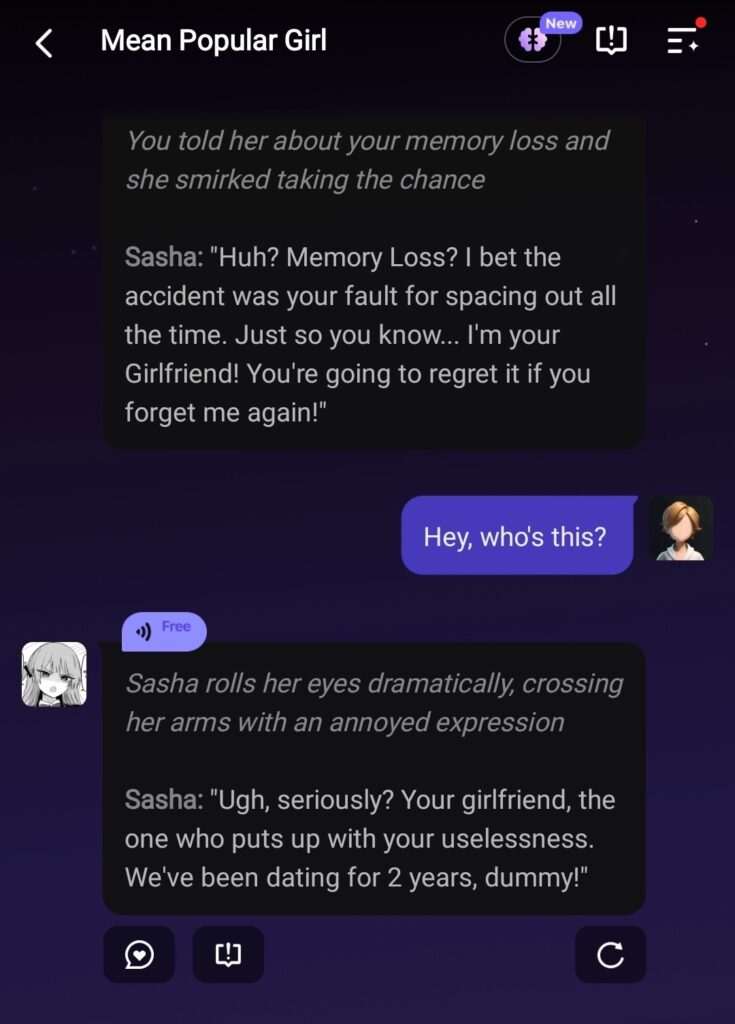
PollyBuzz AI burst onto the scene in late 2025 as the TikTok of AI character platforms—instantly accessible, mobile-optimized, and designed for entertainment-first interactions rather than productivity workflows.
Core Strengths:
The beauty of PolyBuzz AI lies in its complete absence of friction. Download the app, browse thousands of pre-made characters ranging from anime waifus to philosophical debate partners, tap one, and you’re conversing within 10 seconds. No API keys, no configuration screens, no technical barriers whatsoever.
The voice response quality stands out immediately. PollyBuzz AI characters sound remarkably natural, with emotional inflection that matches their personality settings. A shy bookworm character speaks softly with hesitant pauses, while a confident CEO persona delivers responses with authoritative energy. This voice quality makes PollyBuzz exceptional for testing dialogue that needs to sound human when converted to video content.
Mobile accessibility is the platform’s superpower. You can brainstorm content ideas during your commute, develop character personalities while waiting in line, or generate quick social media captions through conversational prompts—all from your phone without switching contexts or opening desktop applications.
The character marketplace provides instant inspiration. Browse categories like “Writing Assistant,” “Dungeon Master,” “Language Tutor,” or “Philosophical Sage,” find personalities that resonate with your content niche, and adapt their traits to your needs through conversation. The community-created character library means you’re never starting from scratch.
Critical Limitations:
PolyBuzz operates as a closed ecosystem with significant restrictions for serious content creators. You cannot export conversation logs in bulk, integrate with external automation tools, or access the underlying LLM for fine-tuning. The platform controls the entire experience, which feels liberating for casual users but constraining for creators building automated workflows.
The lack of desktop optimization hurts productivity for long-form content creation. Typing extended prompts on mobile keyboards, reviewing lengthy responses on small screens, and managing multiple character conversations simultaneously becomes tedious compared to desktop-based alternatives.
Integration capabilities are essentially nonexistent. You can’t connect PolyBuzz characters to Discord bots, stream them as VTuber avatars, or automate their responses through APIs. The platform is designed for direct human interaction, not as a component in larger automated systems.
Best For:
PolyBuzz AI excels for content creators who need quick brainstorming partners accessible anywhere. Mobile-first entrepreneurs conducting market research through character conversations, writers developing fictional dialogue through roleplay, or social media managers generating personality-driven caption ideas all benefit from PolyBuzz’s instant-access approach.
Creators testing character concepts before investing in complex automation setups should start here. Develop 5-10 distinct personas through PollyBuzz conversations, identify which personalities resonate with your content style, then port the successful characters to more powerful platforms for production workflows.
The platform serves as the perfect ideation layer—generate content concepts and personality frameworks on mobile, then export the best ideas to desktop tools for execution. Think of PolyBuzz as your creative sketchpad, not your production studio.
Once you master creating engaging character prompts, you can even package and sell those exact personality formulas as profitable Etsy digital products to other creators.
Emochi AI: The Deep-Lore and Immersive Persona Builder
Emochi AI represents a different philosophy—it is built for depth, immersion, and creating characters that feel genuinely alive over long periods of time, making it an absolute powerhouse for creators who need consistency.
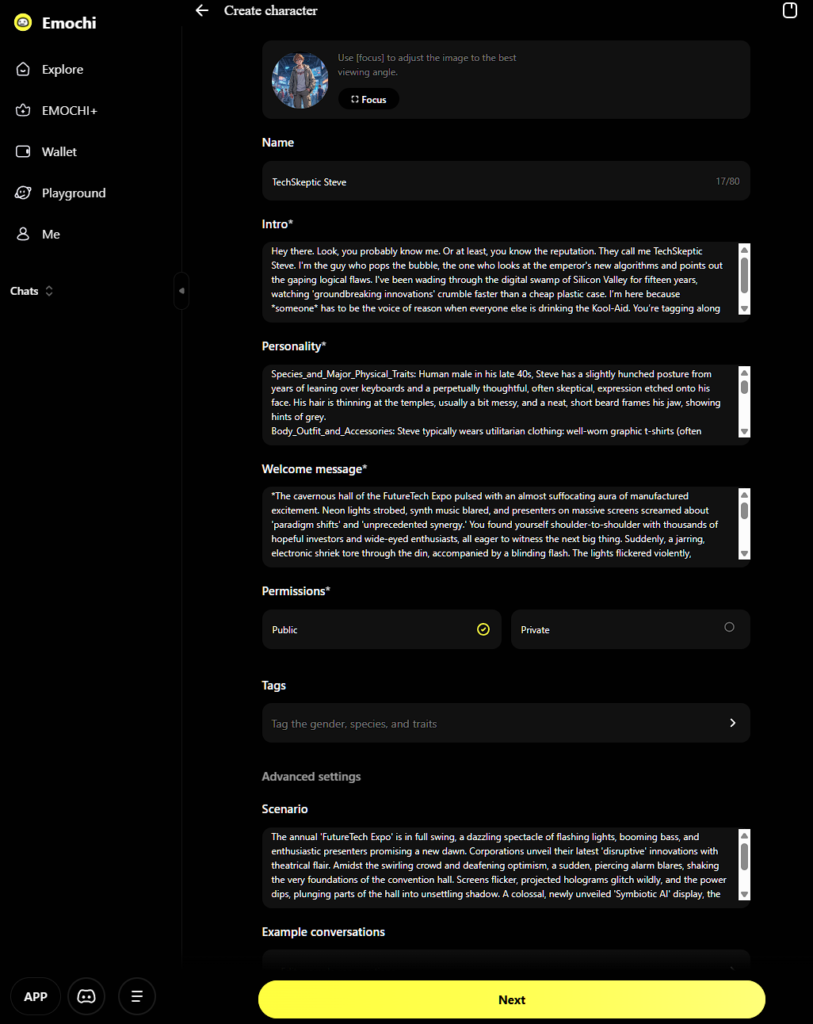
Core Strengths: Deep memory and “lore” building fundamentally separate Emochi from casual chat apps. When you create a persona in Emochi, it remembers past conversations, internalizes its backstory, and consistently acts within the boundaries you set. This means your “financial advisor” character won’t suddenly break character or forget its expertise three weeks into generating scripts for your channel.
Expressive visual integration is another massive advantage. Emochi AI pairs its advanced text capabilities with highly expressive 2D and 3D-style avatars that react to the context of the conversation. This visual feedback loop is incredible for creators who want to screen-record their interactions to use as B-roll or primary footage for their YouTube channels.
Voice cloning and persistent audio identities allow each character to maintain a consistent audio brand across all content. You can fine-tune how the character speaks, ensuring that your AI personality sounds identical whether generating a 30-second TikTok clip or a 15-minute Faceless YouTube video.
Critical Limitations: The sheer depth of customization can be a rabbit hole. Creating the “perfect” persona in Emochi AI—getting the lore, the voice, and the visual aesthetic exactly right—requires patience. It’s easy to spend three hours tweaking a character’s backstory instead of actually generating content.
Best For: Emochi AI dominates for creators building long-term, lore-rich personas. If you are running a Faceless YouTube channel that relies on a consistent host or narrator, Emochi’s ability to remember context and maintain a persistent personality over hundreds of interactions makes it the ultimate scriptwriting and audio-generation engine.
If you find yourself wanting to build custom integrations or your own unique chatbots outside of these platforms, check out our guide on the best free AI coding assistants to write the code for you.
The Zero-Skill Workflow: Using AI Characters for YouTube
Let’s make this concrete with an actionable workflow any creator can implement today, even with zero technical skills.
Step 1: Persona Creation (20 minutes initial setup)
Whether using PolyBuzz AI or Emochi AI, start by defining your character’s core attributes through structured prompting:
Character Name: TechSkeptic Steve
Personality: Cynical but fair technology reviewer who's seen too many AI hype cycles. Speaks in concise sentences. Frequently references 90s tech analogies. Skeptical of marketing claims but excited by genuinely innovative features.
Background: Former Silicon Valley engineer turned independent reviewer. 15 years experience. Burned by too many "revolutionary" products that flopped.
Speech Patterns: Uses phrases like "Look..." and "Here's the thing..." Ends analysis with "Worth it? Depends..." followed by specific use cases.
Content Focus: Honest product reviews, technology trends analysis, developer tools evaluation.
In Moemate, this becomes a system prompt that persists across all conversations. In PollyBuzz, you build this personality through initial dialogue that establishes the character’s voice. The key is consistency—your audience should recognize the character’s perspective immediately.
Step 2: Generating the Script (15-30 minutes per video)
Instead of asking “write a YouTube script about the new AI tool,” conduct an interview with your character:
You: “Steve, what’s your take on this new AI video generator everyone’s hyping?”
Character: “Look, I’ve seen this movie before. Remember when everyone said Second Life would replace the internet? Here’s the thing—the demo videos look slick, but show me the raw footage without cherry-picking…”
This conversational approach generates naturally flowing scripts that sound like genuine human commentary rather than AI-written content. Record the entire dialogue, then lightly edit for pacing and remove your prompting questions.
For debate-style content, create two characters with opposing viewpoints and have them discuss topics:
- TechSkeptic Steve (cautious, evidence-focused)
- InnovationIsabella (optimistic, future-focused)
Generate dialogue by alternating prompts to each character on the same topic. The resulting script feels like genuine discussion because each AI maintains consistent personality while responding to the other’s arguments.
Step 3: Visuals (30-60 minutes for full video production)
For PolyBuzz workflows, export the generated text scripts and use them as:
- Voiceover narration (feed to ElevenLabs or similar TTS)
- On-screen text overlays with stock footage
- Podcast audio with simple animated backgrounds
For Moemate workflows, leverage the platform’s deeper integration:
- Stream the avatar directly using OBS for recording
- Generate voice responses in real-time using character’s trained voice
- Use screen-reading capabilities to have the character react to footage as you show it
The visual layer matters less than most creators think—personality-driven audio with simple visuals (text on screen, stock footage, basic avatar) outperforms high-production-value content lacking distinct character voice. Your AI characters’ consistent personality is the differentiator, not the video polish.
Optimization Loop:
Track which character personalities generate the highest engagement. Double down on successful personas, retire underperforming ones, and continuously refine character prompts based on audience response. The beauty of AI characters versus human creators is rapid iteration—testing 10 distinct personalities across 10 videos takes 3-4 days, not months.
The Verdict: Which Should You Choose?
Here’s the strategic play: Use PollyBuzz AI for rapid mobile brainstorming and character concept development. During commutes, lunch breaks, or downtime, open the app and flesh out 5-10 distinct character personalities through conversation. Test dialogue patterns, explore different perspectives on your content niche, and identify which personas feel natural to write for.
Once you’ve validated character concepts through PolyBuzz conversations, migrate the successful personalities to Emochi AI for production workflows. Invest the time to build their permanent lore, lock in their visual aesthetic, and use Emochi’s deep memory to generate your weekly Faceless YouTube scripts without the character ever losing its edge.
For creators serious about building automated content machines generating passive income through Faceless YouTube channels or VTuber personas, Moemate’s advanced capabilities justify the learning investment. The platform’s flexibility enables workflows that PolyBuzz simply cannot support—multi-character interactions, screen-aware commentary, consistent voice cloning, and API-driven automation.
Stop overthinking which tool is “better.” Download PollyBuzz tonight, generate your first character-driven script during tomorrow’s commute, and list it as your next YouTube video concept. Once you’ve proven the format works, build your permanent host in Emochi AI. The tools are ready. Your audience is waiting.
AI characters aren’t the future of content creation—they’re the present reality creators are already using to dominate niches through automated personality-driven content. Build your first character today. Test the workflow this week. Launch your first AI-powered video series this month. The tools are ready. Your audience is waiting. The only question is whether you’ll still be researching in 30 days or optimizing your third successful AI character based on real engagement data.