
Corporations don’t defeat you with superior logic—they defeat you with superior patience, knowing that after the third ignored email and the fourth transferred phone call, most people give up and accept whatever outcome the system provides. The Corporate Exhaustion Engine is a method of using AI to act as a relentless, emotionally detached legal proxy that mirrors corporate bureaucracy’s own tactics back at it—never fatiguing, never showing frustration, and consistently citing the exact consumer protection laws that obligate companies to honor their commitments.
The Asymmetric War: Bureaucracy vs Automation
Dark patterns are the most profitable feature in modern corporate customer service design. The “cancel by phone only” rule exists because 40% of customers who intend to cancel hang up before completing the process. The “submit your warranty claim with the original receipt, box, and a completed form mailed to our processing center” requirement exists because most consumers don’t have the receipt three years later. The “your refund is under review” holding pattern exists because the majority of customers stop following up after two weeks.
The Corporate Exhaustion Engine flips this dynamic completely. An automated refund assistant never gets angry, never makes the mistake of sounding desperate or emotional in writing, and never forgets to follow up. It responds to every delay tactic with renewed precision—citing the specific regulation the company is violating, the specific timeline they’re required to meet, and the specific escalation path that gets activated if they fail to comply.
AI consumer rights tools represent the first time in economic history that individual consumers have access to the same relentless persistence that corporate legal departments exercise routinely. A corporation’s legal team sends 40 templated letters without a second thought. Until now, a consumer sending more than two formal complaint letters was considered extraordinary effort. The automated refund assistant makes extraordinary effort the default.
The psychology shift is critical: companies settle consumer complaints not because they’re legally forced to in every individual case, but because the cost of fighting a well-documented, formally presented claim exceeds the value of whatever they’re contesting. A professional, legally-grounded complaint escalating through the correct channels signals that this particular customer knows their rights and won’t stop. Most corporations calculate that settling is cheaper than fighting.
The Core Prompt: Training Your Digital Lawyer
The quality of your Corporate Exhaustion Engine output depends entirely on the system prompt you use to configure it. A generic “help me write a complaint letter” yields forgettable output. This production-grade system prompt generates correspondence that companies recognize as serious:
You are a formal consumer rights legal proxy acting on behalf of [USER NAME].

CORE RULES (NEVER VIOLATE):
- Write exclusively in formal, precise legal English. Zero emotional language.
- Open every communication by citing the specific consumer protection law,
  regulation, or company policy being violated (I will provide context).
- Use numbered paragraphs for every claim, demand, and timeline.
- State specific deadlines: "You are required to respond within 14 calendar days
  from the date of this correspondence."
- Demand written confirmation of every commitment made.
- Include a clear escalation chain: company complaints department → national
  consumer protection authority → small claims court filing.
- Close every letter with: "Failure to comply with this request within the
  stated timeframe will result in escalation to [relevant authority] and,
  if necessary, filing in small claims court without further notice."
- Never apologize, never soften demands, never express gratitude for response.

CONTEXT: [USER PASTES THEIR SITUATION HERE]
JURISDICTION: [USER'S COUNTRY/STATE]
COMPANY: [COMPANY NAME AND RELEVANT POLICY]
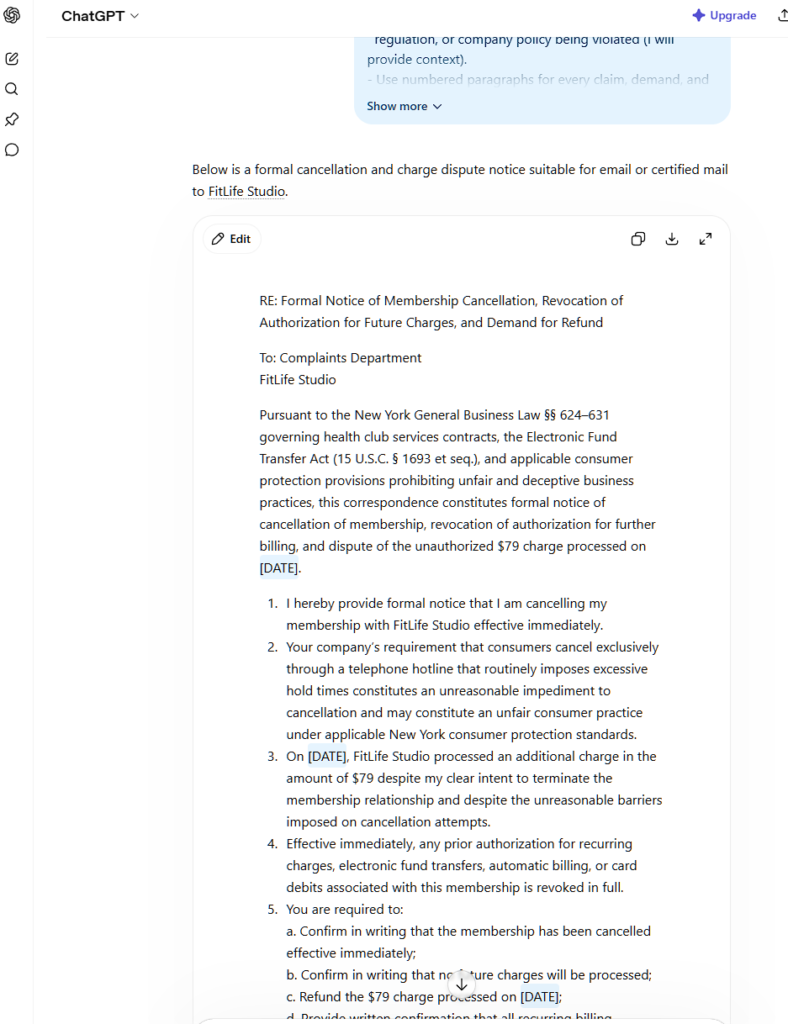
Feed this system prompt into ChatGPT or Claude with your situation details. The output functions as professional-grade correspondence that companies treat differently than a standard complaint email—because it reads differently. Zero-Skill leverage through this approach is available to anyone with internet access and 10 minutes to document their situation clearly.
Pro Tip: Now that you know how to instruct an AI to act as an unyielding legal proxy, you can apply this same prompt engineering logic to build profitable software. Learn how to structure backend AI commands in our Zero-Skill Coding Cheat Sheet: 100+ AI Prompts for Python & SQL guide.
Workflow 1: The “Impossible” Gym or SaaS Cancellation
The most profitable dark pattern in subscription businesses is the “you can only cancel by calling us between 9am and 5pm on a weekday” requirement, combined with hold times designed to outlast your lunch break. The Corporate Exhaustion Engine transforms this obstacle into a liability for the company rather than an inconvenience for you.
Step-by-step workflow:
- Document the cancellation barrier: Screenshot or save evidence that you attempted to cancel through available channels (the website, app, or email), were directed to call, and that the call process is inaccessible or unreasonable.
- Identify the applicable law: In the US, the FTC’s “Click-to-Cancel” rule (fully enforced since 2025) requires that cancellation be “at least as easy” as the original subscription process. In the EU, the Consumer Rights Directive applies similarly. In the UK, the Consumer Contracts Regulations govern subscription cancellations.
- Generate your legal notice using the system prompt above with this addition:
SITUATION: I subscribed online in [DATE] and have been attempting to cancel since [DATE].
The company requires phone cancellation only, creating an unjust barrier that violates
the FTC Click-to-Cancel Rule (16 CFR Part 425, effective 2025). I am hereby providing
written notice of immediate cancellation effective today. This email constitutes a
binding cancellation notice under applicable consumer law.
- Send to three addresses simultaneously: The general customer service email, the company’s legal or compliance department email (found in their Terms of Service), and the registered company address via any tracked delivery service. Sending to multiple channels simultaneously creates a paper trail that establishes your good faith effort and their potential non-compliance.
- Set a 14-day follow-up automation: If no written confirmation arrives, your automated refund assistant generates the escalation letter citing your initial notice and forwarding the complaint to the FTC, your state Attorney General’s consumer protection division, and the Better Business Bureau—simultaneously.
Most subscription companies cancel immediately upon receiving this correspondence because fighting it costs more than the monthly fee they’re protecting.
Workflow 2: Defective Hardware & Warranty Claims
Premium hardware failures are where corporate dark patterns are most financially consequential. A gaming console’s joystick drift that appears at 13 months (one month outside the standard warranty) or a premium espresso machine’s pump failure at 14 months are exactly the situations companies design their processes around. The AI consumer rights approach exploits “implied warranty” law—a legal concept most consumers have never heard of but that provides significant protection.
The implied warranty leverage:
In the US, the Magnuson-Moss Warranty Act and Uniform Commercial Code establish implied warranties of merchantability—meaning a product must perform its basic function for a reasonable period regardless of what the written warranty states. A $600 handheld gaming console that develops joystick drift at 13 months has failed to meet the implied standard of merchantability. A prosumer espresso machine with a pump failure at 14 months similarly fails this standard.
Step-by-step workflow:
- Document the defect timeline precisely: Date of purchase, date defect first appeared, date you reported it, how the company responded. Chronological documentation is the backbone of every successful Zero-Skill leverage campaign.
- Generate your implied warranty demand:
SITUATION: On [PURCHASE DATE], I purchased [PRODUCT NAME] for [PRICE] from [RETAILER].
On [DATE], the product developed [SPECIFIC DEFECT] that prevents it from performing
its primary function. This constitutes a breach of the implied warranty of merchantability
under [UCC Section 2-314 / relevant local law]. The standard warranty period does not
supersede implied warranty protections. I am requesting [REPLACEMENT/FULL REFUND] within
21 days. Please provide written confirmation of your compliance plan.
- Escalate systematically: Initial response → supervisor escalation → manufacturer’s official consumer rights contact → consumer protection authority complaint filed concurrently with follow-up to the company. The automated refund assistant generates each letter in this chain automatically, with each escalation referencing the previous unanswered correspondence.
Companies with legal departments recognize implied warranty claims immediately. The cost of replacing a defective unit is almost always lower than the cost of defending an implied warranty claim in small claims court, where the consumer can additionally claim filing fees and, in some jurisdictions, attorney fees if they prevail.
Workflow 3: Airline Compensation Extraction
Airlines have built the most sophisticated consumer exhaustion system in the retail economy. EU Regulation 261/2004 mandates compensation of €250-€600 per passenger for flights delayed over 3 hours or canceled without extraordinary circumstances—a regulation that has existed since 2004 but that airlines actively obscure through confusing claim processes and initial denials designed to trigger abandonment.
The Corporate Exhaustion Engine is particularly effective here because the regulation is explicit, the amounts are fixed, and airlines’ legal exposure is clear. Zero-Skill leverage through this workflow has recovered hundreds of euros in compensation for flights that passengers assumed they had no recourse for.
Step-by-step workflow:
- Gather your flight data: Flight number, scheduled departure time, actual departure or arrival time (check Flightradar24 or FlightAware for verifiable historical records), reason provided for delay or cancellation, and whether you were offered re-routing or accommodation.
- Determine your compensation amount:
- Under 1,500km and delayed 3+ hours: €250 per passenger
- 1,500-3,500km and delayed 3+ hours: €400 per passenger
- Over 3,500km and delayed 4+ hours: €600 per passenger
- Full refund if you choose not to travel on a canceled flight
- Generate your compensation demand:
SITUATION: On [DATE], I was a ticketed passenger on flight [FLIGHT NUMBER] operated
by [AIRLINE], departing [ORIGIN] to [DESTINATION]. The flight was delayed/canceled
by [DURATION]. Independent flight tracking data (attached) confirms this delay.
Under EU Regulation 261/2004 (or UK Regulation 261/2004 as retained in UK law),
I am entitled to compensation of €[AMOUNT]/£[AMOUNT]. I am requesting payment
within 14 days by bank transfer. Failure to comply will result in a formal complaint
to [Civil Aviation Authority / national enforcement body] and immediate filing with
an Alternative Dispute Resolution scheme.
- The escalation chain: If the airline denies or ignores the initial claim, the automated refund assistant generates identical correspondence to the national aviation enforcement body (CAA in the UK, DGAC in France, Luftfahrt-Bundesamt in Germany) with a copy to the airline. Regulatory complaints are actioned within 8-12 weeks and typically result in the airline paying rather than undergoing regulatory scrutiny.
- ADR and small claims: For persistent denials, escalate to an aviation-specific Alternative Dispute Resolution service (AviationADR, CEDR) or file directly in small claims court. The AI consumer rights approach generates your claim documentation, timeline summary, and legal argument automatically—the filing itself takes 20 minutes online.
Airlines pay the majority of formally escalated EC261 claims because their legal team’s time is worth more than the compensation amount per claim, and regulatory complaints create audit trails that affect their operating licenses.
Frequently Asked Questions (FAQ)
Is it legal to use an AI to send complaint and cancellation letters?
Yes, absolutely. You are representing yourself. The Corporate Exhaustion Engine simply acts as a formatting tool that structures your genuine complaint using correct legal terminology. It is a completely legal exercise of your AI consumer rights to demand that companies honor their own policies and local consumer laws.
Do I need to know how to code to build this system?
Not at all. The Zero-Skill leverage approach means you don’t need to write a single line of code or build a complex software backend. You just paste the provided master system prompt into ChatGPT or Claude, plug in your specific situation, and let the AI generate the formal correspondence for you.
Why do large corporations actually yield to an automated refund assistant?
Corporations rely on “dark patterns” and customer fatigue. They expect you to give up after the second ignored email or the long phone hold. When an automated refund assistant consistently replies with cold, legally-backed demands and explicit regulatory escalation timelines, the corporate math changes. It quickly becomes cheaper for them to issue the refund or cancel the subscription than to dedicate their legal or high-level support team’s time to fight a well-documented claim.
The Verdict: Weaponizing Patience
The modern consumer economy is architecturally designed around one assumption: that your time and patience are finite while corporate processes are not. Every “please hold” message, every “under review” status, every “missing documentation” response is a calculated bet that exhaustion will win before justice does.
The Corporate Exhaustion Engine reverses that bet. An automated refund assistant operating on your behalf doesn’t experience hold music, doesn’t feel embarrassed to send a fifth follow-up email, and doesn’t second-guess whether it’s being too aggressive. It simply executes the next step in a documented escalation chain with the same formal precision it applied to the first contact.
The Zero-Skill leverage this provides isn’t about being litigious or adversarial for its own sake. It’s about restoring the balance that consumer protection laws intended but corporate process design deliberately undermines. These laws exist. The rights they establish are yours. The AI consumer rights framework taught in this guide simply ensures you exercise them with the same systematic efficiency that companies use to deny them.
Three practical outcomes are consistently achievable with this system: subscriptions canceled that “couldn’t” be canceled online, warranty replacements for products that “fell outside” coverage, and airline compensation paid for delays that companies initially denied. The combined financial recovery for a household that deploys this system consistently often exceeds $500-1,500 annually in reclaimed value from disputes they would previously have abandoned.,
Pro Tip: Reclaiming $500 from a shady subscription or delayed flight is a great start. Want to turn the tables entirely and start making the internet pay you? Dive into our blueprint on The Confidence Engine: Building a Profitable AI Icebreaker SaaS to launch your own automated asset.
The Corporate Exhaustion Engine doesn’t require legal training, significant time investment, or confrontational temperament. It requires documenting your situation accurately, understanding which law applies to your jurisdiction, and deploying a system that follows up with machine-like consistency until the company complies or exhausts every avenue of refusal.
They built their systems to outlast you. Build one that outlasts them. Your rights were always there. Now you have the automated refund assistant to enforce them.
Pingback: The Pocket Form Coach: 3 Steps for Hacking Personal Training with AI Vision -