
For neurodivergent creators and entrepreneurs, hearing “just make a to-do list and stick to it” is actively harmful advice because it ignores how ADHD AI tools can serve as an external prefrontal cortex, handling the executive function tasks your brain struggles with—task initiation, prioritization, time estimation, and follow-through—without relying on willpower that evaporates by 10am. These five free tools create a digital support system that works with your brain’s wiring instead of fighting against it, transforming task paralysis from a daily battle into a solvable technical problem.
Why Traditional Productivity Fails the ADHD Brain
Here’s what productivity gurus won’t tell you: their systems assume a neurotypical brain that naturally generates dopamine from completing tasks, accurately estimates time, and remembers multi-step processes without external support. For neurodivergent entrepreneurs managing ADHD, these assumptions are fundamentally broken.
Static planners fail because they don’t account for the reality that your energy, focus, and capacity fluctuate wildly throughout the day. You create an ambitious Monday schedule while hyperfocused on Sunday night, then wake up Monday in a completely different brain state and immediately feel like a failure when you can’t execute the plan. The planner becomes a monument to broken promises rather than a helpful tool.
Generic to-do lists fail because “write the blog post” or “set up the email sequence” are tasks so large and vague that your brain categorizes them as impossible threats rather than actionable steps. The ADHD brain needs granularity so extreme that neurotypical people find it absurd—but that microscopic specificity is what unlocks action.
Rigid calendars fail because they operate on the assumption that you’ll remember to check them, that you’ll accurately estimate how long tasks take, and that missing one scheduled block won’t trigger an all-or-nothing thinking spiral that abandons the entire system. Time blindness isn’t laziness—it’s a genuine neurological difference in how ADHD brains perceive time passage.
The solution isn’t more discipline or better habits. The solution is replacing guilt-based willpower with AI-driven systems that handle the parts your brain genuinely cannot do reliably. This isn’t cheating—it’s accessibility technology for cognitive differences.
Tool 1: Goblin.tools (The Cure for Task Paralysis)
The Problem:
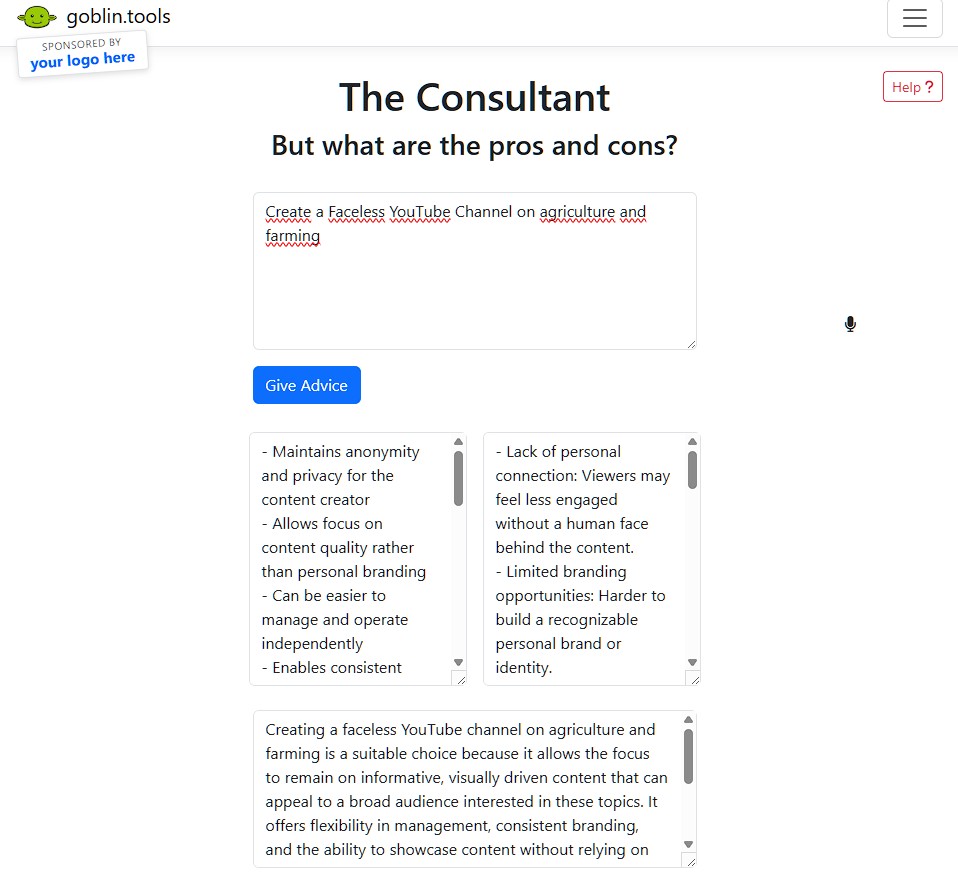
You stare at “Launch a website” on your to-do list and feel instant overwhelm. Your brain knows this isn’t actually one task—it’s 47 micro-tasks hidden inside a vague instruction. But breaking it down manually requires executive function you don’t have when you’re already frozen. This is classic task paralysis—knowing you need to do something but being genuinely unable to identify the first concrete step.
The freezing isn’t procrastination. It’s your brain’s threat response activating when confronted with ambiguity. The task feels too big, too vague, too overwhelming, so your nervous system treats it like a physical danger and locks you in place.
The Solution:
Goblin.tools is a free website created specifically for neurodivergent brains, and the Magic ToDo feature is legitimately life-changing for ADHD AI tools users. You type in any overwhelming task, adjust a “spiciness” slider that controls granularity, and the AI breaks it into absurdly specific micro-steps that your brain can actually process.
The Workflow:
- Go to goblin.tools and select “Magic ToDo”
- Type your overwhelming task: “Clean the kitchen”
- Set spiciness to maximum (usually 3-4 peppers)
- Watch as it generates steps like:
- Put dirty dishes in the dishwasher
- Wipe down the counter on the left side of the sink
- Wipe down the counter on the right side of the sink
- Take out the kitchen trash
- Sweep the floor in front of the stove
The brilliance is the granularity. “Wipe down the counter” becomes TWO separate steps because your ADHD brain needs that level of specificity to overcome initiation paralysis. Each micro-step is so small that your brain doesn’t trigger the overwhelm response.
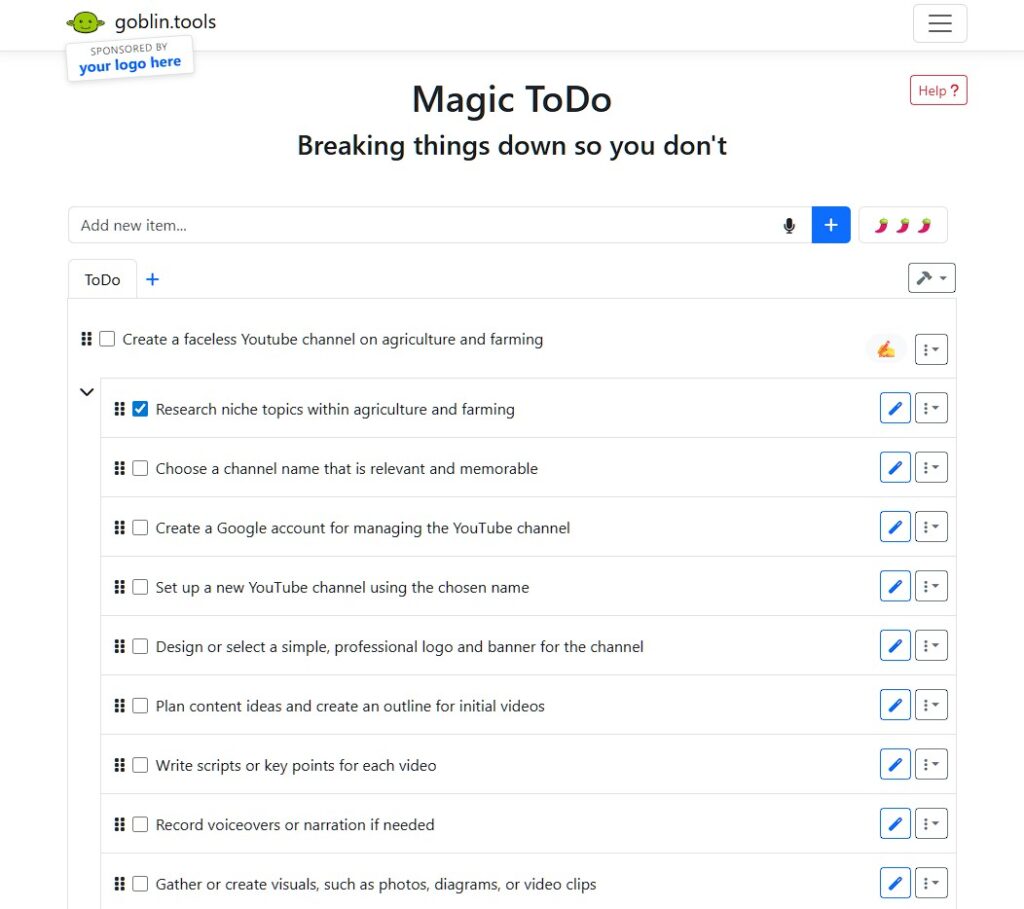
You can break down business tasks the same way. “Write sales email” becomes: Open Google Doc, Write greeting line, Identify customer pain point, Write one sentence addressing pain point, Add call-to-action button, Write subject line. Suddenly a 30-minute task that you’d been avoiding for three weeks takes 8 minutes because the ambiguity is gone.
The spiciness slider is genius because you can adjust based on your current executive function capacity. High-energy day? Use medium spiciness. Brain fog day? Max out the slider and get elementary-school-level instructions. No shame, just accessibility.
Tool 2: AudioPen (The Brain Dump Organizer)
The Problem:
You’re a verbal processor. Ideas flow when you talk through problems out loud, but the second you sit down to write, your brain goes blank. You stare at the blinking cursor, trying to remember the brilliant insight you had in the shower, and nothing comes out. Meanwhile, 47 new thoughts are pinging around your head but you can’t capture them before they vanish.
Or you DO manage to ramble into voice notes, creating 23 audio files titled “New Recording 47” that you’ll never listen to again because transcribing them manually sounds like torture.
The Solution:
AudioPen is a free app (with generous free tier) that solves the verbal-to-written translation problem that plagues neurodivergent entrepreneurs. You talk. The AI doesn’t just transcribe—it rewrites your chaotic stream-of-consciousness into coherent, structured text formatted for your chosen output type.
The Workflow:
- Open AudioPen on your phone or desktop
- Hit record and talk for 1-5 minutes about whatever you’re working on. Don’t edit yourself. Say “um” and “like” constantly. Go on tangents. Backtrack. Your verbal brain works differently than your writing brain—let it flow.
- Select output style: Email, Blog post, To-do list, Social media post, etc.
- The AI reorganizes your rambling into structured content that actually makes sense.
Example: You ramble for 3 minutes about a client project, saying something like: “Okay so Sarah wants the website done but like, I need to remember the login details are in that email from Tuesday, or was it Wednesday? Whatever. And the color scheme she wanted was that blue, the darker one not the light one. Oh and she needs the contact form to go to her assistant’s email not hers. I should probably update the homepage copy too since that placeholder text is still there…”
AudioPen outputs:
Project: Sarah's Website
Login: Check Tuesday/Wednesday emails
Color: Darker blue option
Contact form: Route to assistant's email
Update: Replace homepage placeholder text
For neurodivergent entrepreneurs who think better verbally, this eliminates the translation bottleneck between having ideas and capturing them usefully. You’re not fighting your brain’s natural processing style anymore.
Use AudioPen to brain-dump your creative ideas, and suddenly you have the perfect outline to start designing profitable Etsy digital products without staring at a blank screen.
Tool 3: Reclaim.ai (The Cure for Time Blindness)
The Problem:
Time blindness isn’t about being bad at time management—it’s a genuine neurological difference where ADHD brains struggle to perceive time passage accurately. You think a task will take “a few minutes” and three hours disappear. You create a beautiful blocked schedule, miss one 2pm task because you got hyperfocused on something else, and your all-or-nothing thinking declares the entire day ruined.
Traditional calendars punish time blindness by creating rigid commitments that become sources of shame when your brain’s temporal perception doesn’t match reality.
The Solution:
Reclaim.ai is an AI-powered calendar that treats your schedule as flexible and adaptive rather than rigid and judgmental. The free tier gives you enough functionality to revolutionize how you structure time. Instead of static blocks you’ll inevitably miss, Reclaim creates “habits” and “tasks” that the AI automatically reschedules around your actual behavior.
The Workflow:
- Sign up for Reclaim.ai’s free tier and connect your Google Calendar
- Create “habits” for recurring tasks: “Deep work,” “Admin time,” “Exercise,” “Content creation”
- Set ideal frequency and duration, but mark them as flexible
- Let the AI schedule them in your calendar automatically
- When you inevitably miss a block because you got distracted or a client call ran long, Reclaim doesn’t guilt-trip you—it just quietly moves that habit to another available slot
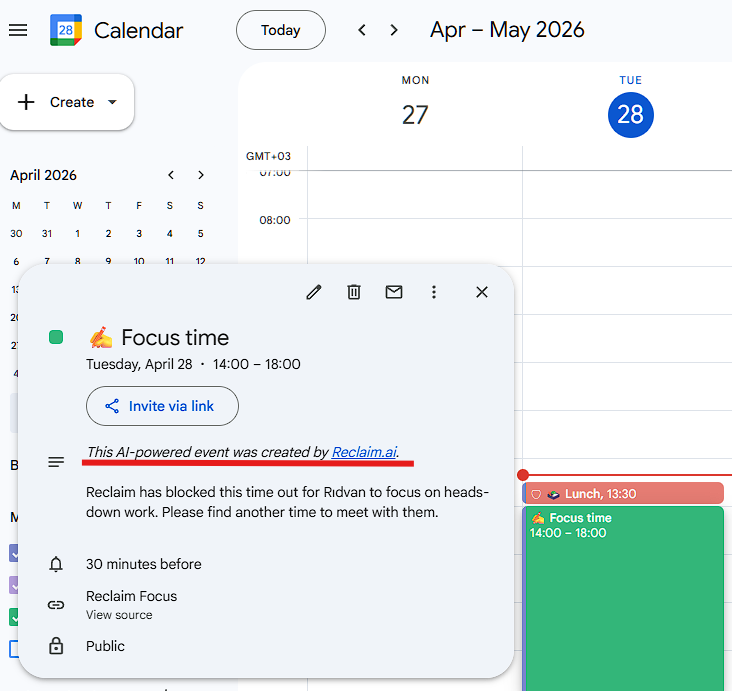
The magic is in the forgiveness. Your brain knows that missing a block doesn’t destroy the system, so you’re less likely to abandon the whole structure when life happens. The AI handles the cognitive load of “when should I reschedule this?” which is often the question that triggers executive dysfunction spirals.
For neurodivergent entrepreneurs running businesses, this means your “write newsletter” habit keeps getting rescheduled until you actually do it, rather than sitting there as a guilt-inducing red block on Tuesday that you stare at all week.
Tool 4: ChatGPT Voice Mode (The Digital Body Double)
The Problem:
The “body double” effect is real for ADHD brains—having another person present (even if they’re not directly helping) makes tasks feel less overwhelming and improves focus. But scheduling actual body doubling sessions is hard, and explaining your chaotic work process to real humans is exhausting.
You need someone to bounce ideas off, to talk through problems verbally, or just to check in every 10 minutes to keep you on track. Your brain works better with external accountability that doesn’t come with judgment.
The Solution:
The free ChatGPT mobile app includes voice mode that transforms the AI into an on-demand body double, accountability partner, or thought-processing companion. Unlike text chat, voice mode creates the conversational flow that neurodivergent brains often need for task initiation and sustained focus.
The Workflow:
For accountability: Open voice mode and say: “I need to do 30 minutes of admin work but I keep getting distracted. Check in with me every 5 minutes to ask what I’m working on.”
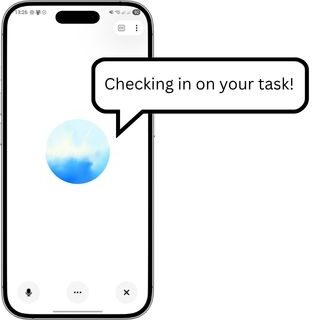
The AI will literally interrupt you every 5 minutes: “Hey, just checking in—what are you working on right now?” This external prompt pulls you out of distraction loops.
For task initiation: Say: “I need to write a client proposal but I’m frozen. Talk me through it step by step like I’m a beginner.”
The AI breaks it down conversationally: “Okay, let’s start simple. What’s the client’s name and what did they ask for?” Then: “Great. What’s one specific problem they mentioned they want to solve?” Building momentum through conversation bypasses the written-task paralysis.
For decision paralysis: Say: “I have six different project ideas and I can’t decide which to start. Ask me questions to help me figure it out.”
The AI interviews you about timeline, resources, excitement level, and strategic fit—externalizing the decision-making process that gets stuck in your head.
The conversational format works because ADHD brains often process better verbally and benefit from external structure. You’re not relying on executive function to initiate and sustain focus—you’re outsourcing that to the AI.
If you prefer working with a consistent digital persona rather than a generic bot, you can even set up custom AI characters to act as your daily accountability partners.
Tool 5: Scribe (The “How Did I Do That Again?” Fix)
The Problem:
You figure out a complex workflow once—how to export data from that platform, format it correctly, and import it to the other system. It takes you 45 minutes of trial and error. You feel accomplished. Three weeks later, you need to do it again and you’ve completely forgotten every step. You have to re-learn the entire process from scratch, which triggers frustration and wastes time you don’t have.
Working memory challenges mean that multi-step processes don’t stick. You can’t just “remember” the 14-step sequence you figured out last month, no matter how hard you try.
The Solution:
Scribe is a free Chrome extension that records your screen actions and automatically generates step-by-step visual guides. You do a process once while Scribe watches, and it creates a detailed tutorial with screenshots and instructions that your future self can follow mindlessly.
The Workflow:
- Install the Scribe Chrome extension
- Before doing any complex task, click the Scribe icon and hit “Start recording”
- Complete the task normally—Scribe captures every click, form entry, and navigation
- Click “Stop recording”
- Scribe generates a visual guide with numbered steps, screenshots showing exactly where to click, and the text you entered
Example captured steps:
- Navigate to exports.platform.com
- Click the “Generate Report” button (screenshot shows exact button)
- Select “Last 30 days” from dropdown menu
- Click “Download CSV”
- Open Google Sheets and select File → Import
- Choose the downloaded file
- Select “Comma” as separator
Now when you need to repeat this task, you don’t rely on working memory—you just follow your personalized screenshot guide that shows exactly what your past self figured out.
For neurodivergent entrepreneurs managing multiple business systems, Scribe eliminates the cognitive load of remembering processes. You’re building a personal knowledge base of “how I do things” that doesn’t depend on your brain’s ability to recall procedures.
Frequently Asked Questions (FAQ)
Are these ADHD AI tools actually free?
Yes. Every tool mentioned in this tech stack has a robust free tier that is perfectly sufficient for building your initial ZeroSkill workflow. Goblin.tools is entirely free on the web, while AudioPen, Reclaim.ai, ChatGPT, and Scribe offer generous free plans that solve the immediate bottlenecks of executive function without requiring a premium subscription.
Isn’t using AI for daily tasks considered cheating?
Not at all. For neurodivergent entrepreneurs and workers, using ADHD AI tools to manage executive function is no different than someone with poor eyesight wearing prescription glasses. Your brain is wired for high-level creative thinking and hyper-focus—not for remembering rigid administrative processes. In this context, using AI is a necessary accessibility tool to prevent burnout and overcome obstacles, not a shortcut.
Will Reclaim.ai mess up my existing Google Calendar?
No. Reclaim.ai syncs safely with your existing Google Calendar to specifically combat time blindness. Instead of overwriting your hard-coded meetings, the AI dynamically schedules your flexible tasks into the empty spaces. If a client call runs long, the AI automatically shifts your incomplete tasks to the next available slot, meaning you don’t have to use your limited executive function to manually reorganize your entire week.
How does Goblin.tools actually stop task paralysis?
Task paralysis happens when your brain perceives a vague task (like “launch a website”) as an impossible threat. Goblin.tools is one of the most effective ADHD AI tools because it bypasses this freeze response entirely. It breaks that massive project down into microscopic, hyper-specific steps. By completely removing ambiguity, your brain feels safe enough to take the very first step.
I get overwhelmed easily. Which of these ADHD AI tools should I start with?
Do not download all five ADHD AI tools at once—that will trigger the exact overwhelm you are trying to avoid. To build a sustainable ZeroSkill workflow, identify your single biggest bottleneck right now. If your primary struggle is staring at a big project and experiencing task paralysis, start exclusively with Goblin.tools. Pick one tool, use it for a full week, and let it successfully handle that specific executive function before adding the next one to your stack.
The Verdict: Building Your Zero-Friction System
Here’s what NOT to do: get excited, download all five tools, spend three hours setting them up, feel overwhelmed, and abandon everything. That’s the ADHD trap and I know you’ve been there before.
Instead, identify your single biggest bottleneck right now:
- If you freeze at vague tasks → Start with Goblin.tools
- If you can’t get thoughts from your head onto paper → Start with AudioPen
- If you create schedules you never follow → Start with Reclaim.ai
- If you need external accountability → Start with ChatGPT voice mode
- If you constantly re-learn the same processes → Start with Scribe
Pick ONE. Use it for a week. Let it become automatic. Then add the next tool.
These ADHD AI tools aren’t crutches—they’re accessibility technology for cognitive differences. Neurotypical people have brains that naturally handle executive function tasks like task breakdown, time perception, and working memory. You don’t. That’s not a moral failing, it’s a neurological difference. Using AI to supplement those functions is no different than using glasses for vision or hearing aids for hearing.
The ZeroSkill workflow for neurodivergent entrepreneurs isn’t about forcing your brain to work differently—it’s about building external systems that work with your brain’s actual wiring. Stop fighting yourself. Start automating the parts that don’t come naturally.
Your business doesn’t need you to develop superhuman discipline. It needs you to implement smart systems that handle the cognitive tasks your brain wasn’t built for. These five free tools do exactly that. Pick one. Install it today. Let AI handle your executive function while you handle the creative work only you can do.
The choice isn’t between being productive or not. The choice is between continuing to struggle alone or accepting that outsourcing cognitive tasks to AI is legitimate, effective, and exactly what your brain needs to thrive.
Really useful! Pixwit AI is fantastic for AI images and Free Video Generator provides excellent free video generation.
I also want to give a shoutout to Free Video Generator (https://freevideogenerator.io/), a wonderful free AI video platform.